



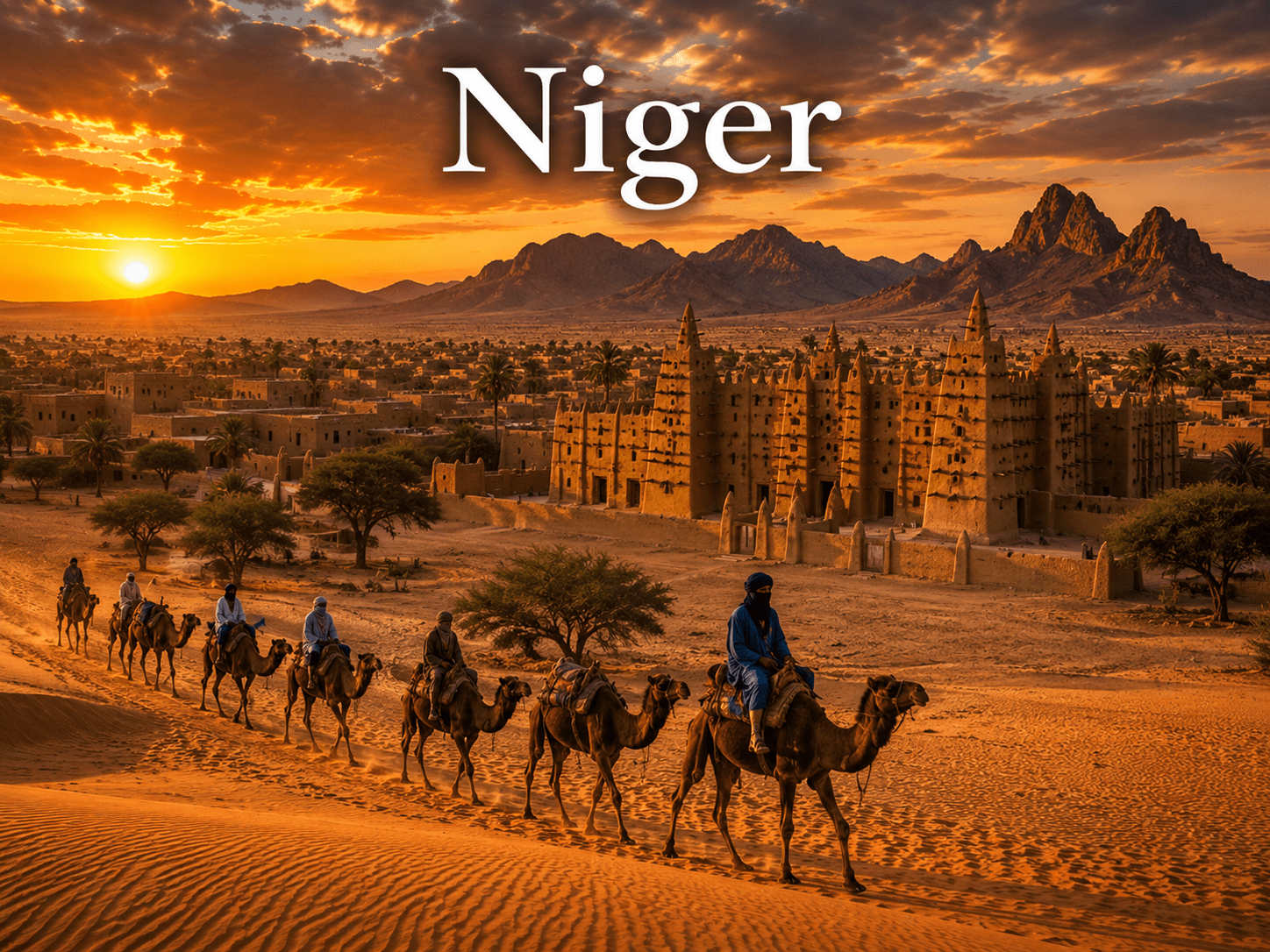
Niger – The Heart of the Sahara and Sahel
Niger is one of West Africa’s most geographically fascinating nations, known for its vast Sahara Desert landscapes, ancient caravan routes, cultural diversity, and rich nomadic traditions. Located in the Sahel region, this remarkable country offers travelers a unique blend of desert scenery, historical heritage, colorful markets, traditional music, and warm hospitality.
The nation is often associated with dramatic dunes, camel caravans, and the legendary Tuareg culture that has shaped life across the Sahara for centuries. Although tourism remains less developed compared to other African destinations, the country possesses extraordinary natural and cultural treasures that attract adventurous travelers, historians, and researchers from around the world.
From the banks of the Niger River to the mountainous regions of the Aïr Massif, visitors can experience a landscape unlike almost anywhere else on Earth. Ancient trade routes, prehistoric rock art, vibrant festivals, and diverse ethnic communities all contribute to the country’s rich identity.
Despite economic and environmental challenges, the nation continues preserving traditions and cultural heritage that reflect centuries of African history and Saharan civilization.
Historical Background of Niger
Ancient Civilizations and Early Settlements
The territory now known as Niger has been inhabited for thousands of years. Archaeological discoveries reveal evidence of prehistoric settlements, ancient tools, and rock art dating back thousands of years when parts of the Sahara were greener and supported larger populations.
Early communities engaged in:
- Farming
- Fishing
- Animal herding
- Regional trade
The region later became connected to major trans-Saharan trade routes linking West Africa with North Africa and the Mediterranean world.
The Era of Trans-Saharan Trade
For centuries, caravan routes crossing the Sahara Desert brought wealth and cultural exchange to the region. Traders transported:
- Salt
- Gold
- Textiles
- Livestock
- Spices
Tuareg and Hausa merchants played important roles in desert commerce and regional politics.
Colonial Period
During the late 19th century, French colonial expansion incorporated the territory into French West Africa. Colonial rule introduced administrative changes, infrastructure development, and new political boundaries.
French influence also affected:
- Education systems
- Language use
- Government institutions
- Economic structures
Independence
The nation gained independence from France on August 3, 1960. Since independence, the country has experienced political transitions, military governments, democratic reforms, and regional security challenges.
Geographical Location and Natural Environment
Where Is Niger Located?
Niger is a landlocked nation located in West Africa. It shares borders with:
- Algeria
- Libya
- Chad
- Nigeria
- Benin
- Burkina Faso
- Mali
Geographic Coordinates
- Approximate Coordinates: 17°N latitude and 9°E longitude
Landscape and Terrain
The geography is dominated by:
- Sahara Desert
- Semi-arid Sahel regions
- Rocky mountains
- Sand dunes
- River valleys
More than two-thirds of the national territory lies within the Sahara Desert.
The Niger River
The Niger River is one of the country’s most important natural resources. It supports:
- Agriculture
- Fishing
- Transportation
- Urban settlements
The capital city developed along the riverbanks.
Climate in Niger
Desert Climate
Most of Niger experiences extremely hot desert conditions with limited rainfall.
Dry Season
- Long and very hot
- Dominates most of the year
Rainy Season
- Usually June to September
- More noticeable in southern regions
Temperatures in desert areas can become extremely high during daytime hours.
Environmental Challenges
The nation faces environmental issues such as:
- Desertification
- Water scarcity
- Drought
- Soil erosion
Climate conditions strongly influence agriculture and daily life.
Culture and Traditions of Niger
Cultural Diversity
Niger is home to multiple ethnic groups, each contributing unique traditions, languages, music, and customs.
Major ethnic communities include:
- Hausa
- Zarma-Songhai
- Tuareg
- Fulani
- Kanuri
- Toubou
Traditional Lifestyle
In many regions, traditional lifestyles remain deeply connected to:
- Herding
- Farming
- Caravan trade
- Family networks
- Religious traditions
Nomadic communities continue traveling across desert landscapes with camels and livestock.
Religion in Niger
Islam is the dominant religion and plays a central role in social and cultural life. Mosques, Islamic schools, and religious celebrations are important throughout communities.
Religious values strongly influence:
- Family structure
- Festivals
- Clothing
- Daily customs
Small Christian and indigenous religious communities also exist in some areas.
Traditional Music and Dance
Music traditions in Niger reflect centuries of Saharan and West African cultural exchange.
Popular Musical Elements
- Drumming
- String instruments
- Call-and-response singing
- Desert blues influences
Tuareg guitar music has gained international recognition for its hypnotic desert-inspired sound.
Dance Traditions
Dance performances are commonly featured during:
- Weddings
- Religious festivals
- Community celebrations
- Cultural ceremonies
Food and Cuisine in Niger
Traditional cuisine reflects local ingredients, desert survival traditions, and regional trade influences.
Common Ingredients
- Millet
- Sorghum
- Rice
- Beans
- Meat
- Dates
Popular Dishes
Jollof Rice Variations
Rice dishes flavored with spices and vegetables are widely enjoyed.
Millet-Based Meals
Millet remains a staple food across rural communities.
Grilled Meat
Goat, lamb, and beef are commonly prepared during celebrations and gatherings.
Tea Culture
Sweet mint tea is especially important in Tuareg hospitality traditions.
Economy of Niger
Economic Overview
Niger has an economy based mainly on:
- Agriculture
- Livestock
- Mining
- Trade
Economic activity is strongly influenced by climate conditions and global commodity prices.
Currency
The official currency is the West African CFA Franc (XOF).
Mining Industry
The country possesses important natural resources including:
- Uranium
- Gold
- Coal
Uranium mining has historically played a major role in export earnings.
Agriculture and Livestock
Many people work in:
- Farming
- Cattle herding
- Camel breeding
- Goat and sheep farming
Trade Partners
Key trade relationships include:
- France
- Nigeria
- China
- Regional West African nations
Major Cities in Niger
Niamey – The Capital City
Niamey is the capital and largest city. Located along the Niger River, it serves as the political, economic, and cultural center of the nation.
Popular attractions include:
- National Museum
- Markets
- Riverfront areas
- Government buildings
Agadez
Agadez is historically important as a major Saharan trade city and gateway to the desert.
The city is known for:
- Mud-brick architecture
- Tuareg culture
- Caravan history
Zinder
Zinder was once the colonial capital and remains an important commercial center.
Maradi
Maradi is recognized for agriculture, commerce, and cross-border trade with Nigeria.
Languages Spoken in Niger
Official Language
French serves as the official language and is used in government, administration, and education.
National Languages
Many local languages are widely spoken, including:
- Hausa
- Zarma
- Tamasheq
- Fulfulde
- Kanuri
Multilingual communication is common across communities.
Tourist Attractions in Niger
Sahara Desert
The Sahara landscape is one of the country’s most extraordinary attractions. Travelers can experience:
- Sand dunes
- Camel caravans
- Desert camping
- Star-filled skies
Aïr Mountains
The Aïr Mountains provide dramatic scenery with:
- Rocky formations
- Ancient rock art
- Oasis settlements
Tenéré Desert
Known for its vast emptiness and remote beauty, the Tenéré Desert is among the most iconic Saharan regions.
National Museum of Niamey
This museum showcases:
- Traditional crafts
- Archaeological artifacts
- Cultural exhibits
- Historical collections
Niger and International Organizations
Niger is a member of several international organizations including:
- United Nations (UN)
- African Union (AU)
- Economic Community of West African States (ECOWAS)
- Organisation of Islamic Cooperation (OIC)
Official Resources
Biodiversity and Natural Environment in Niger
Niger is often associated with the Sahara Desert, but the country also contains a surprising variety of ecosystems ranging from arid dunes to river valleys and semi-arid savannahs. These environments support wildlife adapted to some of the harshest climates on Earth.
Desert Ecosystems
The Sahara region dominates much of the national territory. Despite extreme temperatures and low rainfall, desert ecosystems support specially adapted plants and animals.
Common desert wildlife includes:
- Fennec foxes
- Gazelles
- Desert reptiles
- Camels
- Migratory birds
Vegetation is sparse in the northern desert regions but becomes more noticeable near oases and seasonal water sources.
Savannah Regions
Southern parts of Niger transition into Sahel and savannah environments where rainfall is slightly higher.
These areas support:
- Grasslands
- Acacia trees
- Livestock grazing
- Agricultural communities
The Niger River Ecosystem
The Niger River creates fertile zones that are essential for:
- Farming
- Fishing
- Transportation
- Biodiversity
Riverbanks attract wildlife and support many communities that depend on agriculture and fishing industries.
National Parks and Wildlife Reserves
W National Park
One of the most important conservation areas connected to Niger is W National Park, which extends across parts of Niger, Benin, and Burkina Faso.
The park is known for:
- Elephants
- Lions
- Buffalo
- Antelope species
- Birdlife
It is recognized internationally for biodiversity conservation.
Aïr and Tenéré Natural Reserves
These UNESCO-recognized reserves protect:
- Desert ecosystems
- Ancient cultural sites
- Rare wildlife
- Geological formations
The dramatic landscapes attract researchers, photographers, and adventure travelers interested in remote Saharan environments.
Tuareg Culture and Desert Heritage
The Legendary Tuareg People
The Tuareg are among the most iconic cultural groups associated with Niger. Traditionally nomadic, they have traveled across Saharan trade routes for centuries.
Tuareg culture is famous for:
- Blue desert robes
- Camel caravans
- Poetry and storytelling
- Silver jewelry
- Desert music
Traditional Nomadic Life
Many Tuareg communities historically depended on:
- Camel herding
- Caravan trade
- Salt transportation
- Desert navigation
Although modernization has changed lifestyles in some regions, traditional customs remain culturally significant.
Tuareg Music
Tuareg music has gained international recognition due to its hypnotic guitar rhythms and poetic lyrics inspired by desert life.
Music themes often include:
- Freedom
- Migration
- Nature
- Love
- Cultural identity
Festivals and Cultural Celebrations
Cure Salée Festival
One of the most famous traditional gatherings in Niger is the Cure Salée festival, celebrated by nomadic communities.
The event includes:
- Camel races
- Traditional dances
- Music performances
- Cultural ceremonies
- Livestock trading
Religious Celebrations
Islamic holidays such as:
- Eid al-Fitr
- Eid al-Adha
- Mawlid
are celebrated across the nation with prayers, feasts, and family gatherings.
Local Community Festivals
Villages and towns often organize:
- Harvest festivals
- Wedding celebrations
- Traditional drumming events
- Market fairs
Adventure Travel in Niger
Adventure tourism in Niger appeals to travelers interested in remote landscapes and authentic cultural experiences.
Sahara Expeditions
Travelers can explore:
- Massive sand dunes
- Rocky desert plateaus
- Remote oases
- Ancient caravan routes
Camel trekking remains one of the most memorable Saharan experiences.
Desert Camping
Nighttime desert camping offers:
- Clear star-filled skies
- Traditional campfires
- Tuareg storytelling
- Peaceful desert silence
Rock Art Exploration
The Aïr Mountains contain prehistoric rock art sites that reveal ancient human activity dating back thousands of years.
Transportation and Travel Around Niger
International Access
The main international airport is located in Niamey. Flights connect the country with regional African destinations and selected international routes.
Road Transportation
Road travel is the primary method of domestic transportation.
Common transport options include:
- Buses
- Shared taxis
- Private vehicles
- Motorcycles
Road conditions vary significantly depending on region and weather conditions.
River Transportation
In some southern regions, river transport plays a role in:
- Fishing activities
- Local commerce
- Community mobility
Desert Travel
Travel in remote desert areas often requires:
- Experienced guides
- Four-wheel-drive vehicles
- Specialized navigation knowledge
Best Time to Visit Niger
Cooler Season
The most comfortable time to visit Niger is generally between November and February when temperatures are relatively milder.
Benefits include:
- Better conditions for desert travel
- More pleasant sightseeing
- Clear skies
Hot Season
Temperatures become extremely high during late spring and early summer, especially in Saharan regions.
Rainy Season
Southern areas receive seasonal rains that create greener landscapes and temporary water sources.
Traditional Clothing and Fashion
Desert Clothing
Traditional desert clothing is designed to protect against:
- Heat
- Sandstorms
- Sun exposure
Long flowing robes and turbans are common among Saharan communities.
Colorful Fabrics
Markets throughout Niger display vibrant textiles featuring:
- Geometric patterns
- Embroidery
- Hand-dyed fabrics
Traditional attire remains important during ceremonies and celebrations.
Arts and Handicrafts
Traditional Crafts
Artisans create handmade goods using techniques passed through generations.
Popular crafts include:
- Silver jewelry
- Leatherwork
- Pottery
- Woven mats
- Decorative swords
Agadez Cross Jewelry
The Agadez Cross is one of the country’s most recognizable cultural symbols. These silver pendants are associated with Tuareg heritage and craftsmanship.
Education and Social Development
Education System
The education system includes:
- Primary schools
- Secondary education
- Universities
- Vocational programs
French is commonly used in formal education.
Literacy and Challenges
Educational access has improved in many regions, although rural communities still face challenges related to:
- Infrastructure
- Teacher availability
- Distance to schools
Youth Population
Niger has one of the youngest populations in the world, making education and employment important national priorities.
Economy Beyond Mining
Livestock Trade
Livestock remains extremely important for rural livelihoods.
Animals commonly raised include:
- Camels
- Cattle
- Goats
- Sheep
Regional Trade Networks
Cross-border trade with neighboring countries supports:
- Markets
- Transportation industries
- Agricultural commerce
Handicraft Economy
Traditional crafts contribute to local incomes through:
- Tourism sales
- Export products
- Cultural exhibitions
Daily Life in Niger
Community and Family Structure
Family networks play a central role in social organization. Extended families often live closely connected lifestyles centered around:
- Shared responsibilities
- Religious values
- Traditional customs
Market Culture
Markets are vibrant social and economic centers where people gather to:
- Buy food
- Sell livestock
- Trade crafts
- Meet community members
Hospitality Traditions
Hospitality is deeply valued across Niger. Guests are commonly welcomed with tea, conversation, and meals.
Hidden Gems in Niger
Timia Oasis
Located within the Aïr Mountains, Timia Oasis offers:
- Palm groves
- Waterfalls
- Mountain scenery
- Traditional villages
Dabous Giraffe Rock Carvings
These ancient rock carvings are among the most significant prehistoric artworks in the Sahara region.
Bilma Oasis
Historically important for salt trade caravans, Bilma remains a symbol of Saharan trade history.
Food Culture and Culinary Traditions
Staple Foods
Meals often feature:
- Millet porridge
- Rice dishes
- Bread
- Dates
- Meat stews
Tea Ceremonies
Tea preparation is an important social ritual, particularly among Tuareg communities.
The tea ceremony often symbolizes:
- Friendship
- Respect
- Hospitality
Sports and Recreation
Football Popularity
Football is the most popular sport in Niger. Local clubs and national competitions attract enthusiastic supporters.
Traditional Competitions
Traditional camel races and wrestling competitions remain culturally significant in some regions.
Environmental Challenges and Sustainability
Desertification
Desert expansion threatens:
- Farming land
- Water access
- Rural communities
Reforestation Projects
Environmental programs aim to:
- Restore vegetation
- Improve soil conditions
- Promote sustainable agriculture
International Cooperation
Global organizations continue supporting environmental and humanitarian development projects across the country.
Government and Political Structure
Niger functions as a republic with executive, legislative, and judicial branches. Since gaining independence from France in 1960, the country has experienced multiple political transitions, constitutional reforms, and changing leadership structures.
Executive Branch
The president serves as the head of state and government, overseeing national administration, security, foreign relations, and development policies.
Legislative Branch
The National Assembly is responsible for:
- Passing laws
- Approving budgets
- Supervising government activities
- Representing citizens
Judicial System
The judicial branch interprets laws and oversees legal processes throughout the nation.
Famous Landmarks in Niger
Agadez Historic Center
Agadez is one of the country’s most historically significant cities. It served as an important crossroads for trans-Saharan trade caravans for centuries.
The city is famous for:
- Mud-brick architecture
- Ancient mosques
- Traditional Tuareg culture
- Historic caravan routes
Grand Mosque of Agadez
This iconic mud-brick mosque is among the tallest adobe structures in the world and represents remarkable Sahelian architecture.
Aïr Mountains
The Aïr Mountains provide dramatic volcanic and rocky landscapes rising above the surrounding desert.
Travelers explore:
- Rock formations
- Oasis settlements
- Ancient rock art
- Traditional villages
Tenéré Desert
The Tenéré region is one of the most remote and visually striking desert landscapes on Earth. Massive dunes and open desert plains create unforgettable scenery.
Unique and Interesting Facts About Niger
One of the Hottest Countries in the World
Niger regularly experiences extremely high temperatures due to its Saharan climate.
Home to Ancient Rock Art
The country contains prehistoric rock carvings and paintings dating back thousands of years, revealing that the Sahara was once much greener.
Tuareg Heritage
The Tuareg people are internationally recognized for:
- Desert navigation skills
- Blue robes
- Camel caravans
- Rich oral traditions
Uranium Production
The nation has historically been one of Africa’s important uranium producers.
Young Population
The country has one of the youngest populations globally, creating both opportunities and development challenges.
Tourism Potential in Niger
Untouched Desert Tourism
Unlike heavily commercialized destinations, Niger offers raw and authentic Saharan experiences.
Adventure travelers are attracted by:
- Remote landscapes
- Traditional cultures
- Ancient caravan routes
- Desert expeditions
Eco and Cultural Tourism
Tourism opportunities continue growing around:
- Cultural heritage
- Handicrafts
- Wildlife conservation
- Desert exploration
Photography and Documentary Travel
The dramatic desert scenery and traditional lifestyles attract:
- Photographers
- Researchers
- Documentary filmmakers
Detailed Guide to Major Cities
Niamey
Niamey is the largest city and administrative center of the nation.
Key attractions include:
- National Museum
- Grand Mosque
- Local craft markets
- Niger River waterfront
The city combines modern development with traditional West African culture.
Agadez
Agadez remains one of the country’s most iconic destinations due to its desert heritage and architecture.
Travelers often visit for:
- Tuareg culture
- Historic districts
- Sahara expeditions
- Traditional markets
Zinder
Zinder is an important commercial and historical center known for:
- Traditional palaces
- Markets
- Hausa cultural influence
Maradi
Maradi serves as a key agricultural and trade hub with strong cross-border economic activity.
Festivals and Celebrations
Cure Salée Festival
This traditional nomadic gathering remains one of the most culturally important events in Niger.
Festival highlights include:
- Camel races
- Music performances
- Traditional dress
- Livestock exhibitions
Islamic Celebrations
Major Islamic holidays are observed throughout communities with:
- Community prayers
- Family feasts
- Charity activities
- Cultural gatherings
Music and Dance Events
Traditional drumming and dance performances continue preserving cultural identity across generations.
Traditional Architecture in Niger
Mud-Brick Construction
Traditional architecture is adapted to desert conditions using:
- Adobe bricks
- Thick walls
- Natural cooling techniques
These building styles help reduce indoor heat in harsh climates.
Historic Desert Cities
Ancient Saharan towns reflect centuries of:
- Islamic influence
- Trade history
- African craftsmanship
Transportation and Infrastructure
Road Networks
Roads connect major urban centers, although infrastructure quality varies between regions.
Transportation methods include:
- Buses
- Shared taxis
- Private vehicles
- Motorcycles
Air Transport
International flights mainly operate through:
- Niamey International Airport
Desert Transportation
Remote desert travel often requires:
- Four-wheel-drive vehicles
- Local guides
- Fuel planning
- Water supplies
Business and Economic Opportunities
Mining Industry
Mining continues playing an important role in the national economy.
Key minerals include:
- Uranium
- Gold
- Coal
Agriculture Development
Agriculture projects focus on:
- Irrigation systems
- Food security
- Sustainable farming
Renewable Energy Potential
The country possesses strong solar energy potential due to abundant sunshine throughout the year.
Education and Future Development
Expanding Education Access
Government and international programs continue supporting:
- School construction
- Teacher training
- Literacy improvement
- Rural education
Youth Opportunities
The large youth population creates demand for:
- Employment
- Technical training
- Entrepreneurship programs
Technology Growth
Urban centers increasingly use:
- Mobile banking
- Internet services
- Digital education tools
Cuisine and Culinary Experiences
Traditional Meals
Food in Niger reflects Sahelian and Saharan culinary traditions.
Common meals include:
- Millet porridge
- Rice dishes
- Meat stews
- Grilled lamb
- Bean-based recipes
Dates and Tea
Dates are widely consumed in desert communities, while tea ceremonies remain important social traditions.
Suggested 7-Day Travel Itinerary
Day 1–2: Niamey
Explore museums, markets, and Niger River attractions.
Day 3–4: Agadez
Experience Tuareg culture, desert architecture, and camel caravans.
Day 5–6: Aïr Mountains
Visit oases, rock art sites, and mountain landscapes.
Day 7: Cultural Villages
Discover local crafts, music traditions, and rural hospitality.
Why Travelers Find Niger Fascinating
Travelers interested in authentic Saharan experiences appreciate Niger for its:
- Vast desert scenery
- Traditional nomadic cultures
- Historical trade routes
- Unique architecture
- Remote adventure experiences
The nation offers a rare opportunity to witness ancient desert traditions that still survive in modern times.
UNESCO and International Recognition
Several regions and heritage locations connected to Niger have international recognition through organizations such as:
- UNESCO
- United Nations
- African Union
Official Resources
Challenges and Future Outlook
Environmental Pressures
Major environmental challenges include:
- Drought
- Desertification
- Water shortages
- Climate change
Economic Development Goals
Future development priorities include:
- Education
- Infrastructure
- Renewable energy
- Food security
- Healthcare access
Cultural Preservation
Communities continue working to preserve:
- Traditional languages
- Music traditions
- Nomadic heritage
- Historic architecture
Final Summary
Niger is one of Africa’s most culturally rich and geographically unique destinations. With its vast Sahara landscapes, historic caravan cities, Tuareg traditions, ancient rock art, and vibrant markets, the country offers travelers an unforgettable glimpse into Saharan civilization and Sahelian heritage.
From the bustling streets of Niamey to the remote beauty of the Tenéré Desert, the nation combines history, culture, and natural wonder in extraordinary ways. Although tourism remains less developed than in many global destinations, this authenticity makes travel experiences especially meaningful for adventurous visitors.
Its strong cultural identity, desert heritage, and historical significance continue making the country an important part of West African history and Saharan tradition.
Niger Key Facts Table
| Category | Information |
|---|---|
| Official Name | Republic of Niger |
| Capital City | Niamey |
| Region | West Africa |
| Official Language | French |
| Currency | West African CFA Franc (XOF) |
| Population | Over 25 million |
| Major Religions | Islam |
| Climate | Desert and Semi-Arid |
| Largest Desert Region | Sahara Desert |
| Main Industries | Mining, Agriculture, Livestock |
| Major Exports | Uranium, Gold, Livestock |
| UN Membership | Yes |
| Famous Cultural Group | Tuareg |
| Major River | Niger River |
| Coastline | Landlocked Country |
FAQ Section
What is Niger famous for?
The country is famous for the Sahara Desert, Tuareg culture, camel caravans, uranium mining, and ancient trade routes.
What language is spoken in Niger?
French is the official language, while Hausa, Zarma, Tamasheq, and other local languages are widely spoken.
Is Niger part of the Sahara Desert?
Yes, a large portion of the country lies within the Sahara Desert.
What is the capital of Niger?
Niamey is the capital and largest city.
What currency is used in Niger?
The country uses the West African CFA Franc (XOF).

