



Introduction
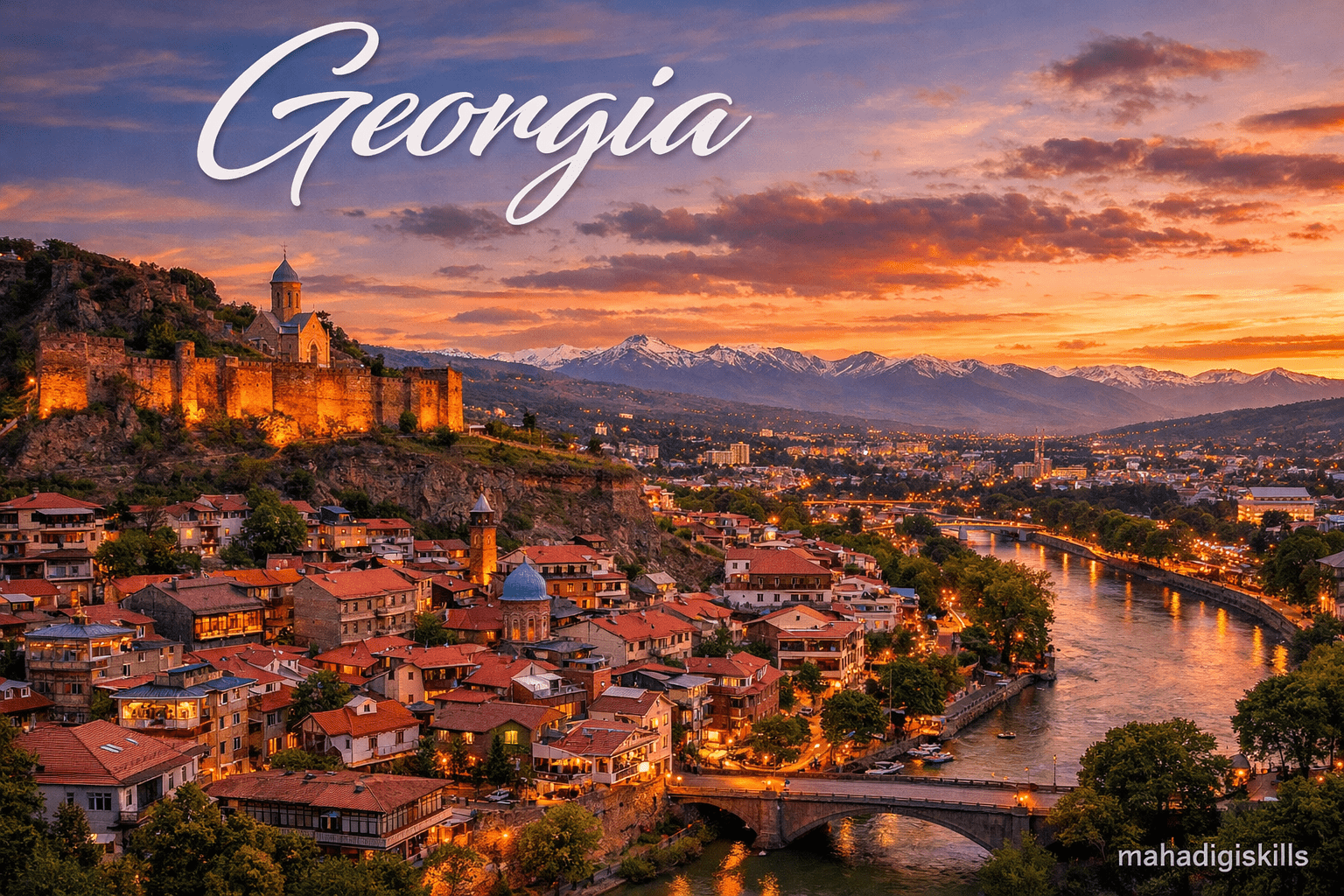
Georgia is a fascinating country located at the crossroads of Eastern Europe and Western Asia. Known for its dramatic mountain landscapes, ancient churches, unique language, and famous wine traditions, this Caucasus nation has become an increasingly popular destination for travelers seeking culture, nature, and history.
The land offers a remarkable blend of historic cities, alpine villages, fertile valleys, and Black Sea coastlines. Visitors exploring this destination discover medieval architecture, welcoming hospitality, vibrant cuisine, and thousands of years of civilization.
Positioned between Europe and Asia, Georgia has been influenced by numerous cultures, empires, and trade routes. This combination has created a distinctive identity that is visible in architecture, traditions, music, and daily life.
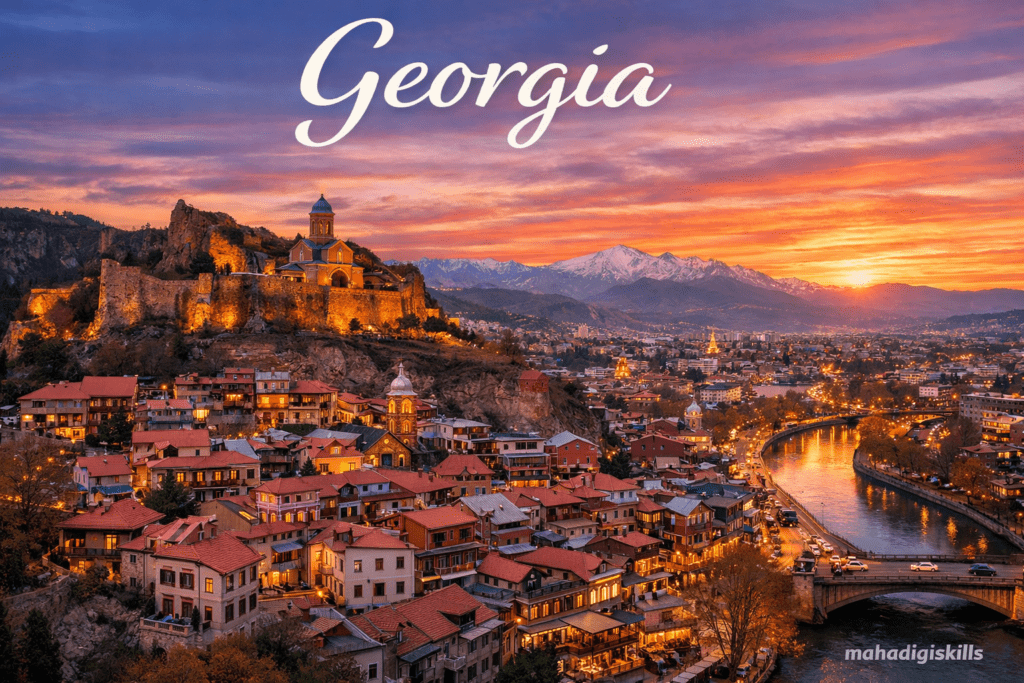
From the colorful streets of Tbilisi to the breathtaking peaks of the Caucasus Mountains, the country provides unforgettable experiences for travelers interested in both history and nature.
Historical Background
The history of Georgia spans thousands of years and reflects the influence of ancient civilizations, powerful kingdoms, and foreign empires.
Early Civilizations
The territory of modern Georgia was once home to the ancient kingdoms of Colchis and Iberia.
Colchis was located along the eastern coast of the Black Sea and became famous in Greek mythology as the place where Jason and the Argonauts searched for the Golden Fleece.
Iberia, located in eastern regions, developed into a powerful kingdom with strong political and cultural connections to neighboring civilizations.
These early societies played important roles in trade between Europe and Asia.
Adoption of Christianity
One of the most significant moments in the history of Georgia occurred in the 4th century, when Christianity was adopted as the state religion.
This made the country one of the earliest Christian nations in the world.
Churches and monasteries built during this period still stand today and remain important religious and historical landmarks.
Examples include:
- Svetitskhoveli Cathedral
- Jvari Monastery
- Gelati Monastery
These structures represent the deep connection between religion and national identity.
Medieval Golden Age
During the 12th and 13th centuries, the Georgian kingdom experienced a golden age under the rule of Queen Tamar.
This period saw major developments in:
- Architecture
- Literature
- Trade
- Political power
The kingdom expanded across much of the Caucasus region and became a cultural and economic center.
Many famous medieval monuments were built during this era.
Period of Foreign Rule
After the medieval golden age, the region faced invasions and control by several powerful empires.
These included:
- Mongol Empire
- Persian Empire
- Ottoman Empire
- Russian Empire
Foreign domination lasted for centuries and influenced the cultural and political landscape.
Despite these challenges, Georgian traditions and identity survived.
Modern Independence
The country declared independence from the Soviet Union in 1991.
Since independence, Georgia has worked to strengthen democratic institutions and build stronger connections with Europe and the international community.
Economic development and tourism have grown significantly in recent decades.
Geography and Natural Landscape
Georgia’s geography is diverse and dramatic, featuring mountains, valleys, rivers, forests, and coastal areas.
Location
The country is located in the Caucasus region, between the Black Sea and the Caspian Sea.
Geographic Coordinates
- Latitude: 41° North
- Longitude: 44° East
Neighboring Countries
The nation shares borders with:
- Russia to the north
- Turkey to the southwest
- Armenia to the south
- Azerbaijan to the southeast
The western side of the country borders the Black Sea, creating a scenic coastline.
Mountain Regions
The Greater Caucasus Mountains dominate the northern part of the country and contain some of the highest peaks in Europe.
These mountains provide:
- spectacular landscapes
- skiing destinations
- hiking trails
- traditional mountain villages
One of the most famous peaks is Mount Kazbek, rising over 5,000 meters above sea level.
Rivers and Natural Resources
Several major rivers flow through the country and support agriculture and local ecosystems.
Important rivers include:
- Kura River
- Rioni River
The river valleys create fertile agricultural lands where vineyards, orchards, and farms thrive.
Climate
The climate varies depending on region.
Western coastal areas near the Black Sea have a humid subtropical climate, while mountain areas experience alpine conditions.
This diversity allows for a wide range of ecosystems, from subtropical forests to high mountain glaciers.
Cultural Heritage
The culture of Georgia is one of the oldest and most distinctive in the Caucasus region.
Hospitality Tradition
Hospitality plays a central role in everyday life. Guests are treated with great respect and generosity.
A traditional feast known as a Supra is an important social event where families and friends gather to share food, wine, and conversation.
During the feast, a Tamada (toastmaster) leads ceremonial toasts celebrating friendship, family, and life.
Traditional Music
Music is an essential part of cultural identity.
Traditional songs often feature polyphonic singing, where multiple vocal parts create rich harmonies.
This style of singing has been recognized by UNESCO as an Intangible Cultural Heritage of Humanity.
Dance and Performing Arts
Traditional dances are energetic and symbolic.
Many dances tell stories of historical battles, romance, or village life.
Male dancers often perform athletic movements, while female dancers move gracefully to represent elegance and strength.
Traditional Cuisine
Cuisine is another important cultural element.
Popular dishes include:
- Khachapuri – bread filled with melted cheese
- Khinkali – dumplings filled with meat and spices
- Lobio – bean stew cooked with herbs
- Churchkhela – traditional sweet made from nuts and grape juice
Meals are often accompanied by locally produced wine.
Wine Heritage
Wine production in Georgia dates back over 8,000 years, making it one of the oldest wine cultures in the world.
Traditional winemaking uses clay vessels called Qvevri, which are buried underground to ferment wine naturally.
This ancient technique is still practiced today.
Economy Overview
The modern economy of Georgia is diverse and continues to develop.
Important sectors include:
- Tourism
- Agriculture
- Wine production
- Hydropower
- Mining
Tourism has become a major contributor to economic growth, attracting visitors interested in culture, mountains, and coastal destinations.
The official currency is the Georgian Lari (GEL).
Major trade partners include:
- Turkey
- China
- European Union countries
- Russia
External Source (DoFollow)
World Bank
https://www.worldbank.org
Tourism in Georgia
Tourism has become one of the fastest-growing sectors of the economy in Georgia. Visitors are attracted by dramatic mountain scenery, ancient monasteries, historic cities, traditional cuisine, and warm hospitality.
Travelers exploring the country often enjoy a wide variety of experiences, including:
- Mountain trekking in the Caucasus
- Cultural tours of medieval churches and monasteries
- Wine tasting in historic vineyards
- Black Sea beach vacations
- Adventure sports such as skiing and hiking
Because of its geographic diversity, Georgia offers both summer outdoor adventures and winter ski tourism, making it a year-round destination.
Major Tourist Attractions
The country contains many iconic destinations that reflect its long history and natural beauty.
Tbilisi Old Town
The capital city Tbilisi is one of the most visited places in Georgia. Its historic Old Town features colorful houses, winding streets, and centuries-old architecture.
Key highlights include:
- Narikala Fortress, overlooking the city
- Sulfur bathhouses in the Abanotubani district
- Peace Bridge, a modern architectural landmark
- Holy Trinity Cathedral, one of the largest Orthodox churches in the world
Visitors often enjoy exploring local markets, cafés, and traditional restaurants in the Old Town.
Kazbegi and Gergeti Trinity Church
The mountainous region of Kazbegi (officially Stepantsminda) is famous for breathtaking alpine scenery.
The most iconic landmark is Gergeti Trinity Church, located high above the valley with the snow-covered Mount Kazbek in the background.
Travelers visit this area for:
- Hiking and mountain trekking
- Photography and sightseeing
- Scenic drives through the Caucasus Mountains
The location is considered one of the most spectacular landscapes in the Caucasus region.
Svaneti Region
The remote region of Svaneti is known for its unique medieval defensive towers and mountain villages.
The town of Mestia serves as the cultural center of the region and offers access to hiking routes and ski resorts.
Historic towers built during the Middle Ages once protected families from invasions and remain a symbol of local heritage.
Svaneti has been recognized as a UNESCO World Heritage cultural region.
Batumi
Batumi is a modern coastal city on the Black Sea and one of the most popular tourist destinations in Georgia.
Attractions include:
- Batumi Boulevard seaside promenade
- Botanical Garden overlooking the sea
- Modern skyscrapers and architectural landmarks
- Beaches and nightlife
The city combines historic charm with contemporary urban development.
Vardzia Cave Monastery
Vardzia is an extraordinary rock-cut monastery complex carved into a cliff during the 12th century.
Built during the reign of Queen Tamar, the complex includes hundreds of chambers connected by tunnels.
Visitors can explore:
- Cave churches
- Living quarters
- Hidden passageways
Vardzia remains one of the most remarkable historical sites in the country.
National Parks and Natural Landscapes
The natural beauty of Georgia includes forests, mountains, rivers, and coastal ecosystems.
Borjomi-Kharagauli National Park
Borjomi-Kharagauli National Park is one of the largest protected areas in Europe.
The park features:
- Dense forests
- Mountain landscapes
- Hiking trails
- Wildlife habitats
It is also famous for Borjomi mineral water, one of the country’s well-known exports.
Tusheti National Park
Tusheti is a remote mountain region famous for traditional villages and stunning alpine scenery.
Visitors often travel here for:
- Trekking adventures
- Cultural exploration
- Scenic mountain passes
Because of its remote location, Tusheti preserves traditional architecture and lifestyle.
Lagodekhi Protected Areas
Located near the border with Azerbaijan, Lagodekhi is one of the oldest nature reserves in the Caucasus region.
The reserve protects forests, waterfalls, and wildlife species.
Popular activities include:
- hiking
- birdwatching
- eco-tourism
Wine Regions and Vineyard Tourism
Georgia is widely recognized as the birthplace of wine, with archaeological evidence of winemaking dating back over 8,000 years.
Kakheti Wine Region
The Kakheti region is the center of wine production.
Visitors travel here to experience:
- traditional wineries
- vineyard tours
- wine festivals
- local culinary experiences
Many wineries still use traditional Qvevri clay vessels for fermentation.
Wine Tourism Experiences
Wine tourism often includes:
- vineyard walks
- wine tastings
- traditional Georgian meals
- cultural performances
This experience allows travelers to learn about ancient winemaking techniques.
Major Cities
Urban centers across the country combine history with modern development.
Tbilisi
The capital city is the political, cultural, and economic heart of Georgia.
With its historic architecture and vibrant nightlife, Tbilisi attracts millions of visitors each year.
Batumi
Located on the Black Sea coast, Batumi is a modern resort city known for beaches and tourism.
The city has developed rapidly and features contemporary architecture and entertainment venues.
Kutaisi
Kutaisi is one of the oldest continuously inhabited cities in Europe.
Important attractions include:
- Bagrati Cathedral
- Gelati Monastery (UNESCO World Heritage Site)
Kutaisi also serves as an important transportation hub.
Rustavi
Rustavi is a major industrial city located near the capital.
The city plays an important role in manufacturing and energy production.
Transportation
Traveling across Georgia is convenient thanks to several transportation options.
International Airports
The main international airports include:
- Tbilisi International Airport
- Kutaisi International Airport
- Batumi International Airport
These airports connect the country with Europe, Asia, and the Middle East.
Railways
Railways connect major cities including:
- Tbilisi
- Batumi
- Kutaisi
- Zugdidi
Train travel is comfortable and affordable for domestic transportation.
Road Transport
Minibuses called marshrutkas operate throughout the country and connect cities, towns, and villages.
Taxis and ride-sharing services are also widely available.
Best Time to Visit Georgia
The best time to visit Georgia depends on the type of travel experience desired.
Spring (April – June)
Spring offers mild temperatures and blooming landscapes, making it perfect for sightseeing.
Summer (July – September)
Summer is ideal for:
- mountain hiking
- beach vacations on the Black Sea
- outdoor festivals
Autumn (September – October)
Autumn is the wine harvest season, when vineyards celebrate traditional festivals.
Winter (December – February)
Winter attracts visitors to ski resorts such as:
- Gudauri
- Bakuriani
Snow-covered mountain landscapes provide excellent winter sports opportunities.
Languages
Language plays a central role in the identity of Georgia. The country has a unique linguistic heritage that distinguishes it from many neighboring regions.
Official Language
The official language of Georgia is Georgian, which belongs to the Kartvelian language family. This language is not related to Indo-European or Turkic languages, making it linguistically unique.
Georgian uses its own alphabet called Mkhedruli, one of the few unique writing systems still in use today.
Other Languages Spoken
Due to historical and regional influences, several other languages are also spoken within the country:
- Russian
- Armenian
- Azerbaijani
- English (widely used in tourism and business)
English has become increasingly common among younger generations and in major cities.
Society and Population
The population of Georgia is approximately 3.7 million people. Society is known for strong traditions, family values, and community relationships.
Ethnic Composition
The population includes several ethnic groups:
- Georgians (majority)
- Armenians
- Azerbaijanis
- Russians
- Other smaller minority communities
These communities contribute to the multicultural character of the nation.
Religion
Religion is an important aspect of life.
The majority of citizens belong to the Georgian Orthodox Church, which has played a significant role in preserving national identity throughout history.
Other religious communities include:
- Islam
- Armenian Apostolic Church
- Catholic Christianity
- Judaism
Religious tolerance has traditionally been a feature of Georgian society.
Economy
The economy of Georgia has grown steadily since independence, supported by reforms and international trade.
Major Economic Sectors
Important industries include:
- Tourism
- Agriculture
- Wine production
- Hydropower
- Mining
- Transportation and logistics
Tourism has become one of the fastest-growing sectors, attracting millions of international visitors each year.
Agriculture and Wine Production
Agriculture remains a vital part of the economy, particularly in rural areas.
Key agricultural products include:
- Grapes
- Wheat
- Corn
- Citrus fruits
- Vegetables
Wine production is especially important because Georgia is considered one of the oldest wine regions in the world.
Trade and International Partnerships
The country maintains trade relations with several global partners.
Major trade partners include:
- Turkey
- China
- Russia
- European Union countries
- Azerbaijan
Because of its location between Europe and Asia, Georgia functions as an important transport corridor for trade routes.
External Source (DoFollow)
World Bank
https://www.worldbank.org
Georgia in International Organizations
Participation in global organizations allows Georgia to cooperate internationally and support economic development.
United Nations Membership
Georgia became a member of the United Nations in 1992, shortly after gaining independence from the Soviet Union.
Through the UN, the country contributes to international efforts related to peacekeeping, development, and humanitarian cooperation.
External Source (DoFollow)
United Nations
https://www.un.org/en/member-states
Other International Organizations
Georgia also participates in several regional and global institutions, including:
- World Trade Organization (WTO)
- Council of Europe
- Organization for Security and Co-operation in Europe (OSCE)
These memberships strengthen diplomatic relations and economic partnerships.
Unique and Interesting Facts
Many fascinating facts make Georgia an extraordinary country to explore.
Birthplace of Wine
Archaeological discoveries show that wine production in Georgia began over 8,000 years ago, making it one of the oldest wine cultures in the world.
Unique Alphabet
The Georgian script is one of only 14 unique writing systems worldwide.
Mountain Diversity
The Caucasus Mountains create dramatic landscapes with some peaks exceeding 5,000 meters in elevation.
Polyphonic Singing
Traditional Georgian polyphonic singing is recognized by UNESCO as an Intangible Cultural Heritage.
Geographic Diversity
Despite its relatively small size, Georgia contains multiple climate zones, including subtropical coastlines and alpine mountain environments.
Best Travel Experiences
Visitors traveling through Georgia often enjoy a wide range of activities.
Popular experiences include:
- Exploring historic monasteries and fortresses
- Hiking through Caucasus mountain villages
- Relaxing on Black Sea beaches
- Tasting traditional cuisine and wine
- Visiting national parks and nature reserves
Because of the country’s cultural diversity and natural beauty, each region offers unique attractions.
Travel Tips for Visitors
Travelers planning a visit to Georgia should consider several helpful tips.
Entry Requirements
Most visitors require:
- A valid passport
- A return travel ticket
- Visa requirements depending on nationality
Many countries enjoy visa-free entry for short stays.
Transportation
Travel across the country can be done using:
- domestic flights
- trains
- buses and minibuses
- taxis and ride-sharing services
Mountain roads may require extra travel time due to terrain.
Internal Links (SEO)
For stronger website SEO, connect this article with related travel blogs such as:
- Egypt Travel Guide
- Estonia Tourism Guide
- Pakistan Travel Guide
Internal linking improves search engine indexing and user navigation.
Final Summary
Georgia is a country rich in history, culture, and natural beauty. Located at the crossroads of Europe and Asia, it offers travelers an extraordinary mix of medieval architecture, breathtaking mountains, ancient wine traditions, and welcoming hospitality.
From the vibrant capital city of Tbilisi to the scenic Caucasus Mountains and the relaxing Black Sea coastline, Georgia provides a diverse range of experiences for visitors.
Its unique culture, historic landmarks, and spectacular landscapes continue to attract travelers seeking authentic and memorable journeys.
Key Facts Table
| Category | Information |
|---|---|
| Capital | Tbilisi |
| Continent | Europe / Asia |
| Population | ~3.7 million |
| Official Language | Georgian |
| Currency | Georgian Lari (GEL) |
| Independence | 1991 |
| Major Mountains | Caucasus Mountains |
| Coastline | Black Sea |
| UN Membership | 1992 |
List of All 195 Countries
- Afghanistan
- Albania
- Algeria
- Andorra
- Angola
- Antigua and Barbuda
- Argentina
- Armenia
- Australia
- Austria
- Azerbaijan
- Bahamas
- Bahrain
- Bangladesh
- Barbados
- Belarus
- Belgium
- Belize
- Benin
- Bhutan
- Bolivia
- Bosnia and Herzegovina
- Botswana
- Brazil
- Brunei
- Bulgaria
- Burkina Faso
- Burundi
- Cabo Verde
- Cambodia
- Cameroon
- Canada
- Central African Republic
- Chad
- Chile
- China
- Colombia
- Comoros
- Congo (Congo-Brazzaville)
- Costa Rica

