



Introduction to Guyana
Guyana is one of the most fascinating yet underrated destinations in South America. Located on the northeastern coast of the continent, Guyana stands out as the only English-speaking country in South America, with a culture that blends Caribbean traditions, South American geography, and diverse ethnic influences.
The nation is known for its vast rainforests, powerful waterfalls, wildlife-rich ecosystems, and multicultural society. Nearly 80% of the country is covered by dense tropical forests, making it one of the most biologically diverse regions on the planet.
Despite its location on the South American mainland, Guyana has strong cultural connections with the Caribbean region, particularly through its history, language, and membership in the Caribbean Community (CARICOM).
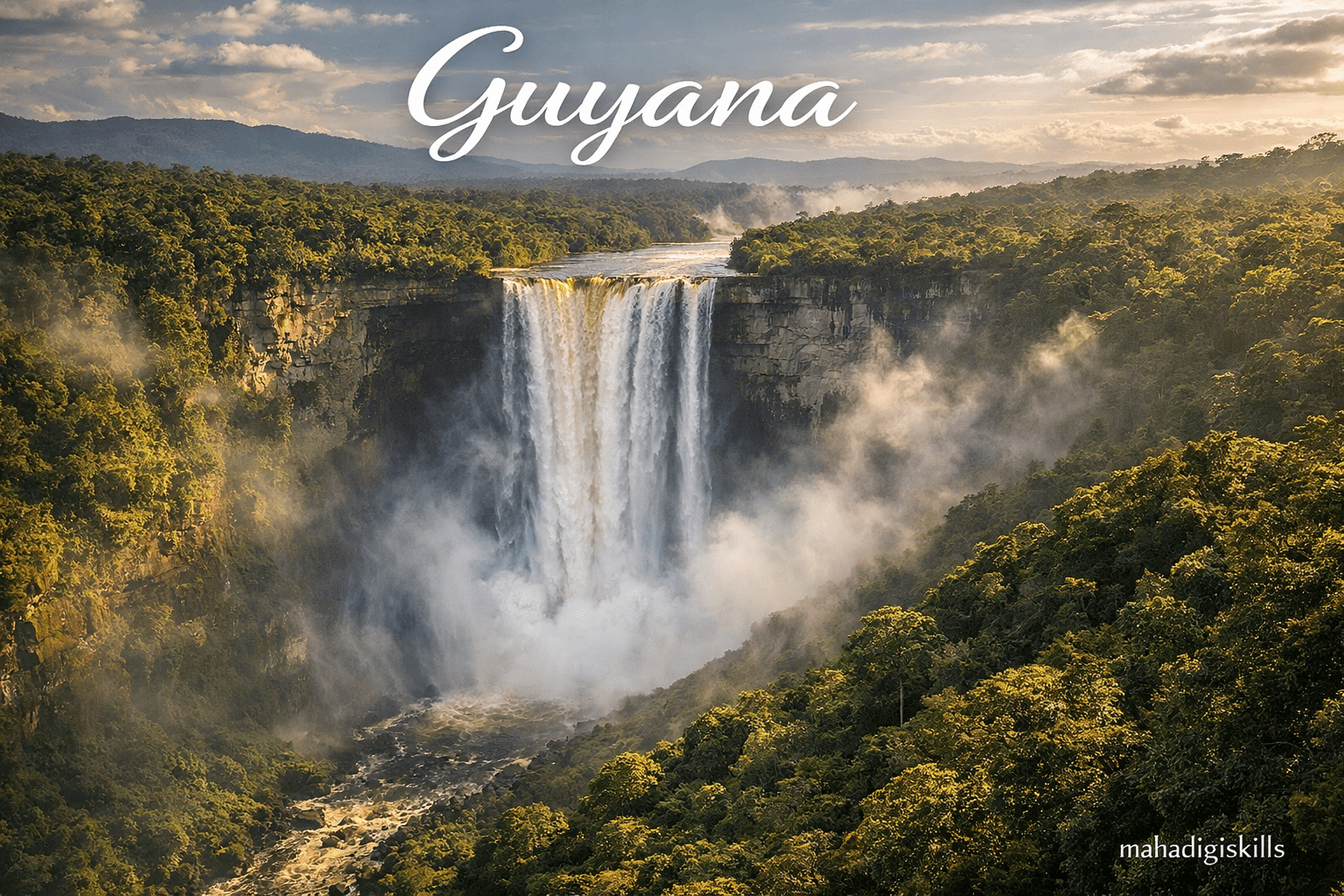
Travelers are often drawn to Guyana for its untouched wilderness and natural wonders. The country is home to Kaieteur Falls, one of the most powerful waterfalls in the world, located deep within the Amazonian rainforest.
Beyond nature, Guyana offers a rich cultural landscape shaped by African, Indian, Indigenous, European, and Chinese heritage. This diversity influences everything from food and festivals to music and architecture.
This comprehensive guide explores the history, geography, culture, economy, tourism, and travel opportunities found throughout Guyana.
Historical Background
Indigenous Peoples and Early Settlements
Long before European explorers arrived, the land now known as Guyana was inhabited by Indigenous peoples who lived in harmony with the rainforest environment.
Major Indigenous groups included:
- Arawak
- Carib
- Wapishana
- Macushi
- Akawaio
These communities developed sophisticated knowledge of the rainforest ecosystem, using rivers for transportation and forests for food, medicine, and shelter.
Traditional lifestyles centered around fishing, farming, hunting, and small village communities.
European Exploration and Colonization
European interest in Guyana began during the 16th century, when explorers from Spain, the Netherlands, France, and Britain arrived along the northern coast.
The Dutch established the first successful colonies, focusing on sugar plantations along coastal river valleys. These plantations relied heavily on enslaved African labor.
In the 19th century, control of the territory passed to the British Empire, and the colony became known as British Guiana.
During this period, plantation agriculture expanded significantly. After slavery was abolished in the British Empire in 1834, labor shortages led to the arrival of indentured workers from India, as well as migrants from Portugal and China.
These migrations created the multicultural society that characterizes Guyana today.
Independence and Modern History
The movement for independence gained momentum during the mid-20th century.
Political leaders such as Cheddi Jagan and Forbes Burnham played key roles in shaping the country’s political future.
Guyana officially gained independence from the United Kingdom on May 26, 1966.
In 1970, the country became a Cooperative Republic, marking a new phase in its political development.
Since independence, Guyana has worked toward economic growth, democratic governance, and regional cooperation with Caribbean and South American nations.
Recent discoveries of offshore oil reserves have dramatically increased international interest in the country’s economic future.
Geography of Guyana
Location and Coordinates
Guyana is located on the northern coast of South America along the Atlantic Ocean.
Geographical coordinates:
4.8604° N latitude
58.9302° W longitude
Neighboring Countries
Guyana shares borders with:
- Venezuela (west)
- Brazil (south)
- Suriname (east)
To the north lies the Atlantic Ocean.
Land Area
Guyana covers approximately 214,970 square kilometers, making it one of the larger countries in the northern region of South America.
Despite its size, the population is relatively small, giving the country a low population density.
Natural Regions
Guyana can be divided into several major geographic regions.
Coastal Plains
Most of the population lives along the narrow coastal strip near the Atlantic Ocean.
These fertile plains support agriculture, particularly:
- Rice
- Sugarcane
- Vegetables
Much of the coastal area lies below sea level, requiring extensive drainage and sea defenses.
Rainforest Interior
The interior of Guyana consists primarily of dense tropical rainforest that forms part of the Amazon Basin ecosystem.This region includes vast protected areas and wildlife reserves that host thousands of plant and animal species.
Wildlife includes:
- Jaguars
- Giant river otters
- Harpy eagles
- Tapirs
- Hundreds of bird species
Eco-tourism initiatives aim to protect these ecosystems while supporting local communities.
Major Rivers
Several large rivers shape the landscape of Guyana.
Essequibo River
The Essequibo River is the longest river in the country and one of the most important waterways in South America.
It stretches more than 1,000 kilometers and supports transportation, fishing, and wildlife habitats.
Demerara River
The Demerara River flows through the capital city Georgetown and historically played a major role in trade and transportation.
Berbice River
Another major river system supporting agriculture and settlements.
Climate
Guyana experiences a tropical climate with warm temperatures throughout the year.
Average temperatures range from 24°C to 31°C.
The country has two rainy seasons:
- May – August
- November – January
These rains nourish the forests and rivers that define the country’s natural landscape.
Major Cities
Georgetown – The Capital
The capital city Georgetown serves as the political, economic, and cultural center of Guyana.
Founded during the colonial period, the city is famous for its distinctive wooden colonial architecture and historic buildings.
Key landmarks include:
- St. George’s Cathedral (one of the tallest wooden churches in the world)
- Stabroek Market
- Guyana National Museum
Georgetown also functions as the country’s main port and gateway for international visitors.
Other Important Cities
Linden
An important mining town known for bauxite production.
New Amsterdam
Located along the Berbice River, this historic town played a key role in colonial trade.
Bartica
Often called the Gateway to the Interior, Bartica connects river transport routes into the rainforest.
Languages of Guyana
The official language of Guyana is English, making it unique among South American nations.
However, several other languages and dialects are widely spoken.
Guyanese Creole
A popular everyday language influenced by English and African linguistic traditions.
Indigenous Languages
Indigenous communities maintain traditional languages such as:
- Macushi
- Wapishana
- Akawaio
- Arawak
These languages represent important elements of cultural heritage.
Culture of Guyana
The cultural identity of Guyana is one of the most diverse in South America. The country’s society reflects centuries of migration, colonial history, and cultural exchange. Today, Guyana is home to a rich blend of Indigenous, African, Indian, European, Chinese, and Portuguese influences.
Because of this diversity, Guyana’s culture combines elements from both Caribbean and South American traditions. Music, food, festivals, and religious celebrations demonstrate how different communities have contributed to the nation’s cultural heritage.
The multicultural character of Guyana can be seen in everyday life, especially in cities where communities of different backgrounds live side by side and celebrate each other’s traditions.
Ethnic Diversity
Guyana’s population consists of several major ethnic groups.
Indo-Guyanese
People of Indian descent form one of the largest communities in Guyana. Their ancestors arrived during the 19th century as indentured laborers after the abolition of slavery.
Indian cultural influences are visible in:
- Cuisine
- Festivals
- Music
- Religious traditions
Many Indo-Guyanese families maintain strong cultural connections with Indian heritage while also embracing Caribbean identity.
Afro-Guyanese
Afro-Guyanese communities are descendants of Africans who were brought to the region during the colonial plantation era.
They have contributed significantly to the country’s:
- Music
- Political history
- Cultural traditions
- Sports and literature
African heritage remains visible through dance, storytelling, and cultural festivals.
Indigenous Peoples
Indigenous communities represent the earliest inhabitants of the land. These groups continue to live primarily in the interior rainforest regions.
Major Indigenous groups include:
- Macushi
- Wapishana
- Akawaio
- Arawak
These communities maintain traditional lifestyles connected to the rainforest ecosystem.
Other Communities
Smaller communities with European, Portuguese, and Chinese ancestry also contribute to the multicultural society of Guyana.
This cultural mixture creates a unique national identity rarely found elsewhere in South America.
Religion in Guyana
Religious diversity reflects the country’s multicultural population.
Christianity
Christianity is practiced by a large portion of the population, including several denominations such as:
- Anglican
- Roman Catholic
- Methodist
- Pentecostal
Churches play an important role in community life and social gatherings.
Hinduism
Hinduism is widely practiced among Indo-Guyanese communities. Temples and religious celebrations are common in many regions.
Important Hindu festivals celebrated in Guyana include:
- Diwali (Festival of Lights)
- Phagwah (Holi Festival)
Islam
Islam is also practiced by a significant minority of the population, particularly among people of South Asian heritage.
Mosques can be found in many cities and towns across the country.
Festivals and National Celebrations
Festivals in Guyana reflect the nation’s multicultural heritage.
Mashramani
Mashramani, often called “Mash,” is one of the most important national festivals.
The celebration marks Republic Day on February 23, commemorating the country’s transition to a republic in 1970.
The festival includes:
- Colorful street parades
- Cultural performances
- Music and dance
- Costume competitions
Mashramani is often compared to Caribbean carnival celebrations because of its vibrant atmosphere.
Diwali
Diwali, the Hindu Festival of Lights, is widely celebrated throughout the country.
During the festival:
- Homes are decorated with lights and lamps
- Religious prayers are performed
- Families gather to share traditional foods
The celebration symbolizes the victory of light over darkness.
Phagwah (Holi)
Phagwah is another vibrant celebration where people throw colored powders and water to welcome the arrival of spring.
This festival highlights the joyful spirit of the Indo-Guyanese community and attracts participants from all backgrounds.
Music and Artistic Expression
Music is an important cultural expression in Guyana.
Popular Music Styles
Common musical genres include:
- Calypso
- Soca
- Chutney music
- Reggae
- Folk music
Chutney music combines Indian rhythms with Caribbean influences and is especially popular during festivals and weddings.
Traditional drumming and storytelling also remain important cultural traditions among Indigenous communities.
Cuisine of Guyana
Food in Guyana reflects its multicultural population. Many dishes combine Indian spices, African cooking traditions, Caribbean flavors, and local ingredients.
Rice, cassava, seafood, and tropical fruits are commonly used.
Popular Traditional Dishes
Pepperpot
Pepperpot is considered the national dish of Guyana.
It is a rich stew made with:
- Beef or pork
- Cassareep (a sauce made from cassava)
- Spices and herbs
The dish is traditionally served during holidays and family gatherings.
Curry and Roti
Indian culinary influence is visible through dishes such as:
- Curry chicken
- Curry goat
- Roti bread
These meals are widely enjoyed across the country.
Fried Rice and Chow Mein
Chinese migration introduced dishes like fried rice and chow mein, which have become popular local street foods.
Economy of Guyana
Guyana’s economy has undergone significant transformation in recent years.
Historically dependent on agriculture and mining, the country is now experiencing rapid growth due to major offshore oil discoveries.
Currency
The official currency is the Guyanese Dollar (GYD).
Natural Resources
Guyana is rich in natural resources including:
- Gold
- Bauxite
- Timber
- Diamonds
Mining has long been an important contributor to the national economy.
Oil Industry Boom
In 2015, major offshore oil discoveries dramatically changed the country’s economic outlook.
Large oil reserves were discovered in the Stabroek Block offshore region.
Production began in 2019, making Guyana one of the fastest-growing economies in the world.
Oil revenue is expected to support:
- Infrastructure development
- Education
- Healthcare
- Economic diversification
Agriculture
Agriculture remains an important sector.
Major agricultural products include:
- Rice
- Sugar
- Coconut products
- Fruits and vegetables
Rice exports are particularly important for trade.
Trade Partners
Guyana maintains trade relationships with many countries including:
- United States
- Canada
- Trinidad and Tobago
- China
- Brazil
Exports primarily include oil, gold, rice, and timber.
Major Cities Beyond the Capital
Linden
Linden is one of the most important mining towns in Guyana. The city has historically been associated with bauxite mining, which played a major role in the country’s industrial development.
New Amsterdam
New Amsterdam is a historic town located near the Berbice River. It was once a major colonial trading center and still contains historic architecture and cultural landmarks.
Bartica
Bartica is often called the Gateway to the Interior because it connects coastal regions with the rainforest interior.
The town serves as a transportation hub for travelers and miners heading into remote regions.
Education and Society
Guyana places strong emphasis on education.
The country has several higher education institutions including:
- University of Guyana
- Technical institutes and vocational schools
Education programs aim to support economic development and prepare the workforce for emerging industries.
Tourism in Guyana
Tourism in Guyana is centered around nature, wildlife, and adventure travel. Unlike many heavily visited destinations in South America, Guyana remains largely untouched by mass tourism. This makes it an ideal place for travelers seeking authentic experiences in pristine environments.
Nearly 80% of Guyana is covered by tropical rainforest, forming part of the greater Amazon ecosystem. These forests contain thousands of plant species and hundreds of wildlife species, making the country one of the most biologically diverse regions on Earth.
Eco-tourism is the fastest-growing sector of Guyana tourism, with conservation projects working closely with local Indigenous communities. Visitors can explore rainforests, waterfalls, savannahs, rivers, and wildlife reserves.
Adventure travelers often come to Guyana for jungle expeditions, birdwatching tours, river journeys, and wildlife photography.
Major Tourist Attractions
Kaieteur Falls
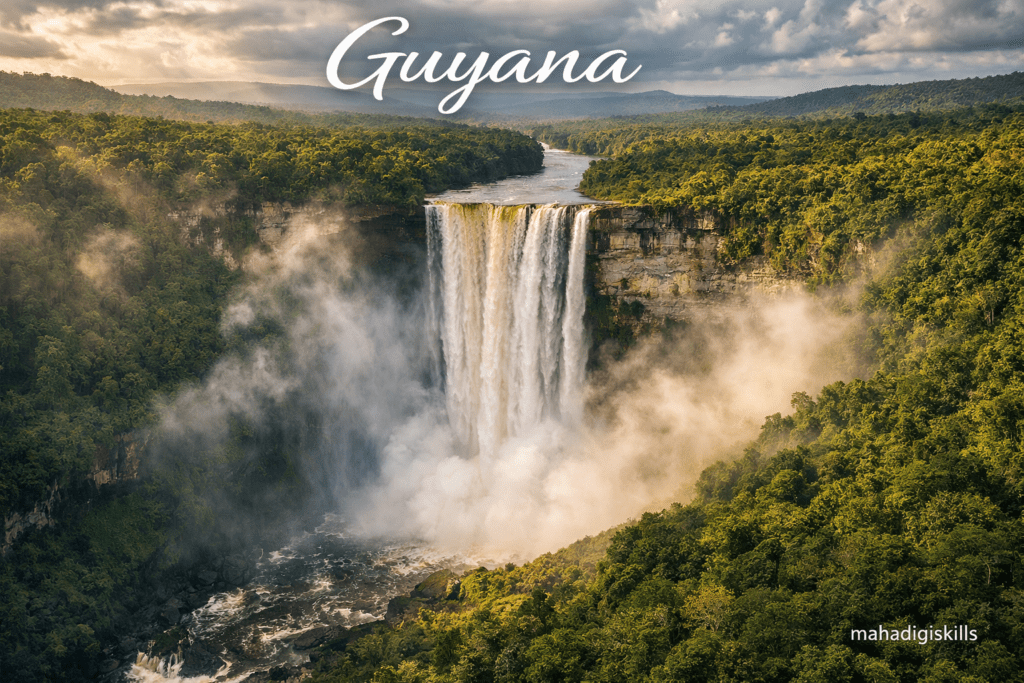
One of the most famous landmarks in Guyana is Kaieteur Falls, located in Kaieteur National Park deep within the rainforest.
Kaieteur Falls is considered one of the most powerful waterfalls in the world.
Key Facts about Kaieteur Falls
- Height: 226 meters (741 feet)
- Nearly four times taller than Niagara Falls
- Located on the Potaro River
The surrounding rainforest is home to rare species such as:
- Golden rocket frogs
- Guianan cock-of-the-rock birds
- Giant river otters
Because of its remote location, Kaieteur Falls remains far less crowded than many famous waterfalls worldwide.
Iwokrama Rainforest Reserve
The Iwokrama International Centre for Rainforest Conservation is one of the most important conservation areas in Guyana.
This protected rainforest covers approximately 1 million acres and plays a major role in global biodiversity research.
Visitors can enjoy:
- Jungle hiking
- Canopy walkways
- River boat trips
- Wildlife observation
Animals found in this region include jaguars, monkeys, giant anteaters, and hundreds of bird species.
Rupununi Savannah
The Rupununi Savannah is a vast grassland region located in southern Guyana near the Brazilian border.
The landscape is very different from the rainforest regions and resembles the African savannah.
Visitors may encounter wildlife such as:
- Giant anteaters
- Capybaras
- Jaguars
- Giant river otters
- Hundreds of bird species
The region also contains traditional Indigenous communities and eco-lodges that promote sustainable tourism.
Shell Beach
Shell Beach is located along the Atlantic coast of Guyana and is famous for its sea turtle nesting sites.
Four species of sea turtles come here to lay eggs:
- Leatherback turtles
- Green turtles
- Hawksbill turtles
- Olive ridley turtles
Conservation programs protect nesting areas and allow visitors to observe turtles responsibly.
Best Time to Visit Guyana
The best time to travel to Guyana depends on weather conditions.
Dry Seasons
The most comfortable months for travel are:
- February – April
- August – November
These periods generally have lower rainfall and easier travel conditions.
Rainy Seasons
Rainfall occurs during two main periods:
- May – July
- December – January
While the rainforest becomes lush and vibrant during these months, travel to remote areas may be more difficult.
Transportation in Guyana
Travel infrastructure in Guyana is improving as tourism grows.
Air Travel
The main international gateway is:
Cheddi Jagan International Airport (Georgetown)
Small aircraft are often used to reach remote rainforest destinations such as Kaieteur Falls.
River Transport
Many communities depend on rivers for transportation.
Boats and ferries connect remote villages and interior regions.
Road Network
Most paved roads are located along the coastal region, while interior roads may be unpaved and accessible mainly by four-wheel-drive vehicles.
International Organizations and Global Relations
Guyana plays an active role in international diplomacy and regional cooperation.
United Nations Membership
Guyana became a member of the United Nations in 1966, shortly after gaining independence.
The UN works with the government to support development projects including:
- Environmental protection
- Education initiatives
- Economic development
- Climate change mitigation
Other International Organizations
Guyana is also a member of:
- Caribbean Community (CARICOM)
- Commonwealth of Nations
- Organization of American States (OAS)
- Union of South American Nations
These organizations strengthen cooperation between Caribbean and South American countries.
External references for research:
Unique and Interesting Facts About Guyana
Here are several fascinating facts about Guyana.
1. Only English-Speaking Country in South America
Guyana is the only nation on the South American continent where English is the official language.
2. Massive Rainforest Coverage
About 80% of the country is covered by rainforest, making it one of the most forested nations on Earth.
3. One of the World’s Most Powerful Waterfalls
Kaieteur Falls has one of the largest single-drop volumes of water anywhere in the world.
4. Rapidly Growing Economy
Thanks to offshore oil discoveries, Guyana has become one of the fastest-growing economies globally.
5. Cultural Diversity
The population represents a mixture of African, Indian, Indigenous, European, and Asian heritage.
Travel Tips for Visitors
Visitors planning a trip to Guyana should consider several practical tips.
Health
- Vaccinations may be recommended before travel.
- Mosquito protection is important in rainforest areas.
Currency
Cash is widely used, especially outside major cities.
Cultural Respect
Visitors should respect local traditions, especially when visiting Indigenous communities.
Final Summary
Guyana is one of the most unique destinations in South America. Its combination of Caribbean culture, English-speaking heritage, vast rainforests, and remarkable biodiversity makes it stand apart from neighboring countries.
From the dramatic power of Kaieteur Falls to the wildlife-rich Rupununi Savannah and the dense jungles of the Iwokrama Rainforest, Guyana offers extraordinary opportunities for eco-tourism and adventure travel.
The country’s multicultural society, influenced by African, Indian, Indigenous, and European traditions, adds another layer of richness to the travel experience.
With growing economic development and increasing global interest, Guyana is emerging as one of the most exciting and unexplored destinations in the world.
Key Facts About Guyana
| Category | Information |
|---|---|
| Capital | Georgetown |
| Continent | South America |
| Official Language | English |
| Currency | Guyanese Dollar (GYD) |
| Independence | May 26, 1966 |
| Population | ~800,000 |
| Climate | Tropical |
| Major River | Essequibo River |
| Famous Landmark | Kaieteur Falls |
| UN Membership | 1966 |
List of All 195 Countries
- Afghanistan
- Albania
- Algeria
- Andorra
- Angola
- Antigua and Barbuda
- Argentina
- Armenia
- Australia
- Austria
- Azerbaijan
- Bahamas
- Bahrain
- Bangladesh
- Barbados
- Belarus
- Belgium
- Belize
- Benin
- Bhutan
- Bolivia
- Bosnia and Herzegovina
- Botswana
- Brazil
- Brunei
- Bulgaria
- Burkina Faso
- Burundi
- Cabo Verde
- Cambodia
- Cameroon
- Canada
- Central African Republic
- Chad
- Chile
- China
- Colombia
- Comoros
- Congo (Congo-Brazzaville)
- Costa Rica

