



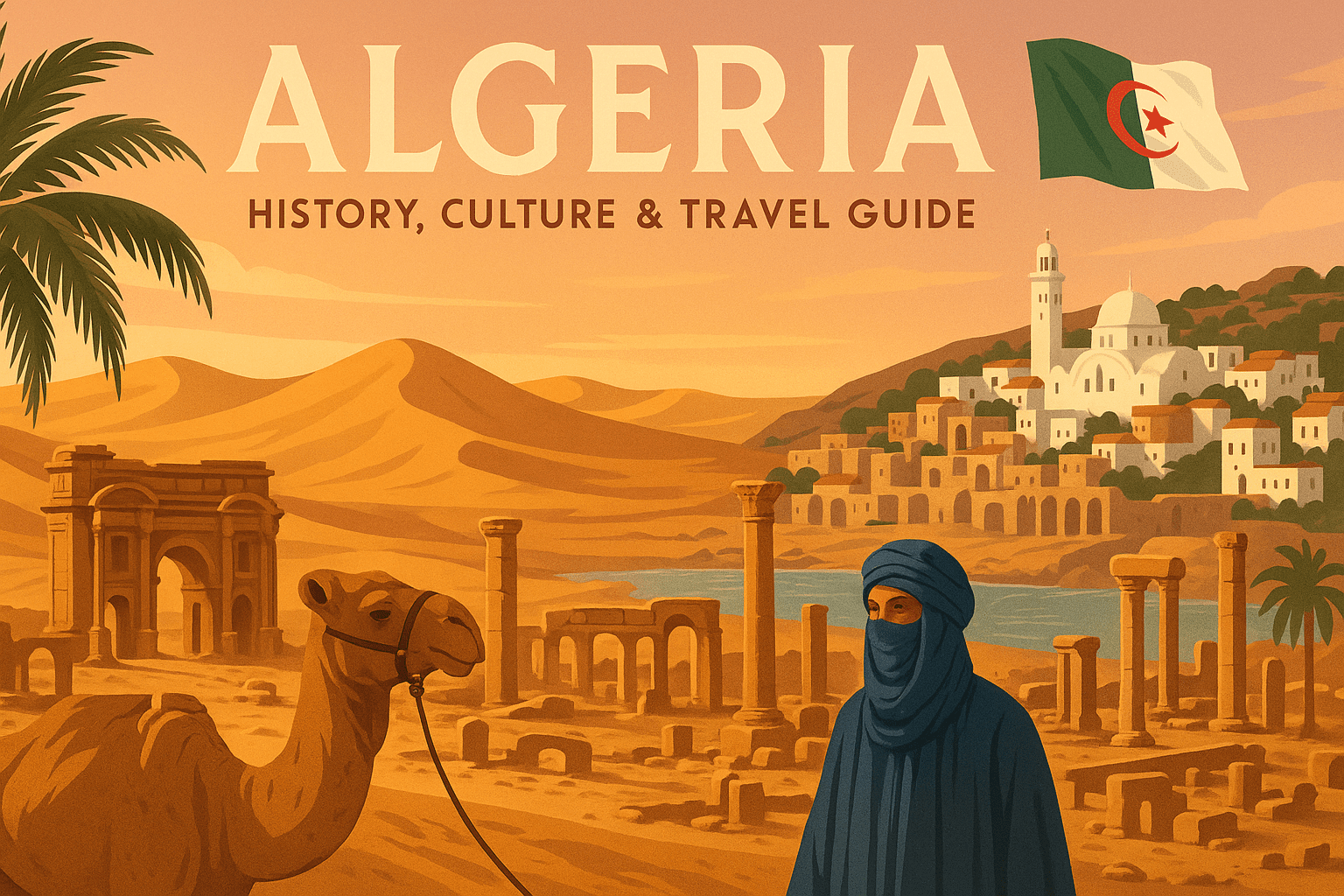
1. Introduction
From the Mediterranean coast to the centre of the Sahara, Algeria is the largest country in Africa in terms of land area. Algeria, a country rich in cultural diversity, historic sites, and breathtaking scenery, combines centuries of history to become a popular travel destination. Its history, profile, culture, economy, and level of contemporary change are all examined in this guide.
2. Historical Overview
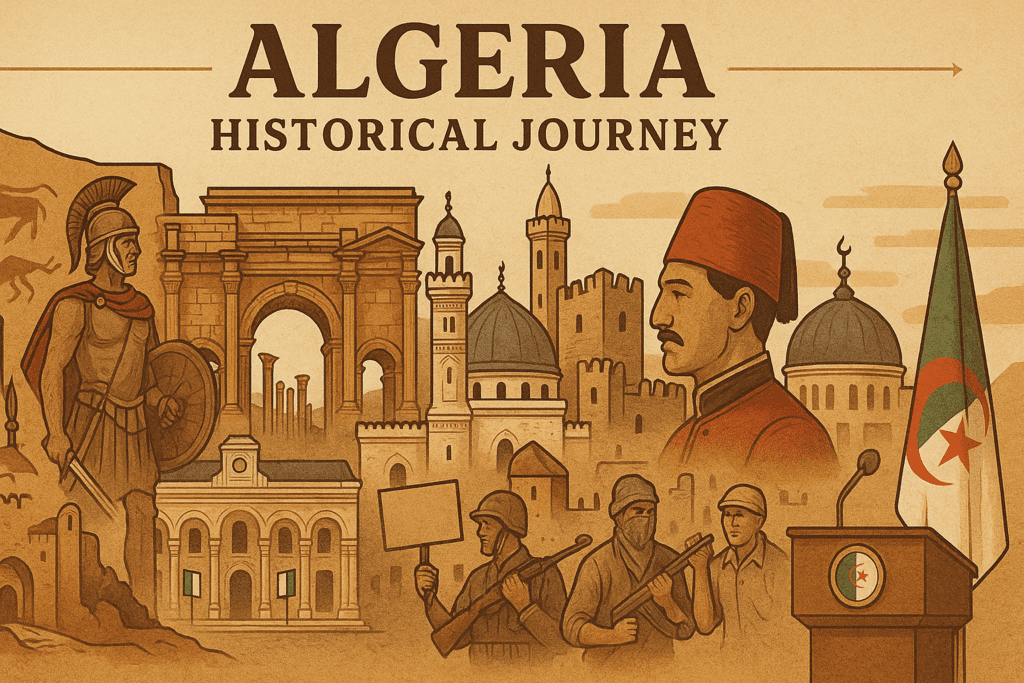
Ancient Civilizations & Roman Era
- By the third century BCE, native Numidians had established strong kingdoms.
- conquered by the Romans and governed as Africa Proconsularis and Numidia.
- Roman ruins at Tipasa and Timgad are among the legacies.
Islamic Dynasties & Ottoman Influence
- The seventh-century CE Arab Muslim conquest brought Islam, the Arabic language, and the Maghrebi architectural style.
- ruled by strong Almoravid/Almohad empires after being ruled by Berber-led dynasties (Rustamids, Zirids).
- Algiers was a Barbary pirate stronghold when it became an Ottoman Regency in the sixteenth century.
French Colonization & Independence
- During a bloody colonial campaign, France (1830–1962) annexed the region; resource extraction and settlers upended traditional life.
- Guerrilla warfare characterised the bloody Algerian War of Independence (1954–1962).
- Independence Day is celebrated every year on July 5, 1962.
Modern Political History
- dominated by Abdelaziz Bouteflika (1999–2019), Boumediene, and Chadli Bendjedid.
- faced a civil war (Black Decade) between Islamist militants and the government in the 1990s.
- Abdelmadjid Tebboune has been in office since 2019 and is in charge of reforms and a cautious opening.
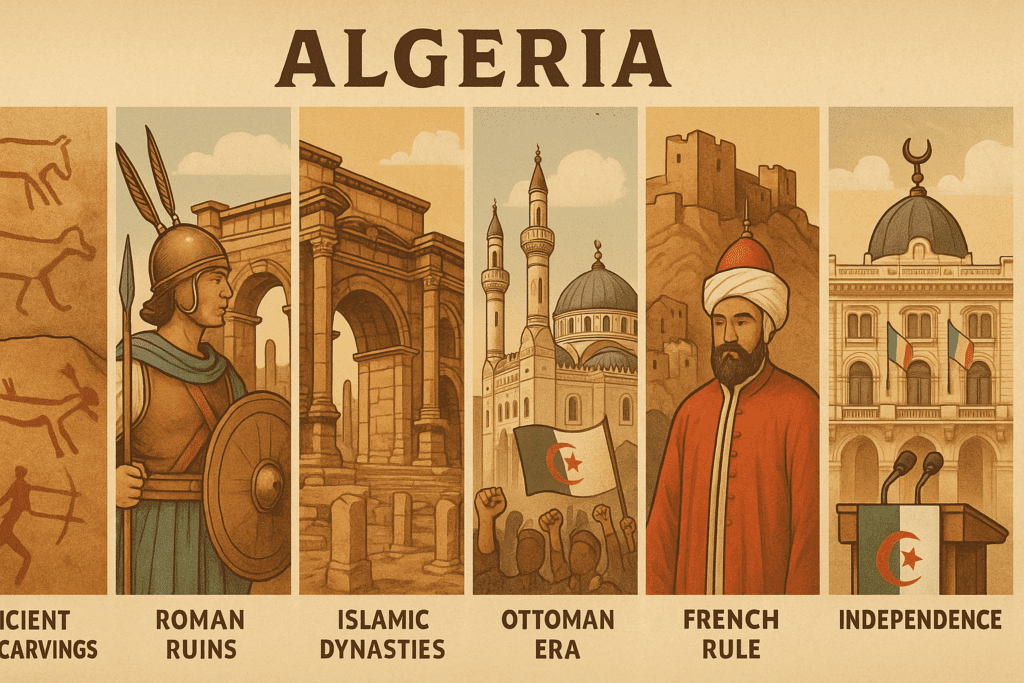
3. Geography & Climate
Location, Area & Borders
- Northern Africa (Maghreb region) is the continent.
- Area: approximately 2.38 million km² (10th largest in the world)
- The Mediterranean Sea (N), Tunisia and Libya (NE), Niger and Mali (S), Mauritania, Western Sahara, and Morocco (W) are the borders.
Topography & Major Regions
- The coastal Tell region features rolling hills and lush, Mediterranean scenery.
- High plateaus: 600–1,200 m above sea level, semi-arid steppes
- Saharan region: wide desert, rocky plateaus, and sand dunes
- Atlas Mountains: The Saharan and Tellian Atlas ranges that stretch from southwest to northeast
Climate
- The northern coast experiences hot summers and mild, rainy winters due to its Mediterranean climate.
- The interior is semi-arid, with significant seasonal variations.
- Sahara: intense desert weather with sweltering days and chilly nights
4. Political Structure & UN Membership
- President and Prime Minister in a semi-presidential republic
- Member of the United Nations since September 8, 1962
- Members of the African Union, Arab League, and OPEC are examples of regional alliances.
5. Demographics & Language
- About 45 million people live there (2025 estimates).
- The majority ethnic group is Arab-Berber, with smaller subgroups such as Tuareg, Mozabites, and Sahrawis.
- Languages: Berber (known as Tamazight), Modern Standard Arabic (official), and French, which is widely used in business and education
- Religion: Sunni Islam (Maliki madhhab) predominates
6. Culture & Traditions
Religion & Festivals
- Islamic customs predominate in public life and daily routines.
- National holidays include Independence Day, Revolution Day (November 1), Eid al-Fitr, and Eid al-Adha.
Art, Music & Literature
- Rich musical genres: Raï, Kabyle folk, and Chaabi
- Visual arts: miniatures, jewellery, carpets, and ceramics
- Literature: Algerian voices are introduced to international literature by authors such as Assia Djebar and Kamel Daoud.
Cuisine & Daily Life
- Essentials: freshly baked bread, grilled meats, couscous, and tajines
- Snacks: mint tea, baklava, and makroud (dates)
- Markets, family get-togethers, and cafés frequently serve as the focal points of daily social life.
7. Economy & Key Industries
- Nominal GDP: approximately $192 billion in 2023
- Hydrocarbons (about 60% of government revenue and 95% of exports) are the main driver.
- Other industries include light manufacturing, growing tourism, and agriculture (wheat, olives).
- Challenges include the need for economic diversification, youth unemployment, and reliance on oil.
8. Major Cities Overview
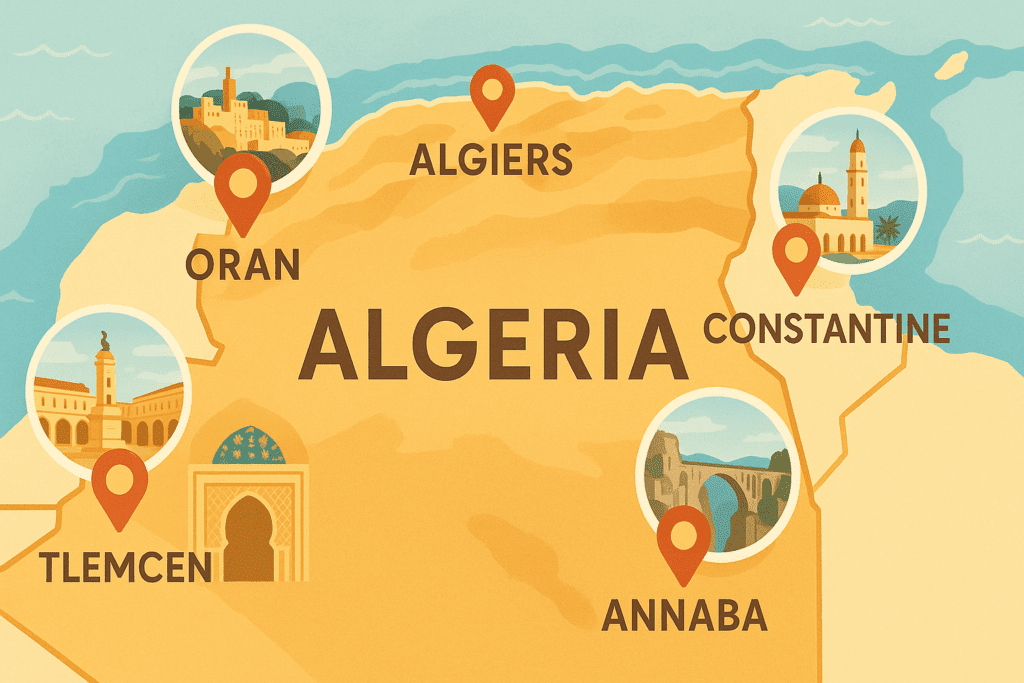
Algiers (Capital)
- The “White City,” which is situated on the Mediterranean coast, features Ottoman casbah, French colonial architecture, and contemporary skyscrapers.
Oran
- Western port city, renowned for its thriving music scene and architecture with Spanish influences
Constantine
- The striking “City of Bridges,” which is situated atop deep gorges and ravines
Annaba
- Significant spiritual and economic hub with a long history of Christianity and Ottoman influence
Tlemcen
- Surrounded by mountains and orchards, this cultural town features Moorish architecture.
9. Tourist Attractions
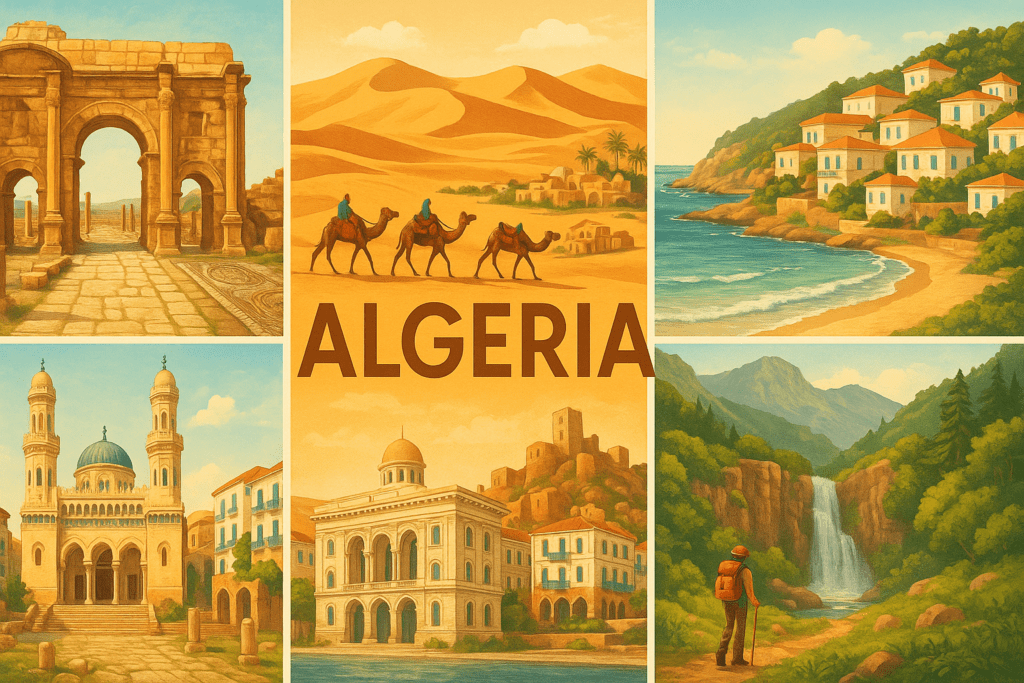
- Roman-era UNESCO World Heritage Sites: Timgad, Djemila, and Tipasa Ruins
- Experiences in the Sahara include camel treks, oases, and sand dunes (El M’zab Valley).
- Coastal communities: Setif and Bejaia
- Cultural landmarks: Ahmed Zabana Culture Palace, Ketchaoua Mosque, and Algiers Casbah
- Mountain getaways: hiking in the Atlas ranges, Chalma waterfalls
10. Unique Facts
- North Africa has a significant concentration of Roman ruins.
- The Sahara region is home to distinctive cultures, such as Tuareg customs and desert celebrations.
- Resurgent Berber identity: Tamazight co-official since 2016
- The second-largest desert dunes are found in Algeria (Erg Iguidi).
- There are many date palms, and Algeria is one of the top date-producing nations.
11. Challenges & Future Outlook
Present Challenges
- Diversifying the economy and reducing reliance on oil are essential.
- Youth unemployment and reform demands
- Stability is impacted by regional tensions, such as those in the Western Sahara.
Outlook
- Decentralisation and open investment are the goals of Tebboune’s government reforms.
- Promoting tourism: lowering visa requirements and investing in sustainable infrastructure
- Increased exports of culture and expansion of the manufacturing and technology sectors
12. Conclusion
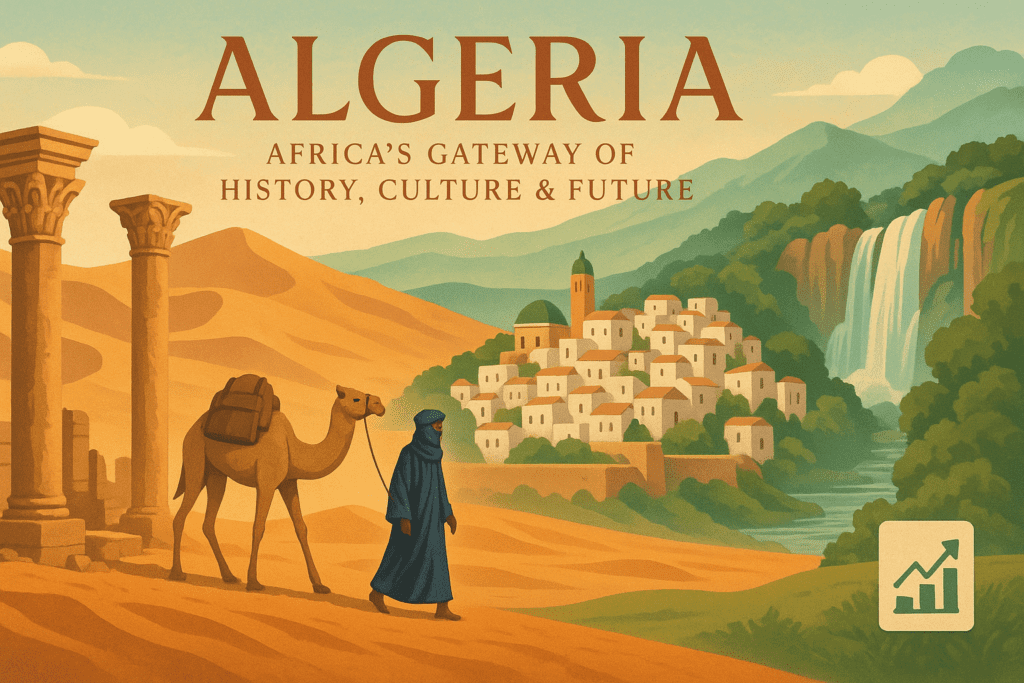
Algeria’s rich cultural diversity, varied landscapes, and ancient history perfectly capture the essence of Africa. Its tourism and cultural optimism are steadily increasing, but its future depends on regional stability and economic diversification. Those who are interested in Algeria’s history, present, and future developments should find this guide useful.
| Anchor Text | URL | Purpose |
|---|---|---|
| Algeria Ministry of Tourism | https://www.mta.gov.dz | Official site for tourism updates, destinations, and travel advice |
| Algeria Official Government Portal | https://www.el-mouradia.dz | For political, government, and national holidays info |
| UNESCO World Heritage Sites in Algeria | https://whc.unesco.org/en/statesparties/dz | Explore Algeria’s UNESCO sites like Timgad, Tipasa, and Kasbah of Algiers |


Algeria’s diversity is really underappreciated, especially its mix of Mediterranean coastline and deep desert landscapes. I think this guide gives travelers a solid starting point for exploring a truly unique country.
[…] 3.Algeria: History, Culture, Geography & Travel Guide […]
[…] 3.Algeria: History, Culture, Geography & Travel Guide […]
Algeria often flies underBlog comment creation the radar as a travel destination, so it’s great to see a guide that brings its rich history and diverse geography into focus. I’d love to see more about how travelers can experience traditional Algerian culture firsthand—like local festivals or regional cuisine across different parts of the country.
Thank you for your kind words and thoughtful comment! 🙌 You’re absolutely right — Algeria has so much untapped potential as a travel destination. We’re glad the guide helped highlight its historical and geographical richness.
And great point! Traditional Algerian culture is incredibly vibrant. From the colorful Timgad Festival celebrating ancient Roman heritage to the lively Guedra dance performances in the Sahara, there’s so much to explore. Each region also offers its own unique flavors — like couscous in Algiers, mechoui in the Sahara, or chakchouka along the Mediterranean coast.
We’ll definitely be adding a section on local festivals, cultural experiences, and must-try regional dishes in our next update. Thanks again for the suggestion — stay tuned! 🇩🇿✨
One thing I find especially fascinating about Algeria is its cultural fusion, with influences from Arab, Berber, and French heritage. The blog does a great job highlighting how these diverse elements come together in the country’s cuisine, architecture, and traditions.
Thank you for sharing such an insightful observation! We’re glad you enjoyed how the blog highlights Algeria’s cultural fusion. The blend of Arab, Berber, and French influences truly makes the country’s cuisine, architecture, and traditions unique, and it’s great to see that resonated with you. We appreciate you taking the time to read and comment!
Really well explained and easy to follow. I’m bookmarking this.
Thank you so much! I’m really glad you found it easy to follow and helpful. Your support means a lot, and I truly appreciate you bookmarking it. Stay tuned for more content like this!
Fantastic insights. I’ll be applying these tips right away.
Thank you so much! I’m really glad you found it easy to follow and helpful. Your support means a lot, and I truly appreciate you bookmarking it. Stay tuned for more content like this!
Thorough breakdown of Algeria — the section on Saharan geography and Berber cultural roots was especially informative. The mix of historical context and practical travel tips makes this a great reference for anyone planning a deeper dive into the region. I keep voice travel notes on the go and use Speech Text to convert them to written form before drafting articles.
Thanks for the thoughtful comment! 🙌 I’m glad you found the mix of Saharan geography, Berber cultural roots, history, and practical travel tips useful. And that voice-note-to-text workflow sounds super handy for capturing ideas while traveling! ✈️🌍
Excellent travel guide — Algeria is genuinely underrated as a destination and most coverage focuses only on the Sahara without doing justice to the Kabylie region or the coastal cities. The historical depth here is appreciated. The visa process detail is especially helpful for first-time visitors planning independently.
Thank you so much for your kind words! I’m glad you appreciated the focus on Algeria’s history, Kabylie, and the coastal cities beyond the Sahara. There’s so much diversity across the country, and I wanted the guide to give first-time travelers a broader picture while also covering practical details like the visa process. I really appreciate you taking the time to share your thoughts! 😊
I appreciated how this guide connects Algeria’s history and cultural diversity with practical travel information instead of treating the country as just a list of attractions. The sections on major cities and geography are especially useful for understanding how varied the travel experience can be across Algeria.
Thank you so much for your thoughtful comment! I’m glad you found the balance between Algeria’s history, cultural diversity, geography, and practical travel information useful. Algeria is incredibly diverse, and understanding the differences between its major cities and regions can make the overall travel experience much more meaningful. I really appreciate you taking the time to share your thoughts! 😊
I appreciated how the guide connected Algeria’s ancient Roman sites with its diverse modern culture, especially the contrast between coastal cities like Algiers and the vast Sahara. The section on Amazigh heritage and the Tuareg communities added depth beyond the usual travel highlights and made me curious to explore southern Algeria.
Thank you so much for your thoughtful comment! I’m glad you enjoyed the connection between Algeria’s ancient Roman heritage and its diverse modern culture. The Amazigh heritage and Tuareg communities really do add another fascinating layer to the country’s story. Southern Algeria, especially the Sahara region, has so much to offer beyond the usual tourist highlights. I hope you get the chance to explore it someday! 😊
アルジェリアといえばサハラ砂漠の印象が強かったのですが、地中海沿岸の都市やローマ遺跡まで詳しく紹介されていて、国土の多様さがよく分かりました。特に歴史と地理を合わせて読むことで、各地域の風景の違いにも興味が湧きます。
コメントありがとうございます!サハラ砂漠のイメージが強いアルジェリアですが、地中海沿岸の都市や古代ローマ遺跡など、地域によって大きく異なる魅力があります。歴史と地理を合わせて見ることで、それぞれの地域の文化や風景の違いもより深く感じられますよね。アルジェリアの多様な魅力に興味を持っていただけて嬉しいです!😊