



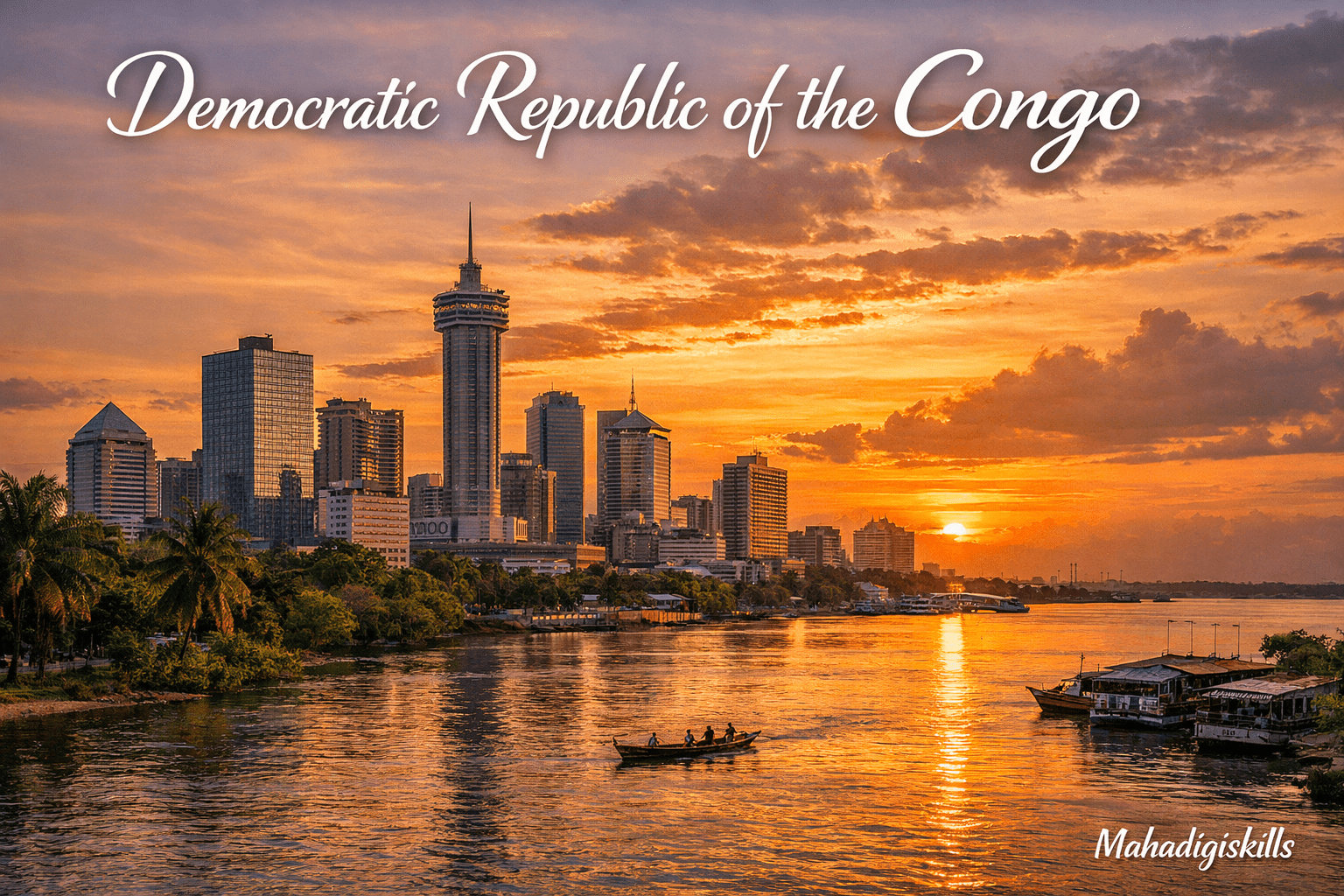
Introduction to Democratic Republic of the Congo
Democratic Republic of the Congo is one of the largest and most resource-rich countries in Africa. Located in the heart of Central Africa, Democratic Republic of the Congo is known for its vast rainforests, powerful rivers, extraordinary biodiversity, and rich cultural heritage.
Often referred to as DR Congo or DRC, the nation is home to one of the largest tropical rainforest systems in the world after the Amazon. The natural landscapes of Democratic Republic of the Congo include dense jungles, massive river systems, volcanic mountains, and diverse wildlife habitats.
The country plays an important role in African geography, culture, and environmental conservation. Travelers and researchers are fascinated by the unique ecosystems, indigenous traditions, and historical significance of Democratic Republic of the Congo.
Geographical Location of Democratic Republic of the Congo
Location in Africa
Democratic Republic of the Congo lies in Central Africa and is the second-largest country in Africa by land area after Algeria.
The country covers a massive territory that stretches across the equatorial region of the continent. Because of its location near the equator, Democratic Republic of the Congo experiences a tropical climate with warm temperatures and heavy rainfall throughout the year.
Geographic Coordinates
Approximate coordinates of Democratic Republic of the Congo:
Latitude: 4°N
Longitude: 21°E
These coordinates place the country almost directly across the equator.
Neighboring Countries
Democratic Republic of the Congo shares borders with nine countries, making it one of the most geographically connected nations in Africa.
Neighboring countries include:
- Republic of the Congo
- Central African Republic
- South Sudan
- Uganda
- Rwanda
- Burundi
- Tanzania
- Zambia
- Angola
The country also has a small coastline along the Atlantic Ocean, providing access to international maritime trade.
Landscape and Natural Features
The landscape of Democratic Republic of the Congo is incredibly diverse.
Important natural features include:
- The Congo River, the second-longest river in Africa
- Vast Congo Basin rainforests
- Volcanic mountains in the eastern region
- Large lakes such as Lake Tanganyika and Lake Kivu
The Congo Basin rainforest covers much of the territory and plays a crucial role in regulating the global climate.
History of Democratic Republic of the Congo
Early Civilizations
Long before European colonization, the region that is now Democratic Republic of the Congo was home to powerful African kingdoms and thriving communities.
Among the most notable early states was the Kingdom of Kongo, which developed sophisticated trade networks, political systems, and cultural traditions.
Trade routes connected the region with other parts of Africa, allowing goods such as ivory, copper, and agricultural products to circulate throughout the continent.
Colonial Period
During the late 19th century, the territory of Democratic Republic of the Congo became the personal property of King Leopold II of Belgium.
The area was initially called the Congo Free State and was controlled by Belgium. This period was marked by widespread exploitation of natural resources such as rubber and ivory.
Due to international criticism of human rights abuses, the territory was later transferred to the Belgian government and renamed the Belgian Congo.
Independence Movement
The struggle for independence grew stronger during the mid-20th century as African nationalist movements spread across the continent.
In 1960, Democratic Republic of the Congo gained independence from Belgium. The country initially faced political instability, leadership struggles, and economic challenges during its early years as an independent state.
Modern Era
In 1997, the country officially adopted the name Democratic Republic of the Congo.
Since then, the nation has worked toward rebuilding political stability, economic growth, and social development.
Despite challenges, Democratic Republic of the Congo remains an important country in Africa due to its vast natural resources, strategic location, and cultural diversity.
Languages of Democratic Republic of the Congo
Language diversity is one of the defining characteristics of Democratic Republic of the Congo.
Official Language
The official language is French, which is widely used in government, education, and administration.
National Languages
In addition to French, the country recognizes four national languages:
- Lingala
- Swahili
- Tshiluba
- Kikongo
These languages are spoken across different regions and ethnic communities.
Local Dialects
More than 200 indigenous languages and dialects exist throughout Democratic Republic of the Congo, reflecting the country’s rich cultural diversity.
This linguistic variety represents centuries of cultural traditions and local identities.
Culture of Democratic Republic of the Congo
Traditional Culture
The culture of Democratic Republic of the Congo is influenced by hundreds of ethnic groups, each with its own traditions, music, art, and ceremonies.
Traditional storytelling, dance, and music play important roles in community life.
Many cultural practices have been passed down through generations.
Music and Dance
The country has one of the most influential music scenes in Africa.
Congolese rumba and soukous music have become internationally famous.
Artists from Democratic Republic of the Congo have helped shape modern African music culture.
Music is commonly performed at festivals, celebrations, and social gatherings.
Food and Cuisine
Cuisine in Democratic Republic of the Congo reflects the country’s agricultural resources and regional traditions.
Popular foods include:
- Fufu (a starchy staple made from cassava or maize)
- Moambe chicken
- Grilled fish from the Congo River
- Plantains
- Cassava leaves
Meals often combine vegetables, grains, and locally sourced ingredients.
Religion
Religion plays an important role in society.
The majority of people in Democratic Republic of the Congo identify as Christian, with both Catholic and Protestant communities.
Traditional African spiritual practices also remain part of cultural life in some regions.
Cultural Festivals
Festivals and celebrations highlight the vibrant traditions of the country.
Events often include:
- traditional dance performances
- music concerts
- cultural exhibitions
- religious celebrations
These gatherings bring communities together and showcase the cultural richness of Democratic Republic of the Congo.
Economy of the Democratic Republic of the Congo
The economy of the Democratic Republic of the Congo is heavily influenced by its enormous natural resources. The country possesses some of the richest mineral deposits in the world, making it extremely important in global mining and energy industries.
Despite these natural advantages, economic development has faced challenges due to political instability, infrastructure limitations, and historical conflicts. However, international investment and development programs are gradually supporting economic progress.
Key sectors that contribute to the national economy include:
- Mining and natural resources
- Agriculture
- Forestry
- Hydropower energy
- Telecommunications
- Tourism
With continued development and improved infrastructure, the nation has strong potential for economic growth in the future.
Currency and Financial System
The official currency is the Congolese Franc (CDF).
While the local currency is widely used for everyday transactions, the US dollar is also commonly accepted in many cities and commercial areas.
Major cities such as Kinshasa and Lubumbashi have banks, currency exchange services, and ATM facilities. Digital banking and mobile payment systems are gradually expanding across the country.
Major Industries
Mining Industry
Mining is the most important industry in the national economy.
The country is one of the world’s leading producers of several valuable minerals including:
- Cobalt
- Copper
- Diamonds
- Gold
- Coltan
Cobalt from this region is especially important for electric vehicle batteries and modern electronics.
Because of these resources, the country plays a significant role in the global technology supply chain.
Agriculture
Agriculture supports a large portion of the population.
Farmers produce crops such as:
- Cassava
- Maize
- Rice
- Coffee
- Cocoa
- Palm oil
Agriculture is mainly practiced by small-scale farmers who grow food for both local consumption and regional markets.
Forestry
Large portions of the Congo Basin rainforest lie within the country’s borders.
The forestry sector provides timber and other forest products. At the same time, environmental organizations emphasize sustainable management to protect biodiversity and ecosystems.
Hydropower Energy
The Congo River has enormous potential for hydroelectric power generation.
Projects such as the Inga Dam have been developed to produce electricity for domestic use and export to neighboring countries.
Experts believe the river system could become one of the largest sources of renewable energy in Africa.
Natural Resources
The Democratic Republic of the Congo is often described as one of the most resource-rich countries in the world.
Important natural resources include:
- Copper
- Cobalt
- Diamonds
- Gold
- Uranium
- Timber
- Hydropower
These resources attract international investment and play an important role in global markets.
Tourism in the Democratic Republic of the Congo
Tourism remains an emerging industry, but the country offers extraordinary natural beauty and wildlife experiences.
Travelers interested in adventure tourism, wildlife conservation, and nature exploration often visit national parks and protected areas.
Tourism highlights include:
- Mountain gorilla trekking
- Volcano exploration
- Rainforest biodiversity
- Cultural experiences with local communities
These attractions provide unique opportunities for eco-tourism.
Famous Tourist Attractions
Virunga National Park
Virunga National Park is one of the most famous protected areas in Africa. Established in 1925, it is the oldest national park in Africa.
The park is known for its incredible biodiversity and diverse landscapes that include:
- tropical rainforests
- savannas
- wetlands
- volcanic mountains
Virunga is one of the few places in the world where visitors can observe endangered mountain gorillas in their natural habitat.
The park is also recognized as a UNESCO World Heritage Site.
Mount Nyiragongo
Mount Nyiragongo is an active volcano located near the city of Goma.
The volcano contains one of the world’s largest lava lakes, creating a dramatic natural spectacle. Adventurous travelers can hike to the summit to observe the glowing lava lake at night.
This volcano is considered one of the most fascinating geological features in Africa.
Congo River
The Congo River is the second-longest river in Africa and one of the most powerful rivers in the world.
The river plays a crucial role in transportation, fishing, and economic activity.
It also flows through some of the most biodiverse rainforest ecosystems on Earth.
National Parks and Wildlife
The country is home to several national parks that protect rare wildlife species and ecosystems.
Kahuzi-Biega National Park
This park is famous for protecting the eastern lowland gorilla, one of the rarest primates in the world.
The park contains mountainous terrain, forests, and volcanic landscapes.
Garamba National Park
Garamba National Park is known for its savanna ecosystems and wildlife populations including:
- elephants
- giraffes
- buffalo
- antelope species
The park is also recognized as a UNESCO World Heritage Site.
Okapi Wildlife Reserve
The Okapi Wildlife Reserve protects the rare okapi, an animal closely related to the giraffe but with zebra-like stripes.
This reserve is located in the dense forests of the Congo Basin and is another UNESCO-recognized conservation area.
Biodiversity
The Congo Basin rainforest contains one of the richest ecosystems on Earth.
The region is home to thousands of species including:
- forest elephants
- chimpanzees
- gorillas
- rare birds
- reptiles
- insects
Scientists consider this rainforest extremely important for global biodiversity and climate stability.
Conservation Efforts
International organizations and local authorities are working to protect wildlife habitats and endangered species.
Conservation efforts focus on:
- protecting rainforest ecosystems
- preventing illegal wildlife trade
- supporting eco-tourism
- preserving biodiversity
These programs aim to ensure that future generations can experience the natural beauty of the region.
Major Cities in Democratic Republic of the Congo
The Democratic Republic of the Congo has several large cities that serve as economic, cultural, and administrative centers. Each city offers a unique perspective on life in this Central African nation.
Kinshasa – The Capital City
Kinshasa is the capital and largest city of the country. Located along the banks of the Congo River, Kinshasa is one of the largest metropolitan areas in Africa.
The city serves as the political, economic, and cultural center of the Democratic Republic of the Congo.
Important attractions in Kinshasa include:
- National Museum of the Democratic Republic of the Congo
- Lola ya Bonobo Sanctuary
- Kinshasa Botanical Garden
- Congo River waterfront
Kinshasa is also known for its vibrant music scene, nightlife, and modern urban culture.
Lubumbashi – Mining and Industrial Center
Lubumbashi is the second-largest city and an important center for the mining industry.
Located in the southeastern region of the country, Lubumbashi plays a major role in the copper and cobalt mining sector.
Visitors can explore attractions such as:
- Lubumbashi National Museum
- Zoo of Lubumbashi
- Cathedral of Saints Peter and Paul
The city also serves as a gateway to mining regions and wildlife parks in southern Congo.
Goma – Gateway to Volcanoes and National Parks
Goma lies near Lake Kivu in the eastern region of the country. The city is located close to Virunga National Park, making it an important starting point for eco-tourism adventures.
Tourists traveling through Goma often visit:
- Mount Nyiragongo volcano
- Virunga National Park
- Lake Kivu beaches
The city has become increasingly important for tourism and conservation projects.
Kisangani – River Trade Center
Kisangani is another significant city located along the Congo River.
Historically, the city developed as an important river port and trading center. Today, it serves as a key transportation hub connecting various regions through river networks.
The surrounding forests and rivers make Kisangani an interesting destination for ecological research and nature exploration.
Interesting Facts About Democratic Republic of the Congo
The Democratic Republic of the Congo is filled with fascinating geographical, cultural, and environmental features.
Here are some interesting facts:
- It is the second-largest country in Africa by land area.
- The Congo River is the deepest river in the world.
- The Congo Basin rainforest is the second-largest rainforest on Earth after the Amazon.
- The country contains some of the largest deposits of cobalt in the world.
- Mountain gorillas, one of the rarest animals on Earth, live in its national parks.
- The country has over 200 ethnic groups and languages.
These unique characteristics make the nation one of the most diverse and resource-rich regions in Africa.
United Nations Membership
The Democratic Republic of the Congo became a member of the United Nations in 1960 after gaining independence.
Today, the country participates in several international organizations, including:
- United Nations (UN)
- African Union (AU)
- World Bank
- International Monetary Fund (IMF)
These partnerships support development programs, peacekeeping missions, and international cooperation.
For more information, visit:
https://www.un.org/en/member-states/democratic-republic-of-the-congo
Best Time to Visit
Travel conditions vary across the country due to its tropical climate.
Dry Season (June – September)
The dry season is generally considered the best time to visit. During these months, wildlife viewing and hiking conditions are more comfortable.
Short Dry Season (January – February)
Another favorable travel period occurs early in the year when rainfall decreases.
Rainy Seasons
Heavy rainfall occurs between:
- March – May
- October – December
Rainy months can make travel difficult in remote areas, especially where roads pass through dense forests.
Transportation and Travel
Travel within the Democratic Republic of the Congo can be challenging due to limited infrastructure in some regions. However, major cities are connected by several transportation options.
Air Travel
Domestic flights connect major cities such as:
- Kinshasa
- Lubumbashi
- Goma
- Kisangani
Air travel is often the fastest way to cover long distances.
River Transportation
The Congo River serves as an important transportation route for goods and passengers.
Boats and ferries operate along different sections of the river system.
Road Networks
Road conditions vary significantly across the country. Major highways connect large cities, but rural areas often rely on smaller roads and dirt tracks.
Travel Tips
Visitors planning to explore the Democratic Republic of the Congo should consider the following tips:
- Travel with experienced guides when visiting national parks.
- Check visa and entry requirements before arrival.
- Stay informed about local travel advisories.
- Respect local customs and cultural traditions.
- Prepare for tropical weather conditions.
Responsible tourism helps support conservation efforts and local communities.
Internal Link Example
If you enjoy learning about African destinations, you may also explore our detailed guide on Morocco, a country known for its historic cities, desert landscapes, and cultural heritage.
DoFollow Links
United Nations
https://www.un.org/en/member-states/democratic-republic-of-the-congo
UNESCO World Heritage Sites
https://whc.unesco.org/en/statesparties/cd
World Bank Country Profile
https://www.worldbank.org/en/country/drc
Final Summary
The Democratic Republic of the Congo is one of the most fascinating and complex countries in Africa. Its enormous natural resources, diverse cultures, and vast ecosystems make it a place of global importance.
From the powerful Congo River and the dense rainforests of the Congo Basin to the volcanic mountains of Virunga National Park, the country’s landscapes are extraordinary.
Although challenges remain, the nation’s biodiversity, wildlife conservation efforts, and cultural heritage continue to attract scientists, adventurers, and travelers interested in exploring one of the most unique regions on Earth.
Key Facts About Democratic Republic of the Congo
| Category | Information |
|---|---|
| Official Name | Democratic Republic of the Congo |
| Capital | Kinshasa |
| Region | Central Africa |
| Population | ~110 million |
| Official Language | French |
| National Languages | Lingala, Swahili, Kikongo, Tshiluba |
| Currency | Congolese Franc |
| Independence | 1960 (from Belgium) |
| UN Membership | 1960 |
| Famous For | Congo River, Rainforests, Gorillas, Minerals |
List of All 195 Countries
A
- Afghanistan
- Albania
- Algeria
- Andorra
- Angola
- Antigua and Barbuda
- Argentina
- Armenia
- Australia
- Austria
- Azerbaijan
- Bahamas
- Bahrain
- Bangladesh
- Barbados
- Belarus
- Belgium
- Belize
- Benin
- Bhutan
- Bolivia
- Bosnia and Herzegovina
- Botswana
- Brazil
- Brunei
- Bulgaria
- Burkina Faso
- Burundi
- Cabo Verde
- Cambodia
- Cameroon
- Canada
- Central African Republic
- Chad
- Chile
- China
- Colombia
- Comoros
- Congo (Congo-Brazzaville)
- Costa Rica

