



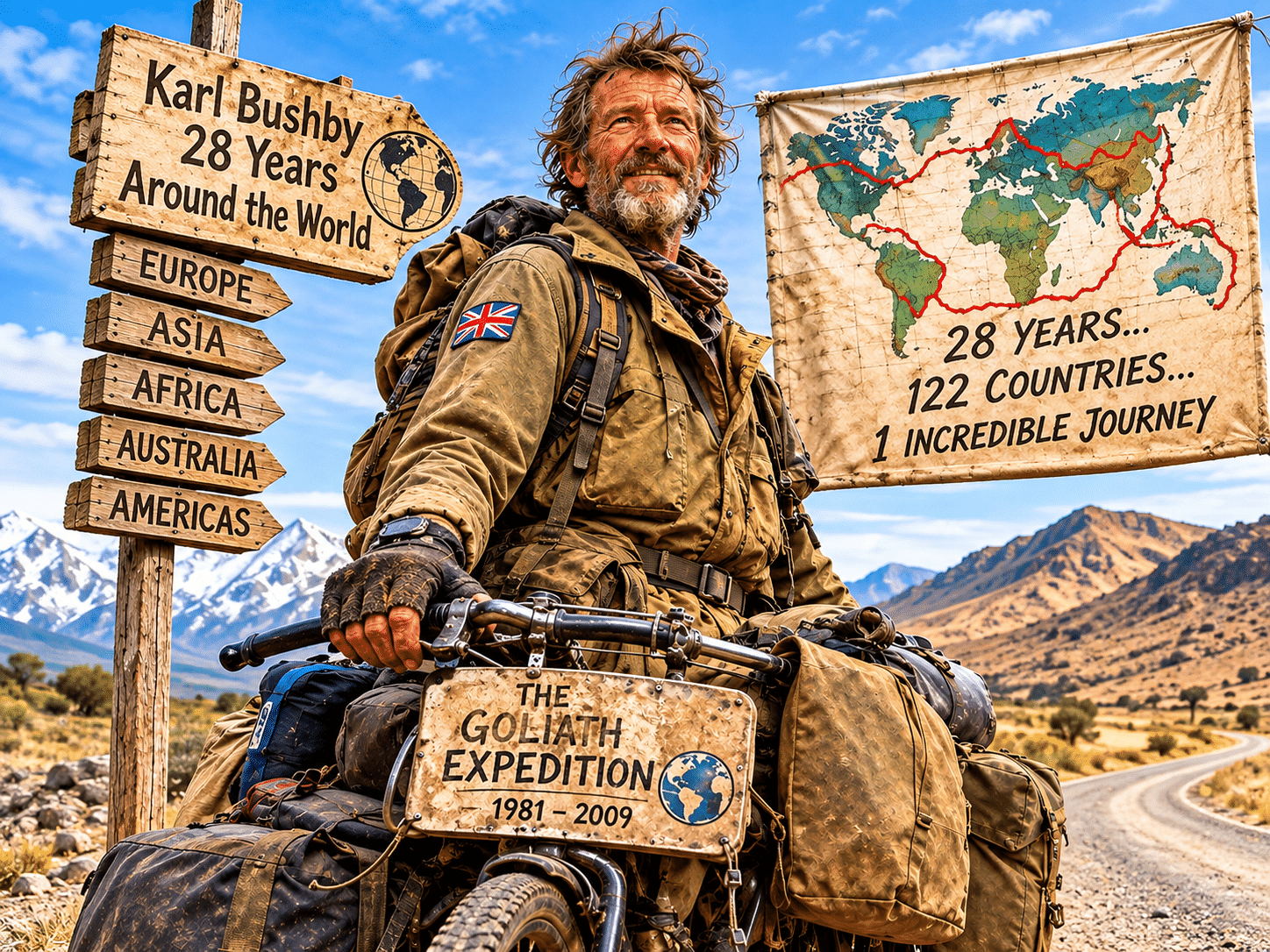
A 28-year journey across continents, jungles, deserts, frozen seas and political borders — driven by one extraordinary promise: to return home without using transport to move forward.
Introduction: A Journey That Challenged the Limits of Human Endurance
Imagine leaving your home with a simple plan: travel to the other side of the world and walk all the way back. No planes, no trains, no buses, no cars to carry you forward. Just your own two feet, a small amount of money, and the determination to keep moving.
For most people, this would sound less like a travel plan and more like an impossible dream. But for British adventurer Karl Bushby, it became a mission that lasted 28 years.
On 1 November 1998, Bushby began his extraordinary journey from Punta Arenas, at the southern tip of Chile. His destination was his home in Hull, England. The expedition became known as the Goliath Expedition, an ambitious attempt to travel around the world on foot without using motorised transport to advance his route.
The journey covered approximately 31,000 miles (50,000 kilometres), crossed four continents and passed through around 30 countries. It involved deserts, mountains, dense rainforests, frozen landscapes, difficult border crossings and some of the most challenging geographical regions on Earth.
But the Goliath Expedition was never simply about walking a long distance. It was about keeping a promise, accepting uncertainty and continuing towards a goal even when the original plan became almost impossible.
By November 2026, Bushby had finally returned to Hull and reunited with his mother, bringing the extraordinary journey to its conclusion. This first part explores the origins of his dream, the rules behind the expedition, the early challenges in South America and the dangerous crossing of the Darién Gap.
1. Who Is Karl Bushby? The Man Behind the Goliath Expedition
Karl Bushby is a British adventurer from Kingston upon Hull, England. Before becoming internationally known for his round-the-world expedition, he served in the British Army’s Parachute Regiment.
His military background helped prepare him for demanding physical environments, long periods of discomfort and situations in which determination matters as much as strength. However, the Goliath Expedition was not a conventional military operation. It was a personal undertaking that required him to make decisions, manage resources and face unpredictable challenges over an extraordinary period.
Bushby was around 28 years old when he began the expedition in 1998. He was not setting out to complete a short endurance challenge or break a simple distance record. His ambition was much bigger: to travel from the southern end of South America to his home in northern England without using transport to move himself forward.
The scale of the challenge was difficult to comprehend. Even if he walked consistently, he would have to cross thousands of kilometres of unfamiliar territory. Some regions would offer established roads and towns, while others would present geographical barriers that could not be overcome by walking alone.
There would also be problems that had little to do with physical endurance: immigration rules, international conflicts, funding, illness, weather and the changing political situation in different countries.
What makes Bushby’s story remarkable is not that every day involved an extraordinary adventure. Much of the expedition consisted of ordinary, repetitive work: walking, repairing equipment, finding food, arranging visas and planning the next section.
That combination of ambition and routine would define the Goliath Expedition for the next 28 years.
Suggested image placement: A documentary-style photograph of Karl Bushby walking with his expedition cart.
Image ALT text: Karl Bushby walking across a remote landscape during his Goliath Expedition around the world.
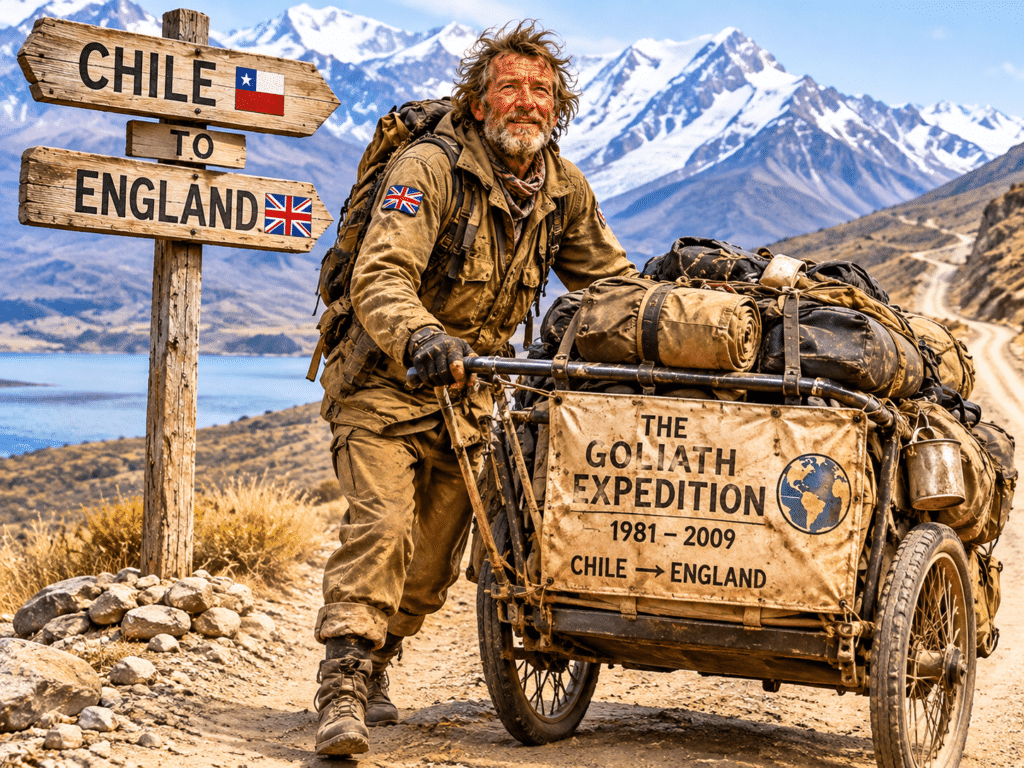
2. The Dream That Started With a Birthday Card
The origins of the Goliath Expedition can be traced to an unusual conversation about geography and human migration.
In the mid-1990s, Bushby’s father, Keith, sent him a birthday card that referred to a discussion involving special forces soldiers. The subject was whether it might be possible to walk from London to New York by travelling over the Bering land bridge between Asia and North America.
The Bering land bridge is associated with prehistoric migration. During periods when sea levels were significantly lower, land connected parts of present-day Siberia and Alaska. Early humans are believed to have used this region to move between Asia and the Americas.
For Bushby, the idea became more than an interesting geographical question. He began considering whether a person could undertake an enormous journey connecting Europe, Asia and North America on foot.
He developed the concept into a route across the continents. Rather than starting in England and walking towards America, he decided to begin in South America and travel north before continuing through North America, Asia and Europe towards home.
The idea was bold, complicated and full of uncertainties. It would involve some of the world’s most difficult terrain and several stretches where ordinary land travel was impossible.
But the central idea had taken hold.
The expedition was eventually named Goliath, reflecting the enormous scale of the challenge. Bushby was not simply planning a long-distance walk; he was attempting a journey that would test the practical limits of travelling around the world without using transport to advance.
The birthday-card story became one of the defining moments in the expedition’s history. A seemingly casual idea had developed into a mission that would shape almost three decades of his life.
Suggested image placement: A map showing the Bering Strait between eastern Russia and Alaska.
Image ALT text: Map of the Bering Strait connecting Siberia and Alaska, a key geographical region in Karl Bushby’s original walking route.
3. The Two Rules That Defined the Goliath Expedition
A journey around the world can be completed in many ways. Travellers can use aeroplanes, ships, trains, bicycles or vehicles. Even expeditions described as walking around the world sometimes rely on transport to cross oceans or bypass inaccessible regions.
Bushby wanted his challenge to follow stricter conditions.
He established two central rules:
Rule 1: No transport to advance the journey.
He could not use a vehicle, aircraft or boat simply to move himself closer to his destination. The expedition had to progress through his own physical effort. Where land routes were unavailable, he would have to find another way to cross the obstacle without breaking the principle of the challenge.
Rule 2: No returning home until the journey was complete.
He would not return to Hull before completing the expedition. The destination was not simply the United Kingdom; it was his home and the family reunion waiting at the end of the route.
These rules made the expedition considerably more difficult than an ordinary long-distance walking challenge.
An ocean could not simply be crossed by booking a flight. A dangerous border could not be bypassed by taking a convenient train. A difficult geographical obstacle could not automatically be solved by boarding a vehicle.
The rules also meant that delays could become enormous. If a country refused permission to enter, Bushby might have to wait months or years. If a route became unsafe, he needed to find an alternative that still respected the expedition’s principles.
The rules were therefore not just motivational statements. They shaped the route, the logistics and almost every major decision.
They also explain why the Goliath Expedition lasted much longer than initially expected.
4. The Beginning: Punta Arenas, Chile — 1 November 1998
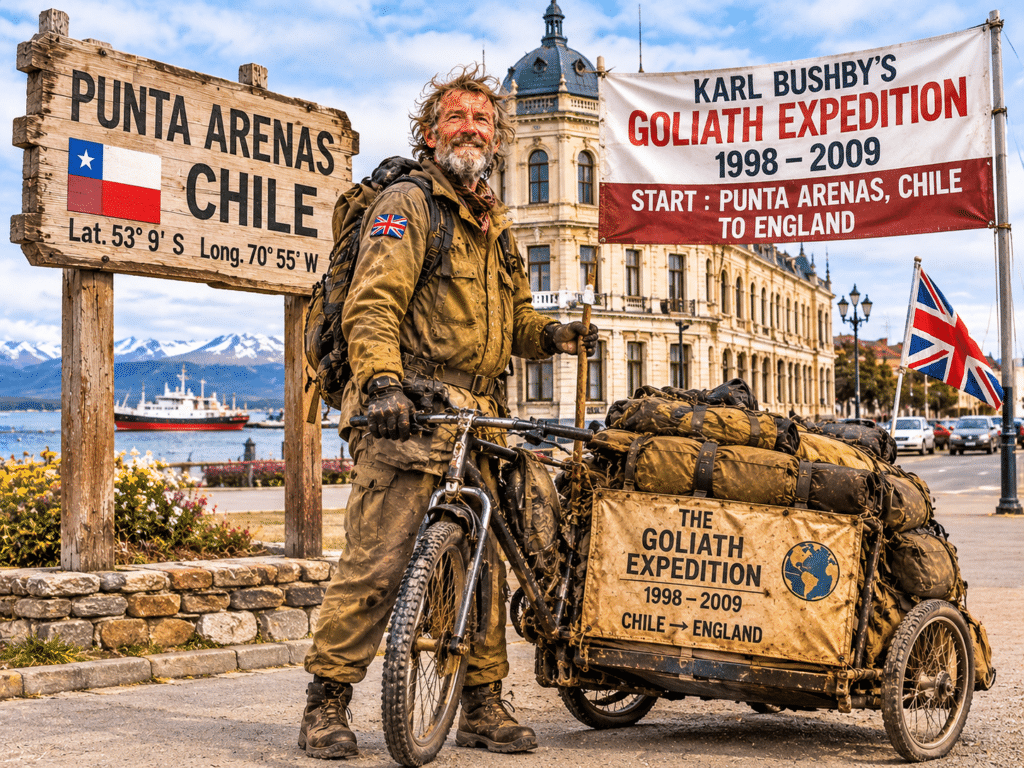
The Goliath Expedition officially began on 1 November 1998 in Punta Arenas, a city near the southern tip of South America.
The location was significant. Punta Arenas sits in the remote Patagonian region, surrounded by dramatic landscapes, strong winds and a climate that can change rapidly. It was a challenging place to begin a journey that would eventually cross much of the planet.
Bushby started with approximately $500 and limited resources. He did not have the enormous financial backing that a major international expedition might normally require. In the early stages, he had to depend on careful spending, practical decisions and assistance from people he encountered along the way.
The first days were a test of whether the idea could survive contact with reality.
The Patagonian landscape is famous for its powerful winds. Walking across exposed terrain with equipment is difficult even under favourable conditions. Strong gusts can make forward progress exhausting, while sudden changes in weather can turn a manageable day into a serious challenge.
Bushby had to establish a sustainable routine. He needed to carry equipment, manage food and water, maintain his belongings and decide how far he could travel each day.
The beginning of the expedition also required a psychological adjustment. It is one thing to imagine walking around the world; it is another to wake up every morning knowing that the journey has barely begun and that thousands of kilometres remain.
There was no quick finish line. There was only the next road, the next settlement and the next stretch of ground.
The journey had officially started, but its most difficult tests were still ahead.
Suggested image placement: A wide landscape photograph of Patagonia, showing the open terrain and distant mountains.
Image ALT text: The remote Patagonian landscape near Punta Arenas, Chile, where Karl Bushby began the Goliath Expedition in November 1998.
5. Life on the Road: The Reality Behind an Extraordinary Expedition
The public image of a world expedition often focuses on spectacular scenery, dramatic encounters and record-breaking achievements. The daily reality is usually much less glamorous.
For Bushby, life on the road meant dealing with the practical problems that appear every day during a long journey.
He needed to find food, locate water, maintain his equipment and identify safe places to rest. His belongings had to be carried or transported in a way that did not violate his expedition rules. His route needed to be planned around roads, terrain, borders and local conditions.
Over time, his equipment included a heavy-duty expedition cart known as The Beast. It became one of the most recognisable parts of his journey, carrying essential supplies and accompanying him across enormous distances.
A cart might sound like a simple solution, but it introduces its own problems. Wheels can puncture, components can break and rough terrain can make movement difficult. A damaged cart can threaten the entire day’s progress.
There were also long periods of isolation. Walking for hours through remote landscapes means spending considerable time alone with one’s thoughts. The physical effort is repetitive, and the psychological challenge can be just as demanding as the terrain.
Bushby later explained that the journey was not simply a matter of walking continuously for 28 years. He spent significant periods dealing with visas, political restrictions, funding difficulties and other delays. In a 2026 interview, he described the less glamorous side of expedition life: everyday maintenance, finding somewhere to wash clothes and continuing through poor weather.
This is an important part of understanding the Goliath Expedition. The achievement was not built only on moments of courage. It depended on thousands of ordinary decisions made consistently over many years.
6. The Darién Gap: One of the Most Dangerous Sections of the Route
One of the most difficult geographical obstacles on Bushby’s route was the Darién Gap, a vast and challenging region of rainforest, mountains and swamps between Panama and Colombia.
The Darién Gap is notorious because it lacks a continuous road connection between Central and South America. Its difficult terrain, dense vegetation and limited infrastructure make it extremely challenging to cross.
The region has also been associated with criminal activity, armed groups, dangerous wildlife and serious security risks. It is not an ordinary hiking destination.
Bushby entered this environment during the early phase of the expedition. The crossing required him to deal with dense jungle, difficult terrain and the presence of armed groups.
Bushby described disguising himself as a vagrant to avoid attracting attention. The journey from Medellín towards Panama City took approximately two months, including an 18-day period in detention near the Panamanian border.
The experience demonstrated how quickly the Goliath Expedition could move beyond the familiar challenges of walking.
In a remote jungle, the most important decision might not be how far to walk in a day. It might be whether to continue along a particular route, how to avoid dangerous encounters or how to communicate with people who control access to the region.
Bushby also reportedly provided a hand-drawn map of militia positions and checkpoints to a Panamanian police intelligence officer, helping authorities understand the situation in the area.
The Darién Gap became one of the expedition’s defining early tests. It was a reminder that the world is not connected by easy walking routes and that an ambitious geographical plan can involve serious risks.
Suggested image placement: Aerial photograph of the dense rainforest and mountainous terrain of the Darién Gap.
Image ALT text: Dense tropical rainforest in the Darién Gap between Colombia and Panama, one of the most challenging regions on Karl Bushby’s route.
7. Detention, Danger and the Importance of Human Help
The Goliath Expedition repeatedly brought Bushby into situations where physical endurance alone was not enough.
The Darién crossing exposed him to security risks and complicated interactions with local authorities. His detention near the Panamanian border was a particularly difficult episode.
Being detained during a long-distance expedition can create several problems at once. It interrupts progress, creates uncertainty about the next stage and can make it difficult to protect equipment or arrange onward travel.
For Bushby, the challenge was especially complicated because he could not simply abandon his route and use conventional transport to continue.
The experience also highlights a recurring theme in his story: the importance of other people.
A journey of this scale might appear to be a solo achievement, but it could never be completed entirely alone. Bushby depended on assistance from people who offered food, accommodation, practical support and advice.
He was welcomed by families in extremely modest homes, helped by people who had very little to spare and supported by strangers across different countries. He also received medical help during periods of illness.
These encounters changed the meaning of the expedition. It was still a personal mission, but its success depended on a worldwide network of human kindness.
The Goliath Expedition therefore tells two stories at the same time: one about an individual’s determination to keep moving, and another about the generosity of people who helped him continue.
8. The Journey Through the Americas: More Than a Test of Distance
The Americas represented a huge part of the Goliath Expedition. From the southern tip of Chile, Bushby needed to make his way north through South America, Central America and eventually North America.
This was not a straightforward route.
South America contains enormous geographical variety. The Patagonian plains, mountain regions, deserts, tropical forests and densely populated cities all require different approaches to travel.
Central America presented further complications. The Darién Gap was a major obstacle, while border crossings and changing political conditions created additional uncertainty.
Even after reaching North America, the journey was far from complete. Bushby’s original concept depended on continuing towards Alaska and the Bering Strait before moving into Asia.
The Americas were therefore not just the first continent-sized section of the expedition. They were the foundation of the route that would eventually connect the southern hemisphere to Europe.
The scale of the journey also made time difficult to measure. A distance that might look manageable on a map could take months to complete when the traveller had to walk, rest, find supplies and deal with border restrictions.
Bushby’s expedition eventually covered approximately 31,000 miles, according to the revised figure reported in 2026.
That figure illustrates the enormous physical scale of the achievement. But the distance alone does not capture the full difficulty. The route also involved repeated periods of waiting, uncertainty and adaptation.
9. The Long Delays: Money, Politics and the Passage of Time
The original plan was ambitious, but Bushby’s journey took much longer than expected.
The expedition was affected by financial difficulties, changing sponsorship arrangements, illness, visa restrictions and international events. The global financial crisis of 2008 weakened the funding environment, while the COVID-19 pandemic later disrupted international travel and movement.
Political developments also complicated the route. Some borders were difficult to cross, and permission to enter certain countries could take a long time to secure.
The most striking example came later in the expedition, when Bushby’s progress through Russia became a major logistical challenge. Visa restrictions and geopolitical developments contributed to long delays before he could continue.
The important point is that the Goliath Expedition did not involve 28 years of uninterrupted walking. In a 2026 interview, Bushby said that he had spent only around 15 of those years actively walking, with much of the remaining time taken up by visas, geopolitics and other interruptions.
This distinction matters because it reveals the true nature of the challenge.
Walking was only one part of the mission. The other part was keeping the expedition alive when progress stopped.
A person can prepare for physical exhaustion, but it is much harder to prepare for years of uncertainty. Funding may disappear. A border may close. A political situation may change. A route that seemed possible may suddenly become inaccessible.
Bushby’s determination was tested not only by the distance ahead but also by the time spent waiting to move again.
10. The Road Ahead: North America, Alaska and the Bering Strait
The next major stage of the Goliath Expedition would take Bushby through North America towards Alaska and the Bering Strait.
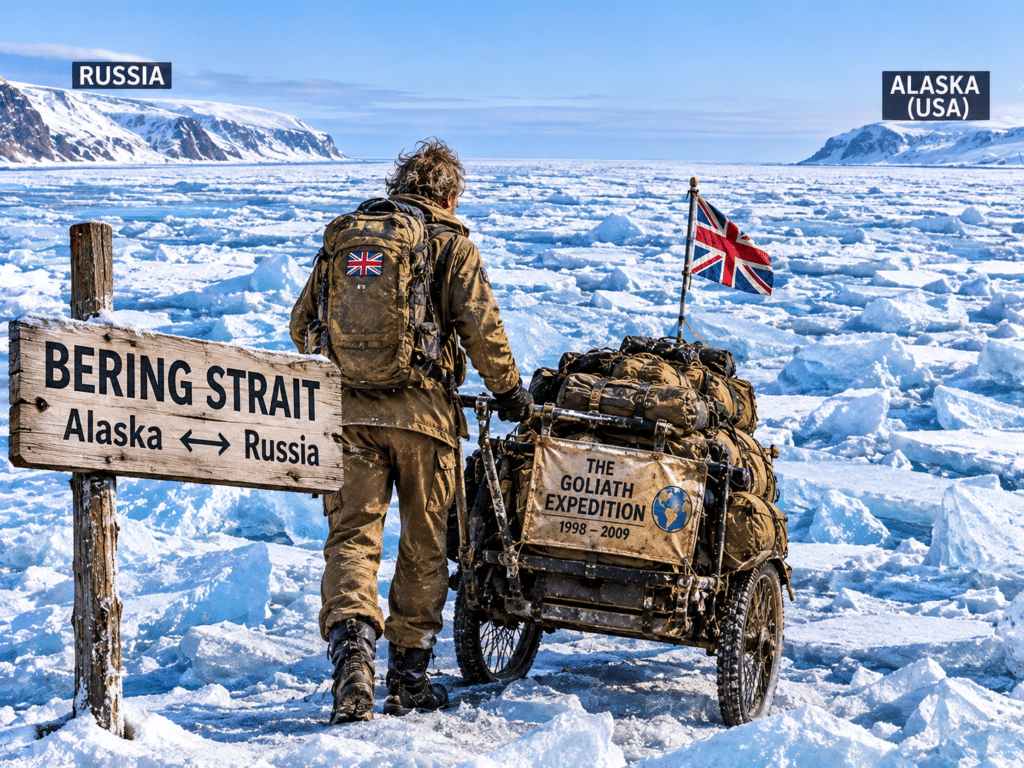
The Bering Strait separates eastern Russia from western Alaska. It is one of the most important geographical features in the expedition because it represents the connection between the continents of North America and Asia.
Crossing the region on foot would be an extraordinary challenge. The weather is severe, the sea ice is unstable and conditions can change rapidly. A route that appears possible on a map may be extremely dangerous in reality.
Bushby’s later journey through the region involved navigating shifting ice and facing the threat of polar bears. He was rescued by helicopter from an ice floe drifting out to sea.
This was a crucial reminder that the expedition’s rules did not make the journey safe or simple. They forced Bushby to find ways to overcome obstacles that most travellers would solve by using conventional transport.
The Bering crossing would eventually become one of the most dramatic chapters of the Goliath Expedition. It would take him from the Americas towards Russia and open the next major phase of the journey across Asia.
But that part of the story deserves its own chapter.
Key Timeline: The Goliath Expedition
| Year / Date | Milestone |
|---|---|
| Mid-1990s | The idea develops after a birthday-card story from Bushby’s father |
| 1 November 1998 | Bushby begins the expedition in Punta Arenas, Chile |
| Early 2000s | He makes his way north through South America and faces the Darién Gap |
| 2000s | The expedition encounters financial, logistical and political difficulties |
| 2006 | Bushby crosses the Bering Strait region, facing dangerous ice conditions |
| 2008 | The global financial crisis affects expedition funding |
| 2020 | COVID-19 creates further delays |
| 2024 | Bushby and his team swim across the Caspian Sea |
| 25 April 2025 | He reaches Istanbul, Turkey |
| 5 October 2026 | He reaches British soil at Shakespeare Beach near Dover after swimming the English Channel |
| 2 November 2026 | He arrives home in Hull and reunites with his mother |
Conclusion: One Man, One Promise and 28 Years of Determination
The early chapters of Karl Bushby’s Goliath Expedition reveal that extraordinary achievements are rarely created by physical strength alone.
His journey began with an unusual idea inspired by a conversation about geography and human migration. It developed into a mission governed by two strict rules: no transport to advance the route and no returning home before completing the journey.
From the windswept landscapes of Patagonia to the dangerous jungle of the Darién Gap, Bushby faced challenges that could have ended the expedition many times. Financial problems, detention, political restrictions and years of waiting made the journey far more complicated than a simple walk around the world.
Yet the expedition continued.
The story also reveals something beyond individual determination: the importance of human kindness. People from different countries and backgrounds helped Bushby with food, accommodation, medical assistance and encouragement. His achievement was personal, but it was supported by countless people.
On 2 November 2026, after 28 years, Bushby finally returned to Hull and embraced his mother, completing the promise that had taken him across four continents and approximately 31,000 miles.
But the Goliath Expedition was not just about reaching a destination. It was about what happens when a person refuses to abandon a goal, even when the world keeps changing around them.
11. North America – The Long Walk Across the Continent
After making his way through South America, Central America and the challenging Darién Gap, Karl Bushby’s journey continued towards North America. This was not simply another stage of his walk. It was a major geographical and physical challenge on the way to Alaska and the Bering Strait.
North America has an extraordinary variety of landscapes. Its southern regions include hot and dry areas, while the central parts contain enormous plains, forests and mountain ranges. Further north, the climate becomes increasingly severe, with long winters and extensive snow-covered regions.
For Bushby, the main objective was to keep moving north. His ultimate destination was Alaska, from where he planned to cross the Bering Strait and enter Russia.
Walking across such a vast continent required careful planning. He had to consider the weather, the availability of food and water, suitable places to rest and the condition of the roads and tracks. His expedition trolley, known as The Beast, was an important part of the journey. It carried essential equipment and supplies, but pulling it over long distances added another physical burden.
A long-distance expedition also involves countless practical problems. Equipment can break, wheels can become damaged, weather can change unexpectedly and routes that appear straightforward on a map can turn out to be difficult in reality.
Bushby also had to manage immigration rules and the time limits associated with visas. In some countries, he could not simply remain indefinitely while making progress at his own pace. He had to organise his journey around administrative requirements as well as geographical conditions.
North America was gradually taking him towards one of the most dangerous and historic stages of the Goliath Expedition.
Suggested image placement: A wide photograph of an open North American landscape or a long road leading towards Alaska.
SEO ALT text: Karl Bushby walking across North America during the Goliath Expedition towards Alaska and the Bering Strait.
12. Alaska – Moving Towards the Frozen Wilderness
As Bushby approached the northern reaches of North America, Alaska became the next major challenge.
Alaska is not an ordinary destination for a long-distance walker. Winter temperatures can fall dramatically, powerful winds sweep across exposed landscapes, and snow can make navigation difficult. Even experienced travellers need to prepare carefully before entering its remote regions.
The western part of Alaska, particularly the Seward Peninsula and the area around Nome, is geographically important for anyone travelling towards the Bering Strait. Across the water lies eastern Russia. The Diomede Islands, situated between Alaska and Siberia, provide a striking reminder of how close the two continents are.
However, the short geographical distance between Alaska and Russia does not make the crossing easy.
The Bering Strait is covered by sea ice during parts of the winter, but this ice is not a stable platform like solid ground. Ocean currents, wind and changing temperatures constantly affect its movement. Large sections can crack, drift apart or collide, creating dangerous ridges and openings of seawater.
Bushby needed to understand these conditions before attempting the crossing. His expedition was about walking around the world, but the Bering Strait presented a challenge that ordinary walking equipment could not solve.
He planned the crossing with French-American adventurer Dimitri Kieffer. Both men understood that they would face freezing temperatures, unstable ice, open water and unpredictable weather.
Alaska was therefore more than another region on the map. It was the gateway to a crossing that could determine whether the original vision of the Goliath Expedition was possible.
Suggested image placement: A photograph of Alaska’s western coastline, with snow-covered ground and frozen sea in the distance.
SEO ALT text: Snow-covered Alaska coastline near the Bering Strait, where Karl Bushby prepared for his historic crossing to Russia.
13. The Bering Strait – The Dangerous Frozen Route from Alaska to Russia
One of the most remarkable chapters of the Goliath Expedition was the Bering Strait crossing.
The Bering Strait separates Alaska in North America from the Chukotka region of eastern Russia. Two important islands lie within it: Big Diomede, which belongs to Russia, and Little Diomede, which belongs to the United States.
Although the distance between the islands is relatively short, the surrounding sea can be extremely dangerous.
During winter, parts of the Bering Strait freeze over. However, sea ice is constantly affected by currents and wind. It can move, crack, separate and pile up into enormous ridges. A route that appears solid one day may become impassable the next.
March 2006: A historic crossing
In March 2006, Karl Bushby and Dimitri Kieffer began their attempt to cross the frozen Bering Strait from Alaska towards Russia.
According to the expedition’s account, the crossing took place between 17 and 31 March.
The beginning was extremely difficult. Strong currents carried the men approximately 50 miles north of their intended route. They encountered large areas of open water and constantly shifting ice. At several points, the conditions threatened to end the expedition.
Then the weather changed.
The direction of the currents shifted, the wind became calmer and temperatures dropped sharply, reaching approximately minus 35 degrees Celsius. Some of the softer ice began to freeze more firmly, creating conditions that allowed the men to continue.
But this did not make the crossing safe. They still had to assess the ice at every stage. The surface beneath their feet could move or break apart, and the ice on which they rested at night was not necessarily stable.
The expedition’s account describes a crossing of roughly 58 miles in a straight geographical sense. However, because of drifting ice and the need to navigate around obstacles, Bushby and Kieffer travelled a much longer route of approximately 150 miles. The crossing took 14 days.
Eventually, they reached the Russian side.
This was a defining moment in the Goliath Expedition. Bushby had successfully moved from North America into Asia without using a conventional vehicle or aircraft to advance his route.
Why was the Bering Strait crossing so dangerous?
- Moving sea ice: Ocean currents constantly shift the ice, making it difficult to rely on a fixed route.
- Open water: Large gaps can appear between sections of ice, forcing travellers to find another way forward.
- Extreme cold: Temperatures can fall below minus 30 degrees Celsius, making it difficult to maintain body heat.
- Ice ridges: Broken sections of ice can pile up into large barriers that are difficult to cross.
- Polar bears: The region is part of the natural habitat of polar bears, adding another potential danger.
The Bering Strait crossing was not simply a matter of walking across a frozen sea. It required constant risk assessment, patience and the ability to adapt to rapidly changing natural conditions.
For Bushby, it was one of the most important achievements of the entire expedition.
Suggested image placement: Two explorers walking across frozen sea ice in the Bering Strait.
SEO ALT text: Karl Bushby and Dimitri Kieffer crossing the frozen Bering Strait from Alaska to Russia in March 2006.
14. Entering Russia – A New Continent and a New Set of Challenges
After crossing the Bering Strait, Bushby entered Russia’s Chukotka region. This is one of the country’s most remote areas, located in the far northeast, where settlements are small and distances between communities can be enormous.
Reaching Russia was not only a geographical achievement. It also meant entering a new political and administrative environment.
After crossing an international border, Bushby needed to deal with local authorities, permissions and arrangements for continuing his journey. Remote border regions can have additional restrictions, particularly where military or security considerations are involved.
One important location was Uelen, a small coastal settlement in Chukotka. It is among the easternmost inhabited settlements in Russia and lies close to the Bering Strait.
Reaching Uelen marked an important milestone. Bushby had crossed from Alaska into Russia and could now begin the next major stage of his journey across Asia.
But the challenges were changing.
In Alaska, the main obstacle had been unstable sea ice. In Russia, he faced a vast landmass, limited infrastructure, remote settlements and complicated administrative requirements.
Some parts of Russia require special permissions for foreign visitors, particularly in border areas. Travellers may need to coordinate with local authorities and comply with specific entry and registration rules.
Bushby’s later journey through Russia became increasingly complicated because of visa and entry restrictions. In 2012, he was refused a Russian visa, preventing him from continuing along his planned route.
This kind of interruption was particularly difficult for someone whose expedition depended on continuous geographical progress.
Russia had opened the door to a new continent, but it would also become one of the greatest administrative challenges of the Goliath Expedition.
Suggested image placement: A photograph of Uelen village or the remote, snow-covered coastline of eastern Russia.
SEO ALT text: Remote Uelen settlement in Russia’s Chukotka region, where Karl Bushby arrived after crossing the Bering Strait.
15. Siberia – Cold, Distance, Isolation and Extreme Conditions
The name Siberia often brings to mind endless forests, frozen rivers, snow-covered roads and extremely low temperatures. It is one of the largest geographical regions in the world, and its enormous size makes travelling across it a serious undertaking.
For Karl Bushby, Siberia represented a different kind of challenge from the Bering Strait.
After crossing into Russia, he needed to continue westwards across a vast territory. The distances between settlements could be considerable, and the availability of supplies and assistance varied from one region to another.
There were several major difficulties.
The weather
Siberian winters can be extremely cold. Freezing winds, snow-covered ground and limited daylight make long-distance walking difficult. Even equipment designed for outdoor travel can become less reliable in severe conditions.
Summer brings a different set of problems. In some remote areas, melting snow creates muddy or marshy ground. Insects and changing weather can also make travel uncomfortable.
Distance and isolation
In many parts of Siberia, settlements are far apart. Food, water, fuel and repair facilities may not be readily available.
A traveller must plan carefully, estimating how long it will take to reach the next settlement and carrying enough supplies to manage unexpected delays.
Equipment and maintenance
Cold weather places additional demands on clothing, footwear, batteries and communication equipment. The expedition trolley also needed regular maintenance.
A broken wheel or damaged component could create serious problems in a remote area where replacement parts were difficult to find.
The psychological challenge
Isolation can be as demanding as physical exhaustion.
Walking for long periods through empty landscapes, dealing with severe weather and waiting for conditions to improve can create enormous mental pressure. The traveller must remain focused even when there are few visible signs of progress.
Bushby had to adapt his plans to these conditions. He could not simply decide how many kilometres to walk each day. Weather, terrain and the availability of supplies all influenced his decisions.
Siberia demonstrated that the Goliath Expedition was not defined by one dramatic event. Much of its difficulty came from the repeated effort required to keep moving through an enormous and often unforgiving landscape.
Suggested image placement: A photograph of a remote Siberian road or a forest covered in deep winter snow.
SEO ALT text: Vast snowy wilderness in Siberia, illustrating the extreme cold and isolation Karl Bushby faced during his Russia journey.
16. The Journey Through Asia – Different Countries, Cultures and Landscapes
As Bushby’s route continued westwards, his journey took him through the enormous and diverse continent of Asia.
Asia is one of the most geographically varied regions on Earth. It includes frozen landscapes, deserts, high mountain ranges, open grasslands and densely populated cities.
For Bushby, travelling through Asia meant adapting not only to different environments but also to different languages, cultures, customs and administrative systems.
Central Asia became particularly important to the Goliath Expedition.
Countries such as Kazakhstan contain enormous open spaces, with long distances between towns and settlements. Travelling through these regions requires careful planning, especially when it comes to food, water and equipment.
The landscape can change dramatically. A traveller may move through wide grasslands, dry regions and remote rural areas before reaching a major city.
Local hospitality also played an important role in the experience. During a journey of this length, assistance from strangers can make an enormous difference. A meal, a place to rest, practical advice or help with repairs can help keep an expedition moving.
However, the administrative challenges never disappeared.
Each country had its own immigration rules, visa requirements and limits on how long a foreign traveller could remain. Bushby had to organise his progress around these restrictions.
By 2019, he had travelled through several countries in Central Asia. However, the COVID-19 pandemic and changing geopolitical conditions later disrupted his plans.
The journey across Asia was therefore not just a test of distance. It required constant adaptation to different environments, societies and national regulations.
A line drawn across a map may make the route look simple. Walking that line is an entirely different experience.
Suggested image placement: A wide landscape photograph of Kazakhstan’s open grasslands or a remote Central Asian mountain route.
SEO ALT text: Central Asian landscape along Karl Bushby’s walking route during the Goliath Expedition across Asia.
17. Border Challenges – Visas, Permissions and International Restrictions
One of the biggest challenges of the Goliath Expedition was crossing international borders.
For an ordinary traveller, a visa problem may be an inconvenience. For Bushby, it could bring his entire expedition to a standstill.
His central rule was that he could not use motorised transport to advance his journey. If a country refused him entry, he could not simply book a flight or take a bus to continue from another location.
He had to wait, negotiate or find another route that respected the principles of the expedition.
Russian visa difficulties
Russia became one of the most significant administrative obstacles.
In 2012, Bushby was refused a Russian visa, preventing him from continuing along his planned route. This was not a minor delay. It affected the wider journey and forced him to reconsider how he could make progress.
For an expedition that had already taken many years, an unexpected refusal could be devastating.
Political changes and restricted routes
International travel depends on more than geography. Political developments, security restrictions and diplomatic relations can determine whether a particular route is accessible.
As the years passed, the political situation in parts of the region changed. Routes that had once appeared possible became difficult or impractical.
Bushby eventually faced the problem of finding a way towards Europe without relying on the routes through Russia and Iran that had become unavailable to him.
The conflict between expedition rules and reality
Bushby could not simply enter a restricted country without permission. Nor could he ignore immigration laws to keep his walking schedule.
He therefore had to accept long periods of waiting and repeatedly reconsider his plans.
The experience revealed an important truth about international expeditions: geographical distance is only one part of the challenge. Borders, government permissions and diplomatic conditions can be just as important as mountains, rivers or deserts.
Sometimes the biggest obstacle on a journey is not a physical barrier. It is a document that may take months or even years to obtain.
Suggested image placement: An international border checkpoint, passport-control area or remote border crossing.
SEO ALT text: International border checkpoint representing the visa and permit challenges faced by Karl Bushby during his Goliath Expedition.
18. The Caspian Sea – The Extraordinary Challenge of Swimming Across It
One of the most extraordinary chapters of the Goliath Expedition was Bushby’s attempt to cross the Caspian Sea by swimming.
This challenge emerged because several land routes towards Europe were no longer practical. Bushby was in Kazakhstan and needed to continue westwards. With his original options restricted, crossing the Caspian Sea became an alternative.
The Caspian Sea is the world’s largest inland body of water. Although it is called a sea, it is not directly connected to the world’s oceans. Its coastline is shared by five countries: Kazakhstan, Turkmenistan, Iran, Azerbaijan and Russia.
Its enormous size makes crossing it a serious undertaking. Weather, waves, water temperature, currents and shipping activity all create potential dangers.
2024: More than a month in the water
In 2024, Bushby undertook the crossing with two experienced Azerbaijani swimmers.
The challenge lasted more than 30 days. Later reporting by the BBC described it as a 31-day swim, making it one of the most remarkable physical achievements of the entire expedition.
Support boats accompanied the swimmers throughout the crossing. These vessels provided essential safety assistance and practical support during the long journey.
Swimming for such an extended period requires extraordinary physical preparation and mental discipline.
The swimmers had to manage fatigue, changing weather, the condition of the water and the physical strain of spending so much time at sea. They also needed to maintain a carefully organised support system.
It is important to understand how this fitted into the Goliath Expedition’s rules. Bushby’s central principle was that he would not use motorised transport to advance his journey. Swimming across the sea allowed him to continue under his own physical effort, while the accompanying boats provided support and safety.
After completing the crossing, Bushby reached Azerbaijan, bringing Europe considerably closer.
Why was the Caspian Sea crossing so significant?
- Distance: The sea is enormous, and crossing it requires sustained physical effort.
- Weather: Conditions can change, making long-distance swimming unpredictable.
- Physical exhaustion: More than a month of swimming places extraordinary demands on the body.
- Safety: Support boats and careful coordination are essential during such an undertaking.
- Expedition rules: Swimming allowed Bushby to overcome a major geographical obstacle without using a motorised vehicle to advance his route.
The Caspian Sea crossing was particularly remarkable because it followed another extraordinary achievement: the frozen Bering Strait crossing.
One had involved walking across unstable sea ice in extreme cold. The other required swimming across a vast inland sea for more than a month.
Both demonstrated the same determination: when the original route became impossible, Bushby searched for another way to continue.
Suggested image placement: A photograph of swimmers in the Caspian Sea with support boats nearby.
SEO ALT text: Karl Bushby swimming across the Caspian Sea in 2024 with support from experienced Azerbaijani swimmers and escort boats.
19. Expedition Delays – The Long Waits That Nearly Stopped the Journey
Karl Bushby’s journey took 28 years, but distance alone does not explain why it lasted so long.
The expedition was repeatedly affected by financial difficulties, visa restrictions, political changes, illness and major international events.
When Bushby first planned the Goliath Expedition, he hoped to complete it in approximately 12 years. The actual journey became far longer and more complicated.
Financial difficulties and sponsorship problems
The global financial crisis of 2007–2008 affected the expedition’s financial arrangements.
A project of this scale requires money for equipment, food, accommodation, communications, repairs and logistical planning. Without reliable financial support, even a physically capable traveller can struggle to continue.
Bushby experienced periods when sponsorship and financial assistance became difficult to secure.
Keeping the expedition alive during these periods required determination and careful planning. He needed to find ways to support himself without abandoning the journey.
Visa restrictions and administrative delays
Visa problems were among the most frustrating obstacles.
A traveller may be physically ready to continue, but without permission to enter the next country, progress becomes impossible.
Bushby experienced this problem repeatedly, particularly during his journey through Russia and neighbouring regions.
Some delays lasted far longer than expected. The expedition could not simply move forward while waiting for official decisions.
The COVID-19 pandemic
In 2020, the COVID-19 pandemic disrupted international travel across the world.
Countries closed borders, introduced restrictions and changed their immigration procedures. Even travellers with existing plans found themselves unable to move freely.
For Bushby, the pandemic created another major interruption in an expedition that had already experienced years of delays.
Changing geopolitical conditions
Political developments also affected the route towards Europe.
The original plan had depended on travelling across Asia and continuing westwards. However, changing international conditions made some of the intended routes increasingly difficult.
The Caspian Sea crossing eventually became an important alternative.
Did Bushby really walk continuously for 28 years?
No. This is an important distinction.
In a 2026 interview, Bushby explained that he had spent approximately 15 years actively walking during the 28-year expedition. Much of the remaining time involved waiting for visas, dealing with political restrictions, arranging logistics and overcoming other interruptions.
This detail helps explain the real nature of the Goliath Expedition.
Walking thousands of kilometres is physically demanding. But keeping a journey alive for decades, especially when progress repeatedly stops, requires another kind of endurance.
A traveller can prepare for tired muscles, bad weather and difficult terrain. It is much harder to prepare for years of uncertainty.
Financial support can disappear. Borders can close. Political circumstances can change. A route that seemed possible one year may become inaccessible the next.
Bushby’s determination was tested not only by the distance ahead but also by the long periods when he could not move forward.
Suggested image placement: Karl Bushby with his expedition trolley on a remote road, representing the long years of travel and delays.
SEO ALT text: Karl Bushby pushing The Beast expedition trolley during the difficult and delayed stages of his Goliath Expedition.
20. Conclusion – A Traveller Moving Closer to Europe and Home
After crossing the Caspian Sea, Karl Bushby’s journey entered another decisive phase.
For years, he had travelled through the enormous landscapes of Asia, crossed difficult borders and waited through lengthy interruptions. Now, Europe was finally within reach.
In 2025, Bushby reached Istanbul, Turkey, and crossed the Bosporus into European territory.
Istanbul has a unique geographical position. It lies across both Europe and Asia, with the Bosporus Strait separating its two continental sides.
For Bushby, reaching Istanbul was much more than arriving in another city. It meant that he had finally returned to the continent where his journey would eventually end.
But his home in Hull, England, was still hundreds of kilometres away.
He needed to continue through Europe, travel towards France and find a way to cross the English Channel before reaching the United Kingdom.
The final stages would bring their own complications.
The English Channel problem
One possible option was to use the Channel Tunnel’s service infrastructure. However, Bushby’s attempt to obtain permission to travel through the tunnel on foot with his expedition equipment was unsuccessful.
This created another major problem.
His expedition rules did not allow him to use a conventional vehicle to advance his route. Therefore, he needed another way to cross the English Channel.
The solution would be extraordinary: he would have to swim.
The English Channel is a busy and challenging stretch of water. Its strong currents, cold temperatures and heavy maritime traffic make it a serious undertaking even for experienced long-distance swimmers.
After 28 years of walking across continents, Bushby was approaching the final obstacle between himself and home.
Part 2: Important Timeline
| Year / Date | Major milestone |
|---|---|
| March 2006 | Karl Bushby and Dimitri Kieffer complete their frozen Bering Strait crossing |
| After 2006 | Bushby continues through Russia’s Chukotka region and towards Siberia |
| 2012 | Russian visa difficulties create a major interruption |
| By 2019 | He has travelled through several countries in Central Asia |
| 2020 | The COVID-19 pandemic disrupts international travel |
| 2024 | Bushby completes the Caspian Sea crossing after approximately 31 days of swimming |
| 25 April 2025 | He reaches Istanbul and enters the European stage of the journey |
| 2026 | He continues through Europe towards France and the English Channel |
Conclusion: The Final Destination Was Finally Within Reach
This part of Karl Bushby’s Goliath Expedition demonstrates that walking around the world involves far more than counting kilometres.
The journey through North America and Alaska, the dangerous frozen Bering Strait, the vast territory of Russia, the isolation of Siberia, the international borders of Central Asia and the extraordinary Caspian Sea swim all demanded different skills.
Sometimes Bushby had to walk across frozen terrain. At other times, he had to travel through remote landscapes, manage difficult weather or wait for permission to cross a national border.
His journey also showed that geography and politics cannot be separated. A route may exist on a map, but that does not mean it is accessible. Crossing it may require permission, resources, careful planning and extraordinary patience.
By reaching Istanbul in 2025, Bushby had finally entered Europe. In 2026, he continued through Belgium and France towards the English Channel.
The traveller who had left Chile in 1998 was now approaching the final stage of his extraordinary journey.
But one enormous challenge remained.
Could he cross the English Channel without breaking the rules that had defined the Goliath Expedition for nearly three decades?
The Final Journey Home: 28 Years, 31,000 Miles and One Unbreakable Promise
On 1 November 1998, Karl Bushby set out from Punta Arenas, at the southern tip of Chile, with an extraordinary ambition: to walk all the way back to his home in Hull, England. He gave himself two rules that would define the next 28 years of his life: he would not use motorised transport to make progress along his route, and he would not return home until he could arrive on foot.
By October 2026, the journey had reached its final geographical obstacle: the English Channel. After completing the crossing from France to England, Bushby still had hundreds of kilometres to cover before reaching Hull. On 2 November 2026, he finally arrived at his mother’s home, bringing the Goliath Expedition to an end.
This final part follows that last stretch, examines the realities behind the extraordinary achievement, and separates what Bushby actually walked from the distances he covered by swimming or other permitted means. It also looks at the people, funding, practical decisions and everyday difficulties that kept the expedition alive for nearly three decades. CBS News+2
21. Europe: The Long Road Finally Leads Towards Home
After completing the Caspian Sea crossing in 2024, Bushby stepped ashore in Azerbaijan. The expedition had entered another decisive phase. For years, the route had been shaped by borders, visa restrictions, political tensions and geographical obstacles. Now, the direction was unmistakable: westwards, towards Europe and eventually the United Kingdom.
On 10 November 2024, Bushby began walking out of Baku, Azerbaijan. His next major objective was Istanbul, the historic city connecting Asia and Europe. The route took him through Azerbaijan, Georgia and Turkey. It was not simply a journey between cities; it was the final continental passage of an expedition that had begun at the southern end of South America.
On 25 April 2025, he reached Istanbul. The city represented a symbolic turning point. For the first time in decades, Bushby was standing at the gateway between Asia and Europe, with his childhood home now on the same continent.
The Bosphorus, however, presented one more unusual challenge. The strait separates the European and Asian sides of Istanbul, and crossing its bridges on foot is generally restricted. Bushby obtained special permission to cross the 15 July Martyrs Bridge, formerly known as the Bosphorus Bridge. A week after arriving in Istanbul, he walked across it and stepped onto the European side.
The moment carried a significance that a normal tourist crossing could never have had. For Bushby, it was another section of the continuous line he had drawn on a map years earlier. Europe was no longer an abstract destination. It was the land beneath his feet.
The expedition’s official website records the Azerbaijan–Georgia–Turkey route and the Istanbul crossing. It does not publish a complete, independently verifiable day-by-day list of every European town or border crossing. Therefore, it would be misleading to invent a detailed itinerary beyond the confirmed locations.
22. The European Journey: Important Routes and Milestones
The European section of the Goliath Expedition was shorter in geographical scale than the enormous crossings of the Americas and Asia, but it carried a different kind of pressure. Bushby was approaching the end of a promise that had occupied most of his adult life.
The confirmed milestones help us understand this final phase:
| Date | Location or stage | Significance |
|---|---|---|
| 10 November 2024 | Baku, Azerbaijan | Began walking west after the Caspian Sea crossing |
| 25 April 2025 | Istanbul, Turkey | Reached the major gateway between Asia and Europe |
| Late April 2025 | Bosphorus Bridge | Crossed on foot with special permission |
| 5 October 2026 | Shakespeare Beach, near Dover, England | Reached British soil after swimming the English Channel |
| 2 November 2026 | Hull, England | Arrived at his mother’s home and completed the expedition |
The route through Azerbaijan, Georgia and Turkey is confirmed by the expedition’s official website. The later journey across continental Europe brought him towards France, from where he attempted the English Channel crossing. Reports confirm that he was in northern France in September 2026, but a complete public record of every road, town and border crossing is not available in the sources consulted.
Europe also introduced a practical difficulty: immigration rules. According to Associated Press reporting, 90-day limits on visits meant that Bushby had to organise his European progress in separate periods rather than simply walking continuously without interruption. The expedition was still governed by its original rule: transport could not be used to advance his position along the route.
This distinction matters. A long-distance expedition is not just a line on a map. It is a complicated sequence of permissions, legal entry, weather windows, safe routes and physical progress. The Goliath Expedition+2
23. The English Channel: The Final Great Water Crossing
By October 2026, one of the final major obstacles between Bushby and his home was the English Channel. The stretch of water separating France and England was not an ordinary sea crossing. It was the last major geographical barrier in a journey that had already included the frozen Bering Strait and the Caspian Sea.
Bushby completed the Channel crossing in stages over three days. He spent approximately 20 hours in the water in total, resting between swimming periods with support from a team. On 5 October 2026, he reached Shakespeare Beach near Dover, on the English coast.
The achievement needs to be described accurately. He did not walk across the Channel, nor did he take a ferry to move forward. He swam the crossing as part of the expedition’s route. His arrival on British soil was therefore a major milestone, but it was not yet the end of the journey: around 400 kilometres remained between Dover and Hull.
Bushby later described the feeling of standing on British soil after so many years away. In an interview reported by the BBC, he spoke about the self-doubt he had experienced before and during the swim. The crossing was demanding even for an experienced adventurer, and he had to manage the physical and psychological challenge of spending long periods in cold open water.
The Channel crossing also brought the expedition full circle in a personal sense. Before leaving the Army, Bushby had been stationed at Dover. He had once looked out towards the sea and imagined arriving on the English coast after travelling across the world. Nearly three decades later, he reached that coastline from the other side of the Channel.
The official expedition website identifies Shakespeare Beach near Dover as the landing location and gives 5 October 2026 as the date. BBC reporting independently confirms that he completed the multi-day swim and reached the United Kingdom. The Goliath Expedition+3
24. The Final Stage: Walking Towards the United Kingdom’s Northern Coast
Reaching England did not mean Bushby could immediately declare victory. His original destination was not simply the United Kingdom. It was his mother’s home in Hull.
After landing near Dover, he still had approximately 400 kilometres to cover. He continued north on foot, pushing the equipment cart that had accompanied him for much of the expedition. The remaining journey took him through the English countryside and towards Yorkshire.
The final stretch was different from the remote wildernesses of Siberia or the jungles of Central America. There were roads, villages, towns, traffic and people who could recognise the story unfolding in front of them. News of his approach spread, and supporters began following his progress.
An Associated Press report from 28 October 2026 described Bushby walking near Market Rasen in Lincolnshire, around 50 kilometres from the finish. He was still pushing his cart and preparing for the final days of the expedition.
The physical challenge was no longer the only issue. Bushby had spent 28 years living around the demands of the road. The prospect of returning to ordinary life was itself unsettling. He had spoken about the difficulty of finding a place in a society that had changed enormously since 1998.
His final miles were therefore both a geographical journey and a transition into a new phase of life. The Associated Press+2
25. November 2026: Homecoming and the End of the Goliath Expedition
The final date is now confirmed: 2 November 2026.
On that Monday, Karl Bushby arrived in Hull, the city he had left nearly 28 years earlier. He had begun his journey in Punta Arenas, Chile, on 1 November 1998. His return took place 28 years and one day later.
Before reaching his mother’s home, Bushby walked through Hull city centre, where crowds and well-wishers gathered to recognise the achievement. He then completed the final stretch of roughly three miles from near the city centre to the neighbourhood where his mother lived.
He was still pushing the cart that had been part of his expedition for approximately 25 years. At the end of the route, he embraced his mother, Angela Bushby, outside her home. The moment marked the end of a journey that had taken him across four continents and through an extraordinary range of landscapes and political situations.
CBS News reported the homecoming and the reunion with his mother. The Associated Press and Euronews also confirmed that the expedition had ended in Hull on 2 November 2026.
There is an important distinction between the Channel landing and the final arrival. Bushby reached British soil on 5 October 2026, but he completed the expedition at his mother’s home on 2 November 2026. The first date marks his return to the United Kingdom; the second marks the actual finish of the Goliath Expedition.
The distinction is essential for an accurate account of the journey. CBS News+3
26. Analysing 28 Years of the Goliath Expedition
The Goliath Expedition was not simply a long walk. It was a complex undertaking involving endurance, navigation, diplomacy, financial survival and the ability to adapt when the original plan became impossible.
A few numbers help put the achievement into perspective:
| Measure | Reported figure |
|---|---|
| Starting point | Punta Arenas, Chile |
| Starting date | 1 November 1998 |
| Finish point | His mother’s home in Hull, England |
| Finish date | 2 November 2026 |
| Duration | 28 years and one day |
| Commonly reported distance | Around 31,000 miles / 50,000 kilometres |
| Continents crossed | Four |
| Countries | Around 30 in many news reports |
| Estimated steps | Around 75 million, according to CBS |
| Major water crossings | Bering Strait, Caspian Sea and English Channel |
There are differences between published totals. The Associated Press and several other reports describe approximately 31,000 miles, or 50,000 kilometres, and around 30 countries. Bushby’s official website gives a figure of 25 countries, while other profiles have reported different distance totals. The Guardian published an estimate of approximately 36,000 miles, or 58,000 kilometres.
These figures should not be treated as perfectly interchangeable. The exact total can vary depending on whether detours, repeated sections, temporary relocations and route measurement methods are included. For a general biography, approximately 50,000 kilometres is the more widely repeated figure in the final homecoming coverage. The safest description is therefore “around 50,000 kilometres,” rather than claiming an exact surveyed distance.
The expedition also involved different forms of movement. Bushby walked across land, crossed the Bering Strait over shifting sea ice with another adventurer, and swam the Caspian Sea and English Channel. It would be inaccurate to describe every kilometre as walking.
The achievement is better understood as an exceptionally long, continuous human-powered journey in which he refused to use transport to advance along the route. The Associated Press+3
27. How Did Karl Bushby Keep the Expedition Going? Funding, Sponsors and Support
One of the most interesting questions about the Goliath Expedition is how Bushby managed to finance it for almost three decades.
He reportedly began with around $500 and no sponsors. The original plan was not backed by a large organisation or a permanent commercial team. Like many ambitious expeditions, it developed over time and depended on a changing mixture of personal resources, outside support and opportunities.
Book income and public attention
Bushby’s book, Giant Steps, helped bring the expedition to a wider audience. The book and media coverage made it possible for people to understand the scale of the journey and follow its progress. Reporting has also described public speaking and related work as sources of income.
Sponsors and financial setbacks
The expedition attracted sponsors at different stages, but support was not constant. The 2008 global financial crisis caused major sponsorship difficulties. Bushby later spent periods in the United States and Mexico, where he could live more cheaply while waiting for a way to continue.
An interview with Bushby published by Dave’s Travel Corner also describes how sponsors often approached him rather than being secured through conventional sponsorship requests.
Long-term production support
According to Associated Press and Euronews reporting, for the final 16 years of the expedition Bushby relied heavily on support from a production company founded by Beau Willimon and Jordan Tappis. The company was backing a documentary project directed by Werner Herzog.
The kindness of strangers
Financial support was only one part of the story. People along the route offered food, shelter, medical help and practical assistance. Euronews reported that a family in Peru helped nurse him back to health after a serious stomach infection. Other people provided simple meals and places to stay, sometimes despite having very little themselves.
Bushby’s own account on his official website describes the expedition as a collective effort involving people from many countries, families, friends and even governments. The support of strangers was not a minor detail; it was part of the infrastructure that made the journey possible.
It is important not to suggest that one sponsor financed the entire expedition. The available reporting points instead to changing sponsors, book and speaking income, production support and countless acts of everyday generosity. The Associated Press+3
28. Daily Life on the Road: Food, Clothing, Shelter and Navigation
A journey lasting 28 years cannot be understood only through its dramatic moments. Much of it consisted of ordinary tasks repeated thousands of times: finding food, managing equipment, planning the next section, dealing with weather and deciding where to sleep.
Food and water
Bushby could not rely on restaurants, supermarkets or regular accommodation being available. In remote areas, he had to make decisions based on what was accessible and affordable. Reports describe him living on discarded food and roadside forage during difficult periods in South America. In other places, local people shared meals with him.
The food was not always elaborate. Euronews reported that people sometimes offered him simple meals of rice and water. In an expedition of this length, the ability to accept help and adapt to local conditions was just as important as carrying supplies.
Clothing and equipment
His clothing and equipment had to change with the environment. The expedition included Patagonia’s powerful winds, the heat of deserts, high mountain routes, tropical jungle, Siberian cold and open-water swims.
A single outfit could not serve every condition. Layers, weather protection, footwear and specialist equipment were necessary. For the sea crossings, wetsuits and flotation equipment played a role. His equipment cart also carried camping supplies, electronics, food and essential survival gear.
The Beast: A travelling companion
One of the most recognisable features of Bushby’s expedition was his equipment cart, which he called “the Beast.”
The original cart lasted approximately three years before breaking down. Bushby built a replacement, known as Beast 2, in Nicaragua. According to The Guardian, the second cart survived for around 25 years.
It was more than a luggage trolley. It carried much of the equipment that allowed Bushby to remain self-sufficient on the road. It became a constant companion and a symbol of the expedition itself.
Shelter and rest
Camping was an important part of the journey, but not every night could be spent in a tent. At different points, he was hosted by local residents or found temporary accommodation. Political restrictions and safety concerns sometimes meant that he had to change his plans or accept assistance.
Navigation and route planning
The route began as a line drawn on a map. In reality, following it required constant adjustment. Roads could end, borders could close, weather could make a crossing unsafe and governments could refuse entry.
Bushby’s military background may have helped him approach planning and risk, but it could not eliminate uncertainty. The expedition required maps, local information, official permissions and communication with people who could help him understand conditions ahead.
The daily reality was not continuous adventure. It was a long sequence of practical decisions, many of them unglamorous but essential. The Guardian+3
29. Twenty Interesting and Verified Facts About Karl Bushby
The following facts are drawn from reporting and the expedition’s own published account. Where figures differ between sources, the wording reflects that uncertainty.
- He began in Chile: Bushby started the Goliath Expedition in Punta Arenas on 1 November 1998.
- His destination was personal: The goal was his mother’s home in Hull, England, not simply a famous city or geographical landmark.
- He started with limited money: Reports say he left with approximately $500 and no sponsors.
- He had two strict rules: No transport to advance the route, and no returning home until he could arrive on foot.
- He was a former paratrooper: Before the expedition, he served in the British Army’s Parachute Regiment.
- The original plan was shorter: The journey was initially expected to take around 12 years, but it eventually lasted 28 years.
- He crossed the Darién Gap: In 2001, he travelled through the dangerous roadless jungle between Colombia and Panama.
- He was detained in Panama: He spent 18 days in custody after crossing a restricted border area.
- He crossed the Bering Strait: In 2006, he and American adventurer Dimitri Kieffer made a rare crossing over shifting sea ice between Alaska and Russia.
- The Bering crossing involved serious danger: They encountered freezing water and had to be rescued from an ice floe.
- He faced Russian immigration problems: Visa restrictions and legal complications delayed his progress for years.
- He protested a visa refusal by walking: In 2012, he walked from Los Angeles to Washington, D.C., to draw attention to his Russian visa problem.
- The pandemic delayed the journey: COVID-19 restrictions interrupted the expedition and kept him from progressing for an extended period.
- He swam the Caspian Sea: In 2024, he completed a 31-day crossing from Kazakhstan to Azerbaijan, with a support team.
- He called his unusual swimming technique “floatimming”: Reports describe it as a combination of floating and swimming, rather than conventional competitive swimming.
- He reached Istanbul in 2025: The city marked his arrival at the meeting point of Asia and Europe.
- He crossed the Bosphorus Bridge on foot: He obtained special permission to walk across the 15 July Martyrs Bridge.
- He swam the English Channel: He reached Shakespeare Beach near Dover on 5 October 2026 after spending around 20 hours in the water over three days.
- He completed the journey in Hull: His final arrival at his mother’s home took place on 2 November 2026.
- His cart lasted almost as long as the expedition: The second version of “the Beast” accompanied him for approximately 25 years.
These facts illustrate why the expedition is so difficult to reduce to a simple record. It involved walking, ice crossings, swimming, detention, diplomacy, financial setbacks and the help of people he met along the way.
30. What Can We Learn From Karl Bushby’s Journey?
The most powerful lesson from the Goliath Expedition is not that a person should walk around the world. It is that a meaningful goal can require a level of patience and commitment that is difficult to imagine at the beginning.
A clear goal can provide direction
Bushby did not begin with a detailed guarantee that every border would open or every crossing would be possible. He began with a destination and a set of rules. That clarity gave him a way to make decisions when the route became complicated.
Persistence is not the same as refusing to adapt
The expedition lasted far longer than planned. Bushby had to change schedules, wait for visas, find new funding and reconsider routes when political conditions changed. His commitment remained, but the methods used to continue had to evolve.
This is an important distinction. Determination does not mean pretending that obstacles do not exist. It means finding a responsible way to respond to them.
People matter as much as planning
The kindness of strangers was a recurring part of the expedition. A meal, a safe place to sleep, medical assistance or help with local information could make a significant difference.
Bushby’s story is therefore not only about individual toughness. It is also about human cooperation. The person walking may be one individual, but the journey can depend on hundreds or thousands of people.
A dream has a cost
The expedition also had personal consequences. Long periods away affected family relationships and ordinary life. Bushby has spoken publicly about the difficulty of returning to society after spending so much of his adult life travelling.
His story should not be romanticised as if a major dream has no sacrifices. Ambition can create extraordinary experiences, but it can also demand time, relationships, money and emotional energy.
The finish line is not always the end of the challenge
After reaching Hull, Bushby faced a new question: how to build a life after 28 years of movement. Completing a long-term goal can leave a person with a new challenge of identity and purpose.
The lesson is not simply “never give up.” It is more thoughtful: choose goals carefully, understand their cost, prepare honestly, adapt when necessary and recognise the people who help you along the way.
31. Could Someone Attempt a Journey Like This Today?
In principle, yes. A person could plan an extraordinary overland expedition across several continents. But repeating Bushby’s exact route and rules would be exceptionally difficult.
The world has changed since 1998. Borders, visa systems, international relations, security conditions and environmental pressures can make a route possible one year and impossible the next.
The legal challenge
A modern traveller would need to research entry rules for every country, obtain the correct visas and understand restrictions on remote border regions. Some areas require permits or escorts; others may be closed to independent travellers. A route that looks continuous on a map may not be legally accessible.
The financial challenge
A multi-year expedition requires a realistic budget. Food, equipment, insurance, visas, communications, medical care and emergency support all cost money. A traveller would need reliable funding rather than assuming that sponsorship would appear when needed.
Bushby’s experience shows that sponsorship can change or disappear. A serious plan should include alternative funding and the ability to pause safely.
The physical and medical challenge
Walking for years places repeated stress on feet, joints, muscles and the cardiovascular system. Extreme heat, cold, altitude, infection and injury create risks that cannot be solved through motivation alone.
Medical planning, training, recovery time and appropriate insurance would be essential. Major open-water crossings would require specialist preparation, qualified support teams and careful assessment of conditions. They should never be treated as casual extensions of a walking holiday.
The environmental challenge
The Bering Strait, deserts, mountain regions and tropical jungles require different equipment and skills. Climate change may also affect seasonal conditions, ice stability and water availability. A traveller cannot safely assume that an old route description remains valid.
The personal challenge
Perhaps the most difficult question is not whether someone can walk the distance. It is whether they can sustain the lifestyle for years.
Bushby’s expedition involved long periods away from family, financial uncertainty, isolation and repeated delays. A person considering a similar journey would need to discuss the consequences with loved ones and build a support system that can last.
A modern version might use satellite communication, digital mapping, online fundraising and remote medical advice. These tools could make planning and safety better, but they would not remove the fundamental challenges of distance, borders, weather and endurance.
The Goliath Expedition is not a template to copy blindly. It is an example of what can happen when a difficult goal is pursued with careful planning, flexibility and a willingness to keep solving problems.
32. Conclusion: One Dream, One Person and 28 Years of Determination
On 1 November 1998, Karl Bushby left Punta Arenas with a destination in mind and a set of rules that would shape his future. He could not have known how many years would pass, how many borders would become obstacles, how many times the route would have to be reconsidered or how much the world would change before he returned.
He crossed South America, Central America and North America. He faced the Darién Gap, the frozen Bering Strait, the enormous distances of Russia and Asia, and the political restrictions that repeatedly interrupted his progress. He swam the Caspian Sea and later the English Channel. He reached Istanbul, crossed the Bosphorus on foot with special permission and eventually made his way through Europe towards England.
The numbers are extraordinary: approximately 50,000 kilometres, around 31,000 miles, four continents and 28 years. But numbers alone cannot explain the expedition. They cannot measure the uncertainty of waiting for a visa, the danger of moving over shifting ice, the difficulty of finding food in remote places or the generosity of strangers who offered help when they had little to spare.
On 5 October 2026, Bushby reached British soil at Shakespeare Beach near Dover. Almost a month later, on 2 November, he completed the final walk to his mother’s home in Hull. The journey that had begun with a line on a map ended at a real front door.
His achievement is not a claim that every person should attempt something equally dangerous or spend decades away from home. It is a reminder that exploration is about more than reaching a destination. It is also about curiosity, resilience, humility and the ability to keep moving through uncertainty.
For 28 years, the road was Bushby’s home. At the end of it, he returned to the place he had been walking towards all along.
One dream. One person. One extraordinary journey.
And finally, home.
Five Detailed FAQs
Q1. Who is Karl Bushby?
Karl Bushby is a British adventurer and former paratrooper from Hull, England. He became internationally known for the Goliath Expedition, a long-distance journey that began in Punta Arenas, Chile, in November 1998. His goal was to reach his mother’s home in Hull without using transport to advance along the route.
Q2. How long did Karl Bushby’s Goliath Expedition take?
The expedition took 28 years and one day. Bushby started on 1 November 1998 and completed the journey at his mother’s home in Hull on 2 November 2026.
Q3. How far did Karl Bushby travel?
Many final reports put the distance at approximately 31,000 miles, or 50,000 kilometres. Some publications give different totals, so it is best to describe the distance as an approximate figure rather than an exact measurement.
Q4. Did Karl Bushby walk every kilometre of the journey?
No. The expedition was primarily a human-powered overland journey, but it included major crossings that were not walking. Bushby crossed the Bering Strait over sea ice with another adventurer and swam the Caspian Sea and English Channel. The expedition’s rule was that he could not use transport to advance along the route.
Q5. When and where did Karl Bushby complete his journey?
He reached British soil at Shakespeare Beach near Dover on 5 October 2026 after swimming the English Channel. He completed the expedition on 2 November 2026, when he arrived at his mother’s home in Hull, England.
7. Suggested Internal Links
Use these as internal links if the corresponding articles already exist on your website:
- Part 1: Karl Bushby: The Beginning of the Goliath Expedition
- Part 2: Karl Bushby: The Journey Through North America, Russia and Asia
- Travel Documentaries: Extraordinary Journeys Around the World
- Adventure Travel: The World’s Most Challenging Overland Expeditions
- Travel Biography: Famous Explorers and Adventurers
- Extreme Challenges: The World’s Most Difficult Sea Crossings
8. Authoritative External References
The following sources are useful for fact-checking, chronology and further reading. These are direct URLs, as requested.
1. Official Goliath Expedition website — Route, milestones, expedition background and final landing information.
https://karlbushby.world/
2. Associated Press — Detailed reporting on the 28-year journey, challenges, funding and final approach to Hull.
https://www.ap.org/news-highlights/spotlights/2026/in-28-years-of-walking-karl-bushby-has-overcome-jungle-desert-and-red-tape-now-hes-nearly-home/
3. CBS News — Report on Bushby’s arrival at his mother’s home in Hull on 2 November 2026.
https://www.cbsnews.com/news/englishman-karl-bushby-returns-home-walking-goliath-expedition/
4. BBC News — English Channel crossing and arrival in the United Kingdom.
https://www.bbc.com/news
5. Euronews — Homecoming, funding, support from strangers and the final stages of the expedition.
https://www.euronews.com/2026/11/02/28-years-and-50000-kilometres-british-adventurer-karl-bushby-arrives-home-after-epic-trek
6. The Guardian — In-depth interview about the expedition, the cart, its personal cost and the challenges of the journey.
https://www.theguardian.com/lifeandstyle/2026/oct/13/karl-bushby-incredible-28-year-walk-home-goliath-expedition-hull
7. 220 Triathlon — Overview of the 31,000-mile journey and its major endurance challenges.
https://www.220triathlon.com/news/he-walked-31000-miles-over-28-years-now-karl-bushby-is-finally-home
8. Dave’s Travel Corner — Interview with Karl Bushby about his expedition and sponsorship experiences.
https://www.davestravelcorner.com/interviews/karl-bushby-adventurer-and-author/
Editorial note: The official expedition website and news reports do not always use identical totals for distance and country count. Keep those figures approximate in the article, and avoid presenting a complete European town-by-town itinerary unless you obtain a verified route record.

