



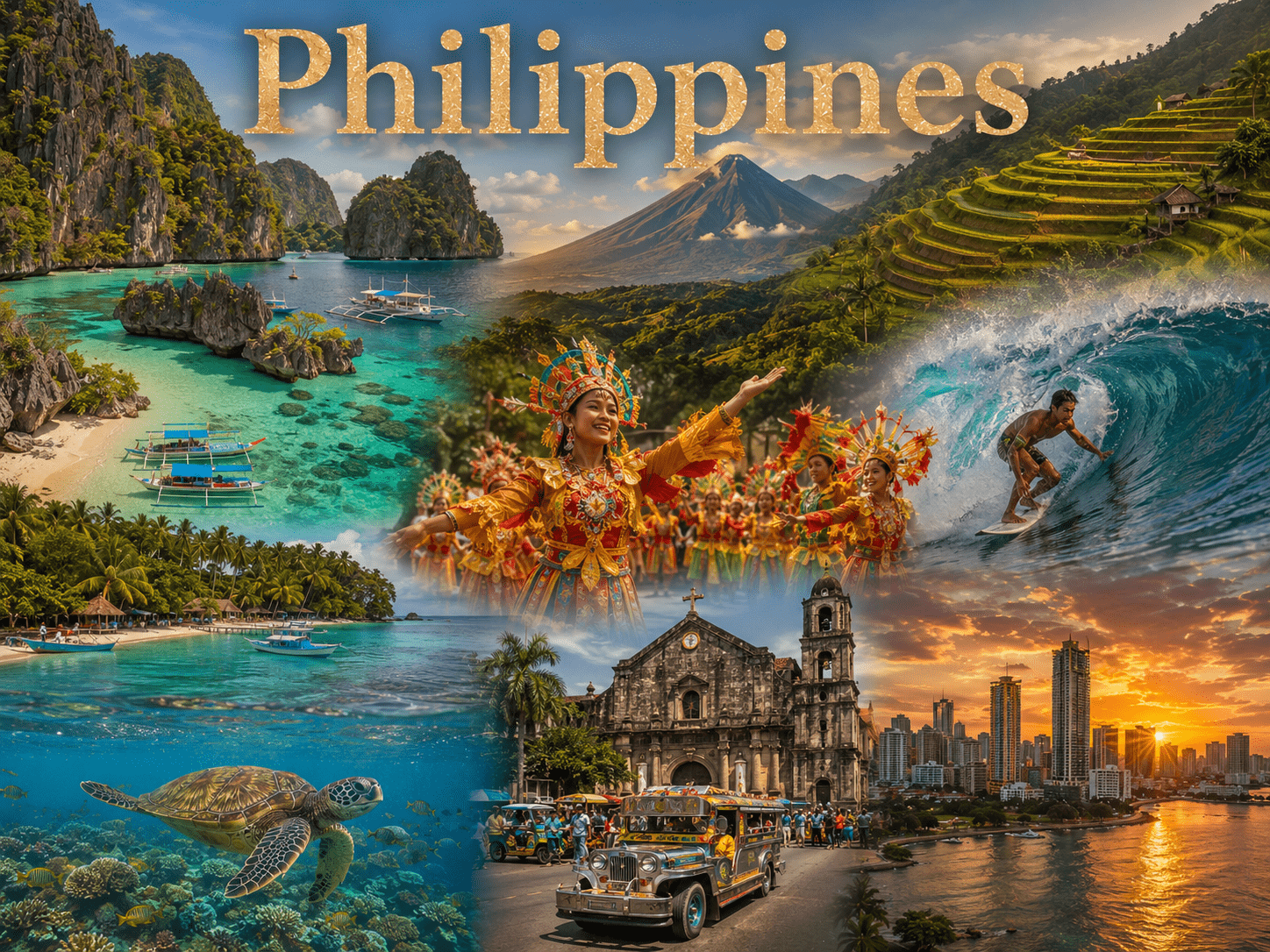
The Philippines – The Pearl of the Orient Seas
Philippines is one of the most beautiful island nations in the world, made up of over 7,000 islands spread across the western Pacific Ocean. Known for crystal-clear waters, white sandy beaches, lush mountains, and vibrant cities, it is a top global destination for tropical tourism.
This island nation blends:
- Spanish colonial history
- Asian cultural roots
- Modern urban development
- Deep Catholic traditions
- Warm hospitality
Travelers visit Philippines for:
- Island hopping adventures
- Diving and snorkeling
- Cultural exploration
- Nature trekking
- Beach holidays
Historical Background of the Philippines
Pre-Colonial Era
Before colonization, the islands of Philippines were home to:
- Tribal kingdoms
- Maritime trade communities
- Austronesian cultures
These early societies engaged in:
- Trade with China and India
- Fishing and farming
- Local governance systems
Spanish Colonization
Spain colonized the islands in the 1500s, introducing:
- Christianity (Catholicism)
- Colonial cities
- European architecture
- New political systems
American Period
Later, the United States influenced:
- Education systems
- Government structure
- English language expansion
Independence
Philippines gained independence in 1946 and became a sovereign nation.
Geography and Location of the Philippines
Island Nation Location
Philippines is located in Southeast Asia, surrounded by:
- Pacific Ocean (east)
- South China Sea (west)
- Philippine Sea (east)
Geographic Coordinates
- Approximate location: 13°N latitude and 122°E longitude
Major Island Groups
The country is divided into:
- Luzon
- Visayas
- Mindanao
Each region has unique culture, geography, and tourism attractions.
Climate in the Philippines
Tropical Climate
Philippines has a tropical maritime climate.
Weather Features
- Hot and humid year-round
- Rainy season (June–November)
- Dry season (December–May)
Best Time to Visit
Best months:
- December to May
Perfect for:
- Beaches
- Diving
- Island hopping
Culture and Traditions of the Philippines
Cultural Diversity
Philippines is a blend of:
- Malay heritage
- Spanish influence
- American culture
- Indigenous traditions
Family Values
Family is central to society:
- Strong respect for elders
- Close family ties
- Community gatherings
Festivals
Popular festivals include:
- Sinulog Festival
- Ati-Atihan Festival
- Panagbenga Flower Festival
Religion in the Philippines
Catholic Majority
Most people in Philippines follow Roman Catholicism.
Religious Influence
Religion shapes:
- Festivals
- Holidays
- Daily life
- Cultural traditions
Churches and religious events are central to communities.
Music, Dance, and Arts
Traditional Music
Music styles include:
- Kundiman (love songs)
- Folk ballads
- Tribal rhythms
Modern Music
Modern genres include:
- Pop
- Rock
- Hip-hop
Dance Culture
Traditional dances include:
- Tinikling (bamboo dance)
- Folk ceremonial dances
Cuisine of the Philippines
Philippines is known for rich and flavorful cuisine.
Popular Dishes
Adobo
Chicken or pork cooked in vinegar and soy sauce.
Sinigang
Sour soup with meat and vegetables.
Lechon
Roasted whole pig, often served at celebrations.
Halo-Halo
Popular dessert with ice, milk, and fruits.
Economy of the Philippines
Growing Economy
Philippines has a developing economy based on:
- Services sector
- Remittances from overseas workers
- Tourism
- Agriculture
Currency
The official currency is the Philippine Peso (PHP).
Major Industries
- Business process outsourcing (BPO)
- Electronics manufacturing
- Agriculture
- Tourism
Major Cities in the Philippines
Manila – Capital City
Manila is the capital and political center.
Cebu City
Cebu City is a major tourism and business hub.
Davao City
Davao City is known for safety and natural beauty.
Languages Spoken in the Philippines
Official Languages
- Filipino
- English
Regional Languages
Over 170 languages are spoken including:
- Cebuano
- Ilocano
- Tagalog
Tourist Attractions in the Philippines
Palawan Islands
Famous for:
- Crystal-clear waters
- Limestone cliffs
- Underground rivers
Boracay
Known for:
- White sandy beaches
- Nightlife
- Water sports
Chocolate Hills
Unique geological formations in Bohol.
Banaue Rice Terraces
Ancient agricultural terraces built by indigenous people.
Philippines and International Organizations
Philippines is part of:
- United Nations (UN)
- ASEAN
- World Trade Organization (WTO)
Official Sources
World Bank Philippines Overview
Islands, Nature & Biodiversity
Philippines is one of the world’s richest biodiversity hotspots, with thousands of islands hosting unique ecosystems. Its location in the Coral Triangle makes it especially important for marine life and coral reef conservation.
Travelers are drawn to:
- Coral reefs and diving spots
- Tropical rainforests
- Volcano landscapes
- Island-hopping adventures
- Rare wildlife encounters
Marine Biodiversity
The waters around Philippines contain:
- Whale sharks
- Sea turtles
- Colorful coral reefs
- Reef fish species
Rainforests and Wildlife
Forests include:
- Philippine eagle habitats
- Monkeys and civets
- Exotic birds
- Endemic plant species
Major Island Groups
Luzon
Luzon is the largest and most developed island, home to:
- Capital region
- Mountain ranges
- Historic sites
Visayas
The Visayas region is known for:
- Beach tourism
- Diving spots
- Cultural festivals
Mindanao
Mindanao offers:
- Mountain landscapes
- Agriculture
- Cultural diversity
Volcanoes and Natural Wonders
Mayon Volcano
Famous for its near-perfect cone shape.
Taal Volcano
One of the world’s smallest active volcanoes located inside a lake.
Underground River (Palawan)
A UNESCO World Heritage Site featuring underground cave systems and rivers.
Festivals and Cultural Celebrations
Sinulog Festival
Held in Cebu, featuring:
- Street dancing
- Religious processions
- Music and costumes
Ati-Atihan Festival
Known as the “Mother of All Festivals” with tribal dance traditions.
Panagbenga Festival
A flower festival held in mountain regions celebrating blooming seasons.
Traditional Culture and Heritage
Indigenous Communities
Philippines is home to diverse indigenous groups with unique traditions.
Cultural Values
Key values include:
- Respect for elders
- Strong community bonds
- Hospitality
- Family-centered lifestyle
Traditional Clothing
Includes:
- Barong Tagalog
- Baro’t Saya
- Tribal garments
Music, Dance & Performing Arts
Traditional Music
Includes:
- Bamboo percussion
- Indigenous instruments
- Folk songs
Modern Music Scene
The country has a vibrant modern music industry including:
- Pop
- R&B
- Rock
- Hip-hop
Traditional Dance
Famous dances include:
- Tinikling (bamboo dance)
- Singkil (royal dance)
- Rural folk dances
Adventure Tourism in the Philippines
Island Hopping
Philippines is famous for island tours featuring:
- Hidden lagoons
- Limestone cliffs
- White sand beaches
Diving and Snorkeling
Top diving spots include:
- Tubbataha Reefs
- Apo Reef
- Coron wreck dives
Hiking and Mountain Trekking
Popular trekking sites:
- Mount Pulag
- Mount Apo
- Sierra Madre trails
Surfing Destinations
Famous surfing spots include:
- Siargao Island
- Baler beaches
Transportation and Travel in the Philippines
Air Travel
Domestic flights connect major islands due to the archipelagic geography.
Ferries and Boats
Sea travel is essential for:
- Inter-island transport
- Tourism
- Cargo movement
Road Transport
Cities feature:
- Jeepneys (iconic transport vehicles)
- Buses
- Taxis and ride-sharing
Best Time to Visit the Philippines
Dry Season
December to May is ideal for:
- Beach vacations
- Diving
- Outdoor travel
Rainy Season
June to November brings:
- Heavy rains
- Typhoon risk in some regions
- Lush green landscapes
Hidden Gems of the Philippines
Siargao Island
A world-famous surfing paradise.
Batanes Islands
Known for:
- Rolling hills
- Stone houses
- Dramatic coastlines
Camiguin Island
Famous for:
- Volcanoes
- Hot springs
- Waterfalls
Sagada
A mountain town known for:
- Hanging coffins
- Caves
- Cool climate
Food Culture and Culinary Experiences
Street Food Culture
Popular street foods include:
- Fish balls
- BBQ skewers
- Sweet snacks
Regional Cuisine
Different regions offer:
- Seafood dishes in coastal areas
- Spicy food in southern regions
- Rice-based meals nationwide
Filipino Hospitality
Food is deeply tied to:
- Family gatherings
- Festivals
- Community celebrations
Economy and Development
Service Sector Growth
Philippines has strong growth in:
- Business process outsourcing (BPO)
- Tourism services
- Financial services
Agriculture
Major products include:
- Rice
- Coconut
- Banana
- Pineapple
Remittances
Overseas workers contribute significantly to the economy.
Education and Modern Life
Education System
The country emphasizes:
- English-language education
- Technical training
- Higher education expansion
Urban Development
Cities like Manila feature:
- High-rise buildings
- Shopping malls
- Business districts
Rural Lifestyle
Rural areas focus on:
- Farming
- Fishing
- Traditional living
Government and Political Structure
Philippines is a democratic republic with a presidential system of government. The country is governed through three branches: executive, legislative, and judicial, ensuring a balance of power and national administration.
National Government
Key responsibilities include:
- Economic planning
- Infrastructure development
- Foreign relations
- Education policies
- Disaster management
Regional Administration
The country is divided into regions and provinces that manage:
- Local governance
- Tourism development
- Public services
- Cultural programs
International Relations
Philippines maintains strong diplomatic ties with countries across Asia, Europe, and the Americas and is active in regional cooperation agreements.
Famous Landmarks in the Philippines
Banaue Rice Terraces
A UNESCO-recognized cultural landscape carved into mountains over 2,000 years ago.
Palawan Underground River
One of the New 7 Wonders of Nature, featuring underground cave systems and river tours.
Intramuros (Manila)
Manila historic walled city showcasing Spanish colonial architecture.
Chocolate Hills
A unique geological formation in Bohol with hundreds of cone-shaped hills.
Mayon Volcano
Famous for its near-perfect cone shape and volcanic beauty.
Unique and Interesting Facts About the Philippines
Island Nation Structure
Philippines is made up of more than 7,000 islands.
Biodiversity Hotspot
It is part of the Coral Triangle, one of the richest marine ecosystems in the world.
Jeepney Culture
Colorful jeepneys are a national symbol of public transport.
Strong Overseas Workforce
Millions of overseas workers contribute significantly to the economy.
Festival Country
The country hosts hundreds of colorful festivals every year.
Economy and Business Opportunities
Service-Based Economy
Philippines has a rapidly growing service sector including:
- IT outsourcing (BPO)
- Tourism services
- Financial services
Agriculture Sector
Key exports include:
- Coconut products
- Bananas
- Rice
- Pineapple
Manufacturing Industry
Includes:
- Electronics
- Semiconductors
- Garments
Tourism Industry
Tourism continues to grow through:
- Island resorts
- Diving tourism
- Cultural tourism
Major Cities in the Philippines
Manila – Capital City
Manila is the political, cultural, and economic center.
Cebu City
Cebu City is a major tourism and business hub.
Davao City
Davao City is known for cleanliness and safety.
Baguio City
A mountain city famous for:
- Cool climate
- Pine forests
- Flower festivals
Transportation and Infrastructure
Air Travel
Domestic flights connect major islands due to geography.
Sea Transport
Ferries are essential for inter-island travel.
Land Transport
Includes:
- Jeepneys
- Buses
- Tricycles
- Ride-hailing services
Travel Itinerary (7 Days in the Philippines)
Day 1–2: Manila
Explore historic Intramuros, museums, and modern districts.
Day 3: Cebu
Visit beaches, historical sites, and waterfalls.
Day 4: Bohol
See Chocolate Hills and river cruises.
Day 5: Palawan
Island hopping and lagoon exploration.
Day 6: Siargao
Surfing and island relaxation.
Day 7: Cultural Experience
Enjoy local festivals, food, and markets.
Best Time to Visit the Philippines
Dry Season (Ideal)
December to May is best for:
- Beaches
- Island hopping
- Diving
Rainy Season
June to November brings:
- Typhoons in some areas
- Fewer tourists
- Green landscapes
Challenges and Future Development
Environmental Concerns
Philippines faces:
- Climate change risks
- Coastal erosion
- Deforestation
Economic Growth
Focus areas include:
- Infrastructure expansion
- Digital economy
- Tourism development
Disaster Preparedness
Due to typhoons and earthquakes, resilience planning is important.
Final Summary
Philippines is one of the world’s most stunning island destinations, offering a perfect blend of tropical beauty, cultural richness, and historical depth. From white-sand beaches in Palawan and surfing waves in Siargao to the historic streets of Manila and ancient rice terraces of Banaue, the country delivers unforgettable travel experiences.
Its unique identity comes from a mix of Asian roots, Spanish colonial influence, and modern global culture. Combined with warm hospitality, vibrant festivals, rich cuisine, and breathtaking natural landscapes, it remains one of the most attractive destinations in Southeast Asia for travelers, explorers, and culture lovers.
Key Facts Table
| Category | Information |
|---|---|
| Official Name | Republic of the Philippines |
| Capital City | Manila |
| Region | Southeast Asia |
| Languages | Filipino, English |
| Currency | Philippine Peso (PHP) |
| Population | Over 110 million |
| Famous Landmark | Palawan Underground River |
| Climate | Tropical Maritime |
| Major Industries | BPO, Agriculture, Tourism |
| Main Exports | Electronics, Coconut, Bananas |
| UN Membership | Yes |
| Famous Transport | Jeepney |
| Tourism Type | Island, beach, adventure |
| Major Regions | Luzon, Visayas, Mindanao |
FAQ Section
What is the Philippines famous for?
Philippines is famous for beaches, islands, diving spots, and cultural festivals.
What is the capital of the Philippines?
The capital is Manila.
How many islands are in the Philippines?
There are over 7,000 islands.
What is the best time to visit?
December to May is the best travel season.
What language is spoken in the Philippines?
Filipino and English are official languages.

