



Introduction
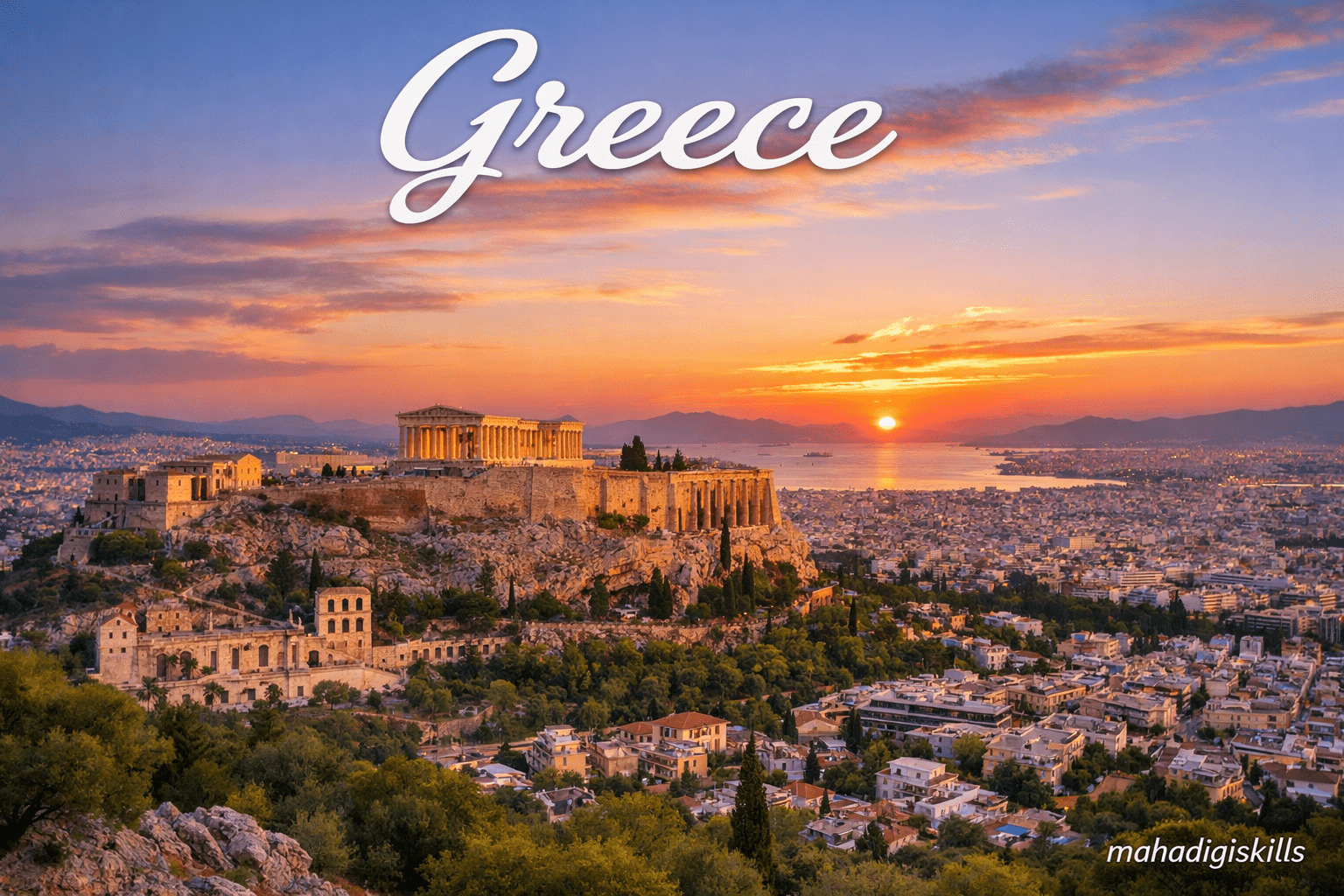
Greece is one of the most historically significant and culturally influential countries in the world. Located in southeastern Europe, Greece is known for its ancient civilizations, beautiful Mediterranean islands, and important contributions to philosophy, science, politics, and art.
For thousands of years, Greece has played a central role in shaping Western civilization. Ancient Greek thinkers such as Socrates, Plato, and Aristotle laid the foundations of modern philosophy and political thought.
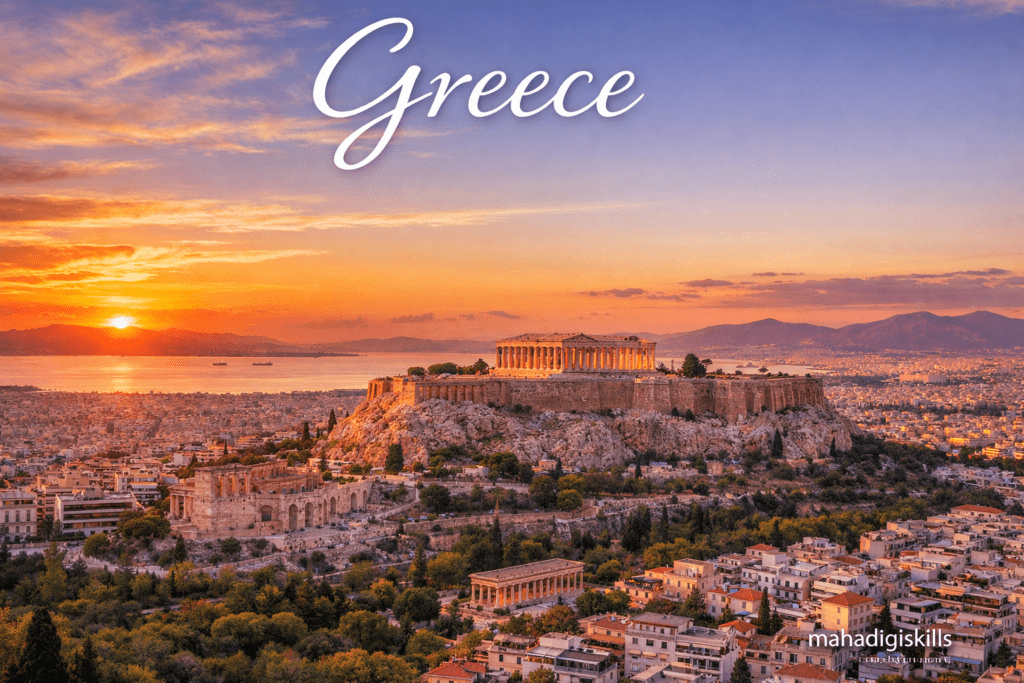
Today, Greece remains one of the most popular travel destinations in Europe. Visitors explore historic ruins, stunning islands, vibrant cities, and coastal landscapes that reflect both ancient heritage and modern Mediterranean culture.
Geography of Greece
Location in Europe
Greece is located in Southern Europe, on the southern tip of the Balkan Peninsula. The country is surrounded by beautiful seas and mountainous landscapes.
Neighboring countries include:
- Albania to the northwest
- North Macedonia to the north
- Bulgaria to the northeast
- Turkey to the east
The country is bordered by several seas:
- Aegean Sea
- Ionian Sea
- Mediterranean Sea
Coordinates
Approximate geographic coordinates:
39.0742° N latitude
21.8243° E longitude
Islands of Greece
One of the most remarkable geographic features of Greece is its large number of islands.
There are more than 6,000 islands and islets, although only about 200 are inhabited.
Famous islands include:
- Santorini
- Mykonos
- Crete
- Rhodes
- Corfu
These islands attract millions of visitors each year due to their beaches, architecture, and scenic beauty.
Mountains and Landscapes
The landscape of Greece is largely mountainous, with dramatic valleys, coastal cliffs, and fertile plains.
Mount Olympus
The highest mountain in Greece is Mount Olympus, reaching approximately 2,918 meters (9,573 feet).
In Greek mythology, Mount Olympus was believed to be the home of the ancient Greek gods.
Climate of Greece
The climate of Greece is mainly Mediterranean, characterized by warm summers and mild winters.
Summer Season
Summers are typically:
- hot
- sunny
- dry
This makes summer the peak travel season for beach holidays and island tourism.
Winter Season
Winters are generally mild in coastal areas but colder in mountainous regions.
Snowfall often occurs in northern Greece and in high-altitude mountain areas.
Winter tourism includes skiing and mountain activities.
History of Greece
Ancient Greece
Ancient Greece is considered one of the most important civilizations in human history.
The period between the 8th century BCE and the 4th century BCE produced groundbreaking achievements in philosophy, science, art, and politics.
Important city-states included:
- Athens
- Sparta
- Corinth
- Thebes
Athens is widely regarded as the birthplace of democracy.
Classical Achievements
Ancient Greece produced major developments that still influence modern society.
Examples include:
- democratic governance
- Olympic Games
- philosophy and ethics
- theater and literature
- mathematics and astronomy
These contributions shaped the foundations of Western civilization.
Hellenistic Era
After the conquests of Alexander the Great, Greek culture spread across parts of Asia, the Middle East, and North Africa.
This era, known as the Hellenistic period, helped spread Greek language, science, and art throughout the ancient world.
Roman and Byzantine Period
Eventually, Greece became part of the Roman Empire.
Later, it was incorporated into the Byzantine Empire, where Greek language and Christian traditions flourished.
The Byzantine period lasted for many centuries and produced remarkable religious architecture and art.
Culture of Greece
The culture of Greece reflects thousands of years of artistic, philosophical, and social traditions.
Religion
The majority of people in Greece belong to the Greek Orthodox Church.
Orthodox Christianity has played a major role in shaping national identity, customs, and celebrations.
Religious holidays such as Greek Easter are among the most important cultural events.
Food and Cuisine
Greek cuisine is famous for its healthy Mediterranean ingredients and flavorful dishes.
Common ingredients include:
- olive oil
- fresh vegetables
- seafood
- herbs
- cheese
Popular dishes include:
Moussaka
A baked dish made with eggplant, minced meat, and béchamel sauce.
Souvlaki
Grilled meat served with bread or pita.
Greek Salad
A fresh salad with tomatoes, cucumbers, olives, and feta cheese.
Music and Dance
Traditional music and dance are essential parts of Greek cultural life.
Popular dances include:
- Sirtaki
- Kalamatianos
- Hasapiko
Music often includes instruments such as the bouzouki, which produces a distinctive Greek sound.
Major Cities
Athens (Capital)
Athens is the capital and largest city of Greece.
It is one of the oldest continuously inhabited cities in the world, with a history spanning more than 3,000 years.
Famous landmarks include:
- The Acropolis
- Parthenon Temple
- Ancient Agora
- Acropolis Museum
Athens is both a historic and modern cultural center.
Thessaloniki
Thessaloniki is the second-largest city in Greece.
Located in northern Greece, it is known for:
- Byzantine architecture
- vibrant nightlife
- cultural festivals
The city is also an important educational and economic center.
Heraklion
Heraklion is the largest city on the island of Crete.
Nearby attractions include the famous Palace of Knossos, associated with the ancient Minoan civilization.
Internal Link Example
For readers interested in European destinations, explore:
- Germany Travel Guide
- Estonia Tourism Guide
Internal linking improves website SEO and helps search engines understand related travel content.
Tourism in Greece
Tourism plays a major role in the economy of Greece, attracting millions of visitors each year. Travelers visit Greece to experience ancient ruins, Mediterranean beaches, beautiful islands, and vibrant cities filled with culture and history.
Because of its warm climate, scenic landscapes, and rich historical heritage, Greece is considered one of the most popular travel destinations in Europe.
Visitors come to enjoy:
- historical landmarks and archaeological sites
- island hopping in the Aegean Sea
- Mediterranean cuisine and culture
- beaches and coastal resorts
- cultural festivals and events
Famous Islands of Greece
One of the most attractive features of Greece is its stunning islands scattered across the Aegean and Ionian seas.
Santorini
Santorini is one of the most iconic islands in Greece. It is famous for its white buildings with blue domes, dramatic cliffs, and breathtaking sunset views.
The island was formed by a volcanic eruption thousands of years ago, which created the impressive Santorini caldera.
Popular activities include:
- sunset viewing in Oia
- visiting volcanic beaches
- exploring traditional villages
- wine tasting tours
Mykonos
Mykonos is well known for its vibrant nightlife, beautiful beaches, and traditional Cycladic architecture.
The island features charming streets, whitewashed buildings, and famous windmills overlooking the sea.
Mykonos attracts visitors looking for:
- beach parties
- luxury resorts
- coastal restaurants
- cultural sightseeing
Crete
Crete is the largest island in Greece and one of the most historically significant regions.
Important attractions include:
- the Palace of Knossos
- ancient Minoan archaeological sites
- mountain villages
- Mediterranean beaches
Crete also offers excellent hiking opportunities and traditional Cretan cuisine.
Rhodes
Rhodes is another popular island known for its medieval architecture and sunny climate.
The Old Town of Rhodes is a UNESCO World Heritage Site and features well-preserved medieval walls, castles, and narrow streets.
Visitors explore:
- the Palace of the Grand Master
- historic fortifications
- seaside resorts
Famous Beaches in Greece
The beaches of Greece are considered some of the most beautiful in Europe.
Navagio Beach (Shipwreck Beach)
Navagio Beach on the island of Zakynthos is one of the most photographed beaches in the world.
It features:
- white limestone cliffs
- turquoise water
- a famous shipwreck resting on the sand
The beach is accessible only by boat.
Balos Lagoon
Balos Lagoon on the island of Crete is known for its shallow turquoise waters and white sand.
This unique coastal landscape creates one of the most picturesque beach environments in the Mediterranean.
Elafonissi Beach
Located in southwestern Crete, Elafonissi Beach is famous for its pink-tinted sand and clear shallow water.
It is often ranked among the best beaches in Europe.
UNESCO World Heritage Sites
Greece is home to numerous UNESCO World Heritage Sites, reflecting its long historical and cultural significance.
Acropolis of Athens
The Acropolis is one of the most important archaeological sites in the world.
It includes the famous Parthenon Temple, built during the 5th century BCE.
This ancient citadel symbolizes classical Greek civilization.
External Source (DoFollow)
UNESCO World Heritage Centre
https://whc.unesco.org
Meteora Monasteries
Meteora is one of the most unique landscapes in Europe.
Large rock pillars rise dramatically from the valley, and ancient monasteries were built on top of these cliffs centuries ago.
Visitors come to explore:
- historic monasteries
- hiking trails
- scenic viewpoints
Delphi
Delphi was once considered the center of the ancient world in Greek mythology.
The site was famous for the Oracle of Delphi, where priests delivered prophetic messages believed to come from the god Apollo.
Today, the archaeological ruins and museum attract history enthusiasts from around the world.
National Parks and Nature
Nature in Greece includes mountains, forests, and coastal landscapes.
Samaria Gorge National Park
Located in Crete, Samaria Gorge is one of the longest gorges in Europe.
The hiking trail stretches approximately 16 kilometers, passing through dramatic rock formations and wild landscapes.
Mount Olympus National Park
Mount Olympus National Park protects the legendary mountain associated with Greek mythology.
The area offers:
- hiking routes
- wildlife observation
- scenic alpine views
Climbing Mount Olympus is a popular adventure activity for experienced hikers.
Festivals and Celebrations
Festivals in Greece are colorful and culturally rich events that celebrate history, religion, and local traditions.
Greek Easter
Greek Easter is the most important religious holiday in the country.
Celebrations include:
- church services
- candlelit processions
- traditional feasts
- fireworks
Athens and Epidaurus Festival
This annual cultural festival features performances of ancient Greek drama, music concerts, and artistic events.
Many performances take place in historic ancient theaters.
Transportation in Greece
Traveling around Greece is relatively easy thanks to modern infrastructure.
Air Travel
Major international airports include:
- Athens International Airport
- Thessaloniki Airport
- Heraklion Airport
Domestic flights connect mainland cities with popular islands.
Ferries
Ferries are a major transportation method connecting Greek islands.
Island hopping by ferry is a popular travel experience for tourists.
Rail and Road Transport
Railways and highways connect major cities across mainland Greece.
Public buses are widely used for regional travel.
Best Time to Visit Greece
The best time to visit Greece depends on travel preferences.
Spring (April–June)
Spring offers pleasant temperatures, blooming landscapes, and fewer crowds.
Summer (June–August)
Summer is the peak travel season due to warm weather and beach tourism.
Autumn (September–October)
Autumn provides comfortable weather and fewer tourists.
Winter (November–March)
Winter is quieter but ideal for exploring cities and historical sites.
Economy of Greece
The economy of Greece is one of the most important in the Mediterranean region and plays a significant role in tourism, shipping, and agriculture.
The country has a mixed economy that includes both modern industries and traditional sectors.
Major economic sectors include:
- tourism
- shipping and maritime trade
- agriculture
- manufacturing
- services and finance
Tourism contributes a large portion of national income, with millions of international visitors arriving every year.
Shipping and Maritime Industry
One of the most important industries in Greece is maritime shipping.
Greek shipowners operate one of the largest merchant fleets in the world. Shipping plays a crucial role in global trade, connecting ports across Europe, Asia, and the Americas.
Major port cities include:
- Piraeus (one of the busiest ports in Europe)
- Thessaloniki
- Patras
Agriculture
Agriculture has historically been a vital part of the economy.
Important agricultural products include:
- olives and olive oil
- grapes and wine
- citrus fruits
- wheat
- vegetables
Greek olive oil is considered among the highest quality in the world and is widely exported.
Trade and International Partners
The economy of Greece relies on international trade with many global partners.
Major trading partners include:
- Germany
- Italy
- China
- United States
- France
Exports include:
- food products
- petroleum products
- pharmaceuticals
- machinery
External Source (DoFollow):
World Bank
https://www.worldbank.org
Language of Greece
Language plays an important role in the cultural identity of Greece.
Official Language
The official language is Greek, one of the oldest written languages in the world with a recorded history of more than 3,000 years.
The Greek alphabet is unique and has influenced many modern alphabets and scientific terminology.
Foreign Languages
Many people in Greece also speak foreign languages, especially in tourism areas.
Commonly spoken foreign languages include:
- English
- French
- German
- Italian
English is widely used in hotels, restaurants, and travel services.
Population and Society
The population of Greece is approximately 10.4 million people.
Most residents live in urban areas, particularly in large cities such as Athens and Thessaloniki.
Greek society values:
- family relationships
- cultural traditions
- hospitality toward visitors
Community gatherings, festivals, and shared meals are important aspects of social life.
Greece in International Organizations
Greece participates actively in many international organizations and global partnerships.
United Nations
Greece became a member of the United Nations in 1945, shortly after the organization was founded.
The country supports international efforts related to:
- peacekeeping
- humanitarian assistance
- environmental protection
External DoFollow Source:
United Nations
https://www.un.org/en/member-states
Other International Memberships
Greece is also a member of several important international organizations:
- European Union (EU)
- NATO
- World Trade Organization (WTO)
- Council of Europe
These memberships strengthen cooperation in economic development, security, and diplomacy.
Interesting Facts About Greece
Here are several fascinating facts about Greece that highlight its historical and cultural importance.
Birthplace of Democracy
Ancient Athens in Greece is widely regarded as the birthplace of democracy, influencing modern political systems worldwide.
Olympic Games
The Olympic Games originated in ancient Greece more than 2,700 years ago in the city of Olympia.
The modern Olympic Games were revived in Athens in 1896.
Thousands of Islands
Greece has more than 6,000 islands and islets, though only about 200 are inhabited.
These islands contribute to the country’s scenic beauty and tourism popularity.
Ancient Architecture
Historic monuments such as the Parthenon, ancient theaters, and temples represent some of the most remarkable achievements in ancient architecture.
Mediterranean Lifestyle
Greek culture is known for its relaxed Mediterranean lifestyle, emphasizing good food, social gatherings, and outdoor living.
Best Travel Experiences
Visitors traveling to Greece can enjoy many memorable activities.
Popular travel experiences include:
- exploring ancient ruins such as the Acropolis
- island hopping across the Aegean Sea
- tasting Mediterranean cuisine
- hiking mountain trails
- attending traditional festivals
These experiences offer a perfect balance of history, culture, and natural beauty.
Travel Tips
Travelers visiting Greece should consider the following tips:
- carry comfortable walking shoes for exploring historical sites
- use ferries for island travel
- try traditional Greek food and local markets
- visit archaeological museums to learn about ancient civilizations
Public transportation is efficient in cities, and taxis are widely available.
Final Summary
Greece is a remarkable destination that blends ancient history, cultural traditions, and breathtaking landscapes. From the iconic ruins of Athens to the beautiful islands of the Aegean Sea, the country offers endless opportunities for exploration and discovery.
Its influence on philosophy, politics, science, and art continues to shape modern civilization. Travelers visiting Greece can experience historic monuments, vibrant cities, Mediterranean cuisine, and warm hospitality.
With its rich heritage and stunning natural beauty, Greece remains one of the most fascinating destinations in Europe and the world.
Key Facts Table
| Category | Information |
|---|---|
| Capital | Athens |
| Continent | Europe |
| Population | ~10.4 million |
| Official Language | Greek |
| Currency | Euro (EUR) |
| Highest Mountain | Mount Olympus |
| Famous Landmark | Acropolis of Athens |
| Government | Parliamentary Republic |
| UN Membership | 1945 |
List of All 195 Countries
- Afghanistan
- Albania
- Algeria
- Andorra
- Angola
- Antigua and Barbuda
- Argentina
- Armenia
- Australia
- Austria
- Azerbaijan
- Bahamas
- Bahrain
- Bangladesh
- Barbados
- Belarus
- Belgium
- Belize
- Benin
- Bhutan
- Bolivia
- Bosnia and Herzegovina
- Botswana
- Brazil
- Brunei
- Bulgaria
- Burkina Faso
- Burundi
- Cabo Verde
- Cambodia
- Cameroon
- Canada
- Central African Republic
- Chad
- Chile
- China
- Colombia
- Comoros
- Congo (Congo-Brazzaville)
- Costa Rica

