



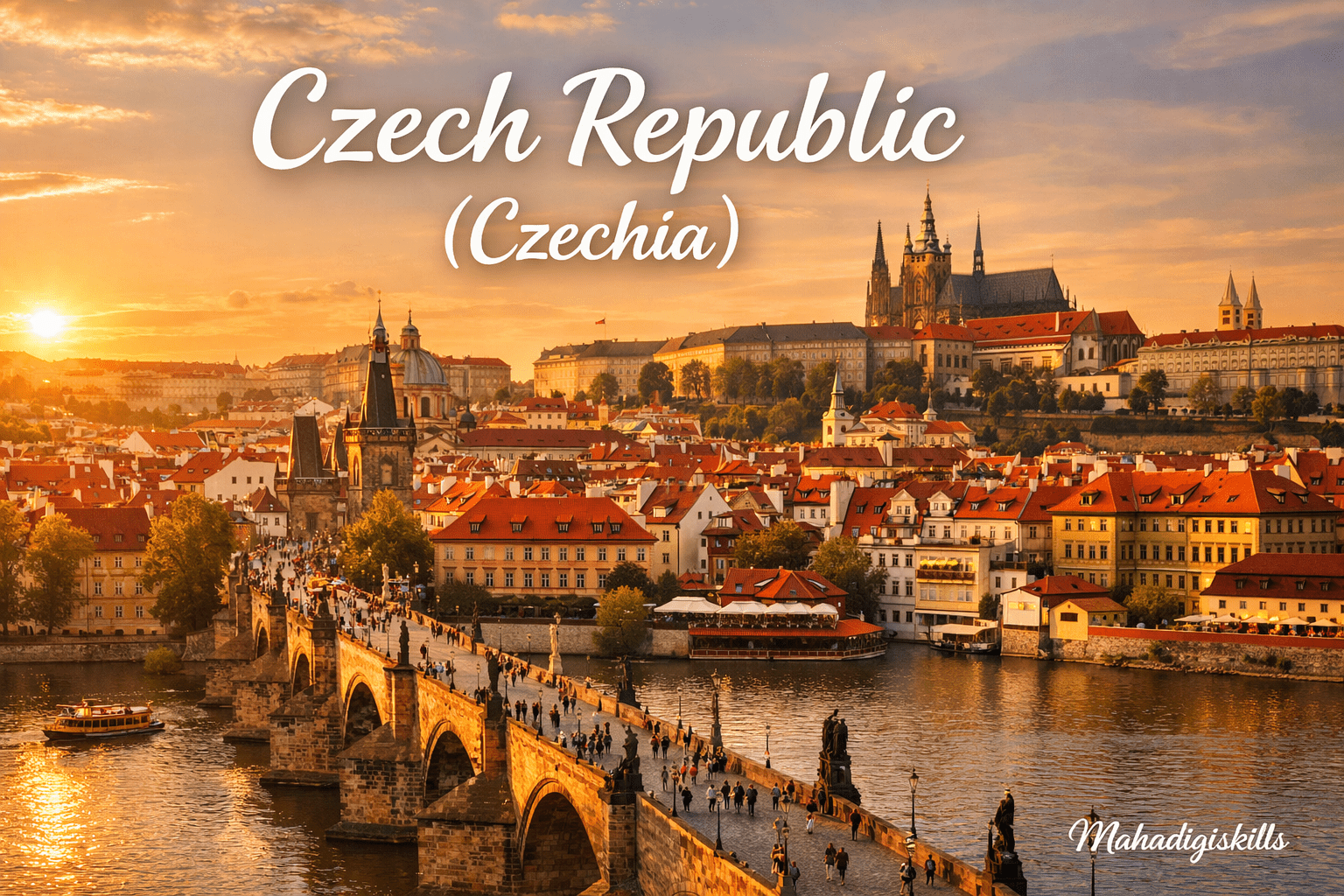
Introduction to Czech Republic (Czechia)
The Czech Republic (Czechia) is a fascinating country in Central Europe known for its rich history, stunning architecture, and vibrant cultural traditions. Despite its relatively small size, the Czech Republic (Czechia) offers an impressive variety of landscapes, historic cities, medieval castles, and picturesque countryside.
Travelers visiting the Czech Republic (Czechia) often begin their journey in Prague, the country’s capital city and one of the most beautiful cities in Europe. However, beyond Prague, the country offers charming towns, scenic mountains, and cultural landmarks that highlight the heritage of the Czech Republic (Czechia).
The nation has long served as a crossroads of European culture and politics. Over centuries, the Czech Republic (Czechia) has experienced influences from the Holy Roman Empire, the Austro-Hungarian Empire, and modern European institutions. These influences have shaped the country’s architecture, traditions, and national identity.
Today, the Czech Republic (Czechia) is known for its historic cities, world-class beer culture, UNESCO heritage sites, and strong cultural traditions.
History of Czech Republic (Czechia)
The history of the Czech Republic (Czechia) stretches back more than a thousand years. The region has been inhabited since prehistoric times and played an important role in the political and cultural development of Central Europe.
Early Slavic Settlements
The earliest Slavic tribes arrived in the region of the Czech Republic (Czechia) during the 6th century. These communities established agricultural settlements and gradually formed early political structures.
One of the earliest known states in the area was Great Moravia, a powerful Slavic kingdom that existed during the 9th century. Great Moravia played a major role in spreading Christianity and literacy throughout the region that is now the Czech Republic (Czechia).
Kingdom of Bohemia
During the medieval period, the territory of the Czech Republic (Czechia) became part of the Kingdom of Bohemia, which emerged as a powerful state within the Holy Roman Empire.
The city of Prague developed into an important political and cultural center. Under the rule of Charles IV in the 14th century, the Czech Republic (Czechia) experienced a golden age of cultural and architectural development.
Charles IV founded Charles University in Prague in 1348, one of the oldest universities in Europe. Many of Prague’s most famous landmarks were constructed during this period.
Habsburg Rule
In 1526, the Kingdom of Bohemia came under the control of the Habsburg dynasty, becoming part of the vast Austro-Hungarian Empire. For centuries, the lands of the Czech Republic (Czechia) remained under Habsburg influence.
During this period, the region experienced both economic growth and political tensions. The Thirty Years’ War (1618–1648) began in Prague and had devastating effects across Central Europe.
Despite political conflicts, cities across the Czech Republic (Czechia) continued to develop culturally and economically.
Formation of Czechoslovakia
After World War I and the collapse of the Austro-Hungarian Empire, the independent state of Czechoslovakia was created in 1918.
This new country combined the territories of modern-day Czech Republic (Czechia) and Slovakia. Prague became the capital, and the nation developed into one of the most industrialized economies in Central Europe.
However, the country faced significant challenges during World War II when Nazi Germany occupied the region.
Communist Era
After World War II, Czechoslovakia came under the influence of the Soviet Union and adopted a communist political system.
For decades, the country remained part of the Eastern Bloc. Despite political restrictions, the cultural and intellectual life of the Czech Republic (Czechia) continued to thrive.
In 1968, the Prague Spring reform movement attempted to introduce political liberalization. Although the reforms were eventually suppressed, the movement became an important symbol of democratic aspirations.
Velvet Revolution and Modern Czechia
In 1989, the Velvet Revolution peacefully ended communist rule in Czechoslovakia. Democratic reforms were introduced, and the country transitioned toward a market economy.
In 1993, Czechoslovakia peacefully separated into two independent nations:
- Czech Republic (Czechia)
- Slovakia
Since independence, the Czech Republic (Czechia) has become a stable democracy and a member of the European Union and NATO.
Geography of Czech Republic (Czechia)
Location in Central Europe
The Czech Republic (Czechia) is located in the heart of Europe and is a landlocked country surrounded by several neighboring nations.
The country borders:
- Germany to the west
- Poland to the north
- Austria to the south
- Slovakia to the east
Because of this central location, the Czech Republic (Czechia) has historically served as an important trade route connecting Western and Eastern Europe.
Geographic Coordinates
- Latitude: 49° N
- Longitude: 15° E
These coordinates place the Czech Republic (Czechia) firmly within Central Europe.
Landscapes and Natural Features
The landscape of the Czech Republic (Czechia) includes forests, mountains, rolling hills, and fertile plains.
Bohemian Forest
The Bohemian Forest forms part of the natural border between the Czech Republic (Czechia) and Germany. This region features dense forests and scenic hiking trails.
Krkonoše Mountains
The Krkonoše Mountains lie along the northern border with Poland. These mountains contain the highest peak in the Czech Republic (Czechia), Sněžka, which rises to 1,603 meters.
This region is popular for skiing and outdoor recreation.
Rivers
Several important rivers flow through the Czech Republic (Czechia), including:
- Vltava River
- Elbe River
- Morava River
The Vltava River flows through Prague and is one of the most scenic waterways in the country.
Climate of Czech Republic (Czechia)
The Czech Republic (Czechia) has a temperate continental climate characterized by warm summers and cold winters.
Summer
Summer temperatures typically range from 20°C to 30°C, making it an excellent time to explore cities and countryside landscapes.
Winter
Winter temperatures can drop below 0°C, especially in mountainous regions of the Czech Republic (Czechia). Snowfall is common, making the mountains popular for winter sports.
Spring and Autumn
Spring and autumn offer mild weather and beautiful scenery, particularly in historic towns and rural landscapes.
Culture and Traditions of Czech Republic (Czechia)
The culture of the Czech Republic (Czechia) reflects centuries of European traditions and artistic achievements.
Family life, education, literature, and music have always played important roles in the national identity of the Czech Republic (Czechia).
Religion in Czech Republic (Czechia)
The Czech Republic (Czechia) is known for being one of the most secular countries in Europe.
Although Christianity historically influenced the country, many citizens today identify as non-religious.
Major religious groups include:
- Roman Catholics
- Protestants
- Orthodox Christians
Historic churches and cathedrals across the Czech Republic (Czechia) remain important cultural landmarks.
Festivals in Czech Republic (Czechia)
Many festivals celebrate the traditions and cultural heritage of the Czech Republic (Czechia).
Popular events include:
- Prague Spring International Music Festival
- Karlovy Vary International Film Festival
- Traditional Christmas markets
These events attract visitors from around the world.
Traditional Czech Food
Cuisine in the Czech Republic (Czechia) reflects Central European culinary traditions.
Popular dishes include:
- Goulash
- Svíčková (beef with creamy sauce)
- Roast pork with dumplings
- Trdelník pastry
Food culture in the Czech Republic (Czechia) is often accompanied by locally brewed beer.
Beer Culture in Czechia
The Czech Republic (Czechia) is famous for having one of the highest beer consumption rates in the world.
The country is home to historic breweries such as Pilsner Urquell, which introduced the famous Pilsner beer style.
Beer halls and breweries are an essential part of social life in the Czech Republic (Czechia).
Languages Spoken in Czech Republic (Czechia)
The official language of the Czech Republic (Czechia) is Czech.
However, many people also speak:
- English
- German
- Slovak
English is widely used in tourism areas, making travel easier for international visitors.
Economy of Czechia
The economy of Czechia is considered one of the most stable and developed in Central Europe. Over the past few decades, the country has successfully transitioned from a centrally planned system to a modern market economy.
Today, the nation benefits from strong industrial production, advanced manufacturing, and a growing technology sector. Its strategic location in the center of Europe makes it an important hub for trade and logistics.
Since joining the European Union in 2004, the country has experienced increased economic cooperation, foreign investment, and infrastructure development. The economy now relies heavily on manufacturing, exports, services, and tourism.
Major sectors contributing to economic growth include:
- Automotive production
- Engineering and manufacturing
- Tourism and hospitality
- Technology and innovation
- Financial services
These industries play a key role in maintaining economic stability and employment.
Currency and Financial System
The official currency used in the country is the Czech Koruna (CZK).
Although the nation is part of the European Union, it has chosen to retain its national currency rather than adopt the euro. Visitors traveling through the country will commonly use the koruna for daily expenses, transportation, and accommodation.
ATMs, credit cards, and digital payment systems are widely accepted in major cities and tourist areas.
Major Industries
Automotive Industry
The automotive industry is one of the most important economic sectors. The country is home to several major automobile manufacturers and production facilities.
The most famous automobile brand associated with the nation is Škoda Auto, which exports vehicles to markets across Europe and the world.
Automotive manufacturing contributes significantly to exports and employment.
Engineering and Manufacturing
Engineering and industrial production have long been important parts of the economy. Factories produce machinery, electrical equipment, chemicals, and industrial tools used across Europe.
A highly skilled workforce and advanced industrial infrastructure make the country an attractive location for international manufacturing companies.
Technology and Innovation
Technology companies and startups have expanded rapidly in recent years. Cities like Prague and Brno are becoming important technology hubs in Central Europe.
The country has also invested in scientific research, software development, and digital innovation.
Tourism Industry
Tourism contributes significantly to the national economy. Historic cities, castles, cultural festivals, and scenic landscapes attract millions of visitors each year.
Travelers are drawn to the country’s medieval towns, architectural landmarks, and vibrant cultural atmosphere.
Trade and International Partnerships
Due to its central European location, the country maintains strong trade relationships with neighboring nations and other European markets.
Major trading partners include:
- Germany
- Slovakia
- Poland
- Austria
- France
- Italy
Exports from the country primarily include automobiles, machinery, electronics, and industrial equipment.
Tourism in Czechia
Tourism is one of the fastest-growing sectors of the economy. Visitors travel from around the world to explore historic cities, castles, and natural landscapes.
The country’s tourism appeal includes:
- medieval architecture
- UNESCO heritage towns
- scenic mountains and forests
- spa resorts and wellness centers
- cultural festivals and music events
These attractions make the nation a popular travel destination throughout the year.
Famous Tourist Attractions
Prague Castle
Prague Castle is one of the most famous landmarks in the country and among the largest historic castle complexes in the world.
The castle complex includes several significant buildings such as:
- St. Vitus Cathedral
- Old Royal Palace
- Golden Lane
- Historic gardens
For centuries, the castle served as the seat of kings, emperors, and modern presidents.
Charles Bridge
Charles Bridge is one of the most iconic structures in Prague. Built in the 14th century, the stone bridge connects the Old Town with the Lesser Town.
The bridge is decorated with historic statues and offers panoramic views of the Vltava River and surrounding architecture.
Karlštejn Castle
Located about 30 kilometers from Prague, Karlštejn Castle is one of the most famous medieval castles in Central Europe.
The fortress was built in the 14th century by Emperor Charles IV to protect royal treasures and sacred relics.
Today, the castle attracts visitors interested in medieval history and architecture.
Český Krumlov
The town of Český Krumlov is one of the most picturesque destinations in the country. Its historic center features winding medieval streets, colorful houses, and a large castle complex overlooking the Vltava River.
Because of its well-preserved architecture, the town has been recognized as a UNESCO World Heritage Site.
Castles and Historic Fortresses
The country is often referred to as the “Land of Castles.” More than 2,000 castles and chateaux are spread across its landscape.
Some of the most famous include:
- Karlštejn Castle
- Hluboká Castle
- Lednice Castle
- Konopiště Castle
These historic structures provide insight into royal history and aristocratic life during the medieval and Renaissance periods.
UNESCO World Heritage Sites
The country has several locations recognized by UNESCO for cultural and historical importance.
Important heritage sites include:
- Historic Centre of Prague
- Historic Centre of Český Krumlov
- Kutná Hora and Sedlec Ossuary
- Lednice–Valtice Cultural Landscape
- Holašovice Historic Village
These sites attract travelers interested in architecture, history, and cultural heritage.
Natural Landscapes and National Parks
Nature lovers can explore mountains, forests, and protected national parks across the country.
Bohemian Switzerland National Park
Bohemian Switzerland National Park is one of the most spectacular natural regions. The park is famous for dramatic sandstone rock formations, deep valleys, and scenic hiking trails.
The highlight of the park is the Pravčická Gate, the largest natural sandstone arch in Europe.
Šumava National Park
Šumava National Park lies along the borders with Germany and Austria. The park contains dense forests, rivers, wetlands, and mountain landscapes.
Outdoor activities include hiking, cycling, wildlife observation, and cross-country skiing.
Krkonoše National Park
Krkonoše National Park contains the country’s highest mountains and alpine landscapes.
The area is popular for:
- hiking during summer
- skiing in winter
- mountain photography
This region offers some of the most beautiful natural scenery in Central Europe.
Spa Tourism
Spa tourism is another unique attraction. The country has a long tradition of wellness resorts and mineral spring towns.
Popular spa destinations include:
- Karlovy Vary
- Mariánské Lázně
- Františkovy Lázně
These towns have welcomed visitors seeking relaxation and health treatments for centuries.
Major Cities in Czechia
Several cities across Czechia showcase the country’s mix of medieval architecture, modern development, and cultural heritage. Each city offers a different experience for visitors exploring this Central European destination.
Prague – The Capital City
Prague is the capital and largest city in the country. It is widely considered one of the most beautiful cities in Europe thanks to its historic architecture, cobblestone streets, and scenic river views.
The city developed as a cultural and political center during the medieval period and continues to be the heart of the nation today.
Important attractions in Prague include:
- Prague Castle
- Charles Bridge
- Old Town Square
- Astronomical Clock
- St. Vitus Cathedral
Millions of travelers visit Prague every year to experience its history, museums, restaurants, and lively cultural scene.
Brno – The Cultural Center of Moravia
Brno is the second-largest city in the country and the main cultural center of the Moravia region.
The city is known for its universities, historic landmarks, and modern architecture.
Popular attractions in Brno include:
- Špilberk Castle
- Cathedral of St. Peter and Paul
- Villa Tugendhat (UNESCO Site)
- Moravian Museum
Brno also hosts international cultural festivals, exhibitions, and conferences throughout the year.
Ostrava – Industrial Heritage City
Located in the northeastern region, Ostrava developed as an important industrial city due to its coal mining and steel production.
Today, the city has transformed many of its former industrial sites into cultural and tourist attractions.
Interesting places to visit include:
- Dolní Vítkovice Industrial Complex
- Ostrava Zoo
- New City Hall Tower
Ostrava also hosts one of the largest music festivals in Central Europe, attracting thousands of visitors each year.
Plzeň – Birthplace of Pilsner Beer
Plzeň (also spelled Pilsen) is internationally famous for its brewing tradition.
The city is the birthplace of Pilsner lager, one of the most popular beer styles in the world.
Visitors traveling here can explore:
- Pilsner Urquell Brewery
- St. Bartholomew’s Cathedral
- Historic Old Town Square
- Underground tunnels beneath the city
Beer culture remains an important part of local life.
Interesting Facts About Czechia
This Central European nation has many fascinating cultural and historical characteristics.
Here are some interesting facts:
- The country has more than 2,000 castles and chateaux.
- Prague Castle is considered the largest ancient castle complex in the world.
- Beer consumption per person is among the highest globally.
- The Astronomical Clock in Prague is one of the oldest functioning clocks in the world.
- The country is known for its crystal glass and porcelain production.
- Many UNESCO World Heritage Sites are located throughout the nation.
These unique features make the destination especially attractive for history lovers and travelers.
Membership in the United Nations
The nation became a member of the United Nations in 1993 after the peaceful dissolution of Czechoslovakia.
Today the country participates actively in global organizations including:
- United Nations
- European Union
- NATO
- Council of Europe
- World Trade Organization
These international partnerships support economic cooperation, diplomacy, and cultural exchange.
Best Time to Visit
The country offers enjoyable travel experiences throughout the year.
Spring (April – June)
Spring is one of the best times to visit. Parks and gardens bloom with flowers, and temperatures are comfortable for sightseeing.
Summer (July – August)
Summer is the peak tourist season. Cities host outdoor festivals, concerts, and cultural events.
Autumn (September – October)
Autumn offers colorful landscapes and fewer tourists, making it ideal for exploring historic towns.
Winter (November – February)
Winter transforms cities like Prague into magical destinations with Christmas markets and festive decorations.
Mountain areas also attract visitors for skiing and winter sports.
Transportation and Travel
Traveling around the country is easy thanks to efficient transportation networks.
International Airports
Major airports include:
- Václav Havel Airport Prague
- Brno Airport
- Ostrava Airport
These airports connect the country with destinations across Europe and the world.
Train Network
The rail system is one of the most convenient ways to travel between cities.
High-speed and regional trains connect major destinations including Prague, Brno, and Ostrava.
Public Transport
Cities have reliable public transport systems including:
- Metro
- Trams
- Buses
Prague’s metro system is especially efficient and easy for tourists to navigate.
External DoFollow Sources
United Nations
https://www.un.org/en/member-states/czechia
UNESCO World Heritage Sites
https://whc.unesco.org/en/statesparties/cz
World Bank Country Profile
https://www.worldbank.org/en/country/czechia
Final Summary
Czechia is a remarkable destination in Central Europe known for its historic architecture, medieval towns, scenic landscapes, and vibrant cultural traditions.
From the famous skyline of Prague to charming towns like Český Krumlov and historic spa cities such as Karlovy Vary, the country offers diverse travel experiences.
Visitors can explore castles, museums, mountain landscapes, and lively cultural festivals throughout the year. Combined with rich history and welcoming hospitality, the destination continues to attract millions of travelers annually.
Key Facts
| Category | Information |
|---|---|
| Official Name | Czech Republic |
| Capital | Prague |
| Region | Central Europe |
| Population | ~10.7 million |
| Language | Czech |
| Currency | Czech Koruna |
| EU Membership | Since 2004 |
| UN Membership | Since 1993 |
| Famous For | Castles, beer, historic cities |
A

